Sunday, March 4, 2012

The Savage God Was Nice To Children (Charles Terrasse's Account)


Alfred Jarry, Lithographic cover for one of three issues of Répertoire des Paintins, executed at the time of the 1898 marionette revival of Ubu Roi at composer Claude Terrasse's Théâtre des Pantins, Paris.


    I can still hear my mother telling me sadly:  “You know, my little one, he is dead, the poor man.”  And we really felt the hurt of it, it was my first real grief.  For he was a most charming companion to us children.

         I know nothing of Jarry the man of letters, whom so many others knew.  But the simple, kind and childlike Jarry, the friend to children, deserves to be remembered.   This was the Jarry I knew, the one who spoke to children with the heart of a child.


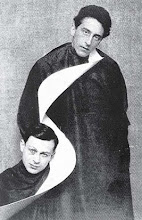
Alfred Jarry in 1903-4


    First of all, there was the Théâtre des Pantins, at 6, Rue Ballu, near the Place Blanche.  To the small children we then were, my brother Jean and I, this theater was a place full of enchantment, a forbidden paradise.  It was there, at the table, that I so often picked up and played with those puppets which represented Père Ubu, Mère Ubu, the Palotins, and especially, the Bear.


Pierre Bonnard:  Claude Terrasse and his two sons, Jean and Charles, 1903.  Bonnard, who designed the original Ubu Roi set and two years later with Jarry, its marionette cast, was Claude Terrasse's brother-in-law and uncle to his memoirist son.


    I often saw them sitting around this table, sorting out the puppets, or repairing them, or just talking.  Firstly there was Uncle Pierre, Pierre Bonnard, here the puppet maker but otherwise, because he was of course a painter, it was he who had decorated the theater.   Then my father and Franc-Nohain, Ferdinand Herold, and finally, he who I never heard called anything except Père Ubu, but whom I called, using the familiar “tu,” just plain Alfred:  Alfred Jarry.


 Pierre Bonnard, Self-Portrait, 1906.


     One night he provoked my father into a duel.  A duel with gruyere and red wine.  Who could finish first, eating three or four ounces of gruyere cut into tiny pieces, or drinking a glass of wine, both with a teaspoon.  Neither one of them managed it, they both laughed so much, the one at the sight of the other swallowing, the other because he could no longer swallow at all.


Another of the three issues of Répertoire des Paintins with Alfred Jarry lithographic cover, 1898.


    He taught me many things.  He remembered so much from his school days.  And it was he who taught me my first word of Latin, and, by repeating it the way he said it, I can still remember it the way he said it:  T-A ta B-E-R taber N-A  taberna C-U cu nacu bernacu tabernacu L-O lo culo naculo bernaculo tabernaculo R-U-M rum  lorum culorum  naculorum  bernaculorum tabernaculorum.  It has to be said all in one breath.


Alfred Jarry, Ubu letterhead design for Théâtre des Pantins, 1898.


    He always seemed the same, a kindly man, who rarely laughed, but who was never morose either, although he was sometimes a little sarcastic, but he always regarded me with a beautiful smile, and whenever I approached him he would always deposit on my forehead his little mechanical kiss.


Page from the original theatrical program for Ubu Roi, performed one time only on December 10, 1896.


NOTES:


1. “After us, the Savage God” -- William Butler Yeats,  after attending the premiere performance of Alfred Jarry’s Ubu Roi, Théâtre de l’OEuvre, Paris, December 10, 1896, which resulted in a riot and the banning of the play.  


2.  Charles Terrasse's moving anecdotes above are excerpted from Alastair Brotchie's essential and highly recommended Alfred Jarry,  A Pataphysical Life , published 2011 by MIT Press, Cambridge, Massachusetts.


Saturday, March 3, 2012

Japan invents speech-jamming gun that silences people mid-sentence (Just Imagine)


Updated: Friday, 02 Mar 2012, 6:43 PM EST FoxOrlando

Published : Friday, 02 Mar 2012, 8:26 AM EST FoxOrlando

TOKYO (Newscore) --


Japanese researchers have invented a speech-jamming gadget that painlessly forces people into silence.

Kazutaka Kurihara of the National Institute of Advanced Industrial Science and Technology, and Koji Tsukada of Ochanomizu University, developed a portable "SpeechJammer" gun that can silence people more than 30 meters away.

The device works by recording its target's speech then firing their words back at them with a 0.2-second delay, which affects the brain's cognitive processes and causes speakers to stutter before silencing them completely.

Describing the device in their research paper, Kurihara and Tsukada wrote, "In general, human speech is jammed by giving back to the speakers their own utterances at a delay of a few hundred milliseconds. This effect can disturb people without any physical discomfort, and disappears immediately by stopping speaking."

They found that the device works better on people who were reading aloud than engaged in "spontaneous speech" and it cannot stop people making meaningless sounds, such as "ahhh," that are uttered over a long time period.

Kurihara and Tsukada suggested the speech-jamming gun could be used to hush noisy speakers in public libraries or to silence people in group discussions who interrupt other people's speeches.

"There are still many cases in which the negative aspects of speech become a barrier to the peaceful resolution of conflicts," the authors said.


NOTEAnd to think that I was already sufficiently impressed with the electric rice cooker and the Walkman!!


Ouvert Toute La Nuit


Caroline said that if I wrote this no one would believe it, but it’s true, so . . . .


    On our first trip to Paris together around 1983 we checked into a hotel that had been recommended to us by a friend who had stayed there before and liked it a lot.   We arrived on a gray rainy day following a 10-day stay in London where friends had lent us their house in Putney, although it really seemed as if they had lent us their entire London lives and outlook, and we experienced that city joyfully and gratefully.


    Caroline, looking very lovely with her London smile and Brown's of South Molton Street haircut, had a dreadful cold and Paris imposed a dissonant tone beginning with the very first taxi ride from the airport.  When we arrived at our hotel reception, it gave off an ominous bad vibe, which translated into open hostility when an angry-looking male  clerk eventually descended from a sort of raised alcove office to check us in.  We were all American smiles and cooperative fluent-enough French, even when we were shown to an ugly room in a back corridor on a low floor.  When the door closed, we looked at each other and agreed that it was like being locked in a trunk.


    Despite Caroline’s malady, we decided to press on with the day and had a great afternoon, lunching at Willi’s Wine Bar (still extremely new, we learned of Mark Williamson and Steven Spurrier’s restaurant through our heavily-marked Gault-Millau Paris guide) and dropping in at the headquarters of J. Danflou, the famed producer of cognacs, armagnacs and eaux-de-vies.  (From our guidebook we thought we’d be visiting a retail establishment, but these were actually the Danflou corporate offices.  They treated us royally, insisting we sample a wide range of their amazing liquors sold in the famous medieval-shaped bottles, and M. Danflou himself stopped by to shake our hands and say rather portentously: “I love Americans, but I hate Germans.”)


    Later that evening after turning in, Caroline woke up crying and practically on fire.  She asked me please to get her aspirin.  I dressed and visited the front desk, where the same devil from earlier in the day was on duty.  I asked him for several aspirin in perfectly serviceable French and he told me that if I did not vanish from his sight immediately he would call the police to arrest me.  I told him that would be fine; perhaps one of the gendarmes would have an aspirin on him.


    Getting nowhere fast, I told Caroline what happened and seeing the look of desperation on her face I said that I knew that Paris had all-night pharmacies marked by green or blue-green crosses and I would visit one of those.  She looked really alarmed then, but I knew I needed to take care this. 


    We were in a perfectly lovely Parisian neighborhood and my nocturnal stroll felt very “I am a Surrealist in Paris out past midnight.”  Louis Aragon and Andre Breton were definitely guiding my steps to the first druggist, who couldn’t have been more cooperative and furnished me with tablets, sore throat patent medicine, soothing lozenges, etc.


Returning to our weird hotel, the sight of Caroline’s relieved face  was uplifting and revivifying.  (Those were the days when simple pleasures visited more often.)  She took the pills and liquid and felt much better in the morning.  We phoned our friends, asked if we might return to London to finish out our vacation with them (we were not tired of London yet; we were not tired of life), spent one more terrific Run For Your Life Day in Paris (Eiffel Tower, Yves Saint Laurent, Saint-Chapelle, Montparnasse and the Latin Quarter), and departed Dodge for Londinium where we showed our friends things about Putney and environs that even they didn’t know.


Friday, March 2, 2012

The Minor Arts


Living a moral and ethical life (or trying to) is most appropriately grouped among what are called the "minor arts."


Rare Gilt Bronze Table by Tiffany Studios New York. 


**  Terracotta figurine of a pig, Greek, provenance unknown, date unknown, donor unknown, Bryn Mawr College Art and Archaeology Collection.


*** Cartoon (Empatheen) by Peter Blegvad.


Thursday, March 1, 2012

A Short History Of Bonsai


Kokan Shiren (虎関師錬), (1278–1347)
Rhymeprose on a Miniature Landscape Garden


     What I liked to do for fun when I was a child was to gather up sacks of stones and pile them on a table near the window high and free. When I reached middle age, I felt ashamed of doing this and so I stopped, becoming like any other ordinary person, obtuse like a brick. Finally, I have reached decrepit old age, and I particularly dislike the sound of children’s games in the summer. So I had the children gather up stones in the corner of the wall. I brushed them off and washed them, preparing a green celadon tray with white sand on the bottom. The result was poetry that would lighten your heart. The landscape lent a coolness to the air and dispelled the heart. 


     A visitor saw it and exclaimed, “Okay, okay, but it seems a little bald, doesn’t it?”


   I responded, “You see a pile of stones and fail to see the mountains. The marvelous thing about miniature landscape gardens is that they are imitations of mountains and streams. The base is made to look flowing waves and the cliffs are made to seem covered with vegetation. Sometimes you can see miniature gnarled pine or knobby plum. You might see unusual blossoms or strange new shoots from their trimmed branches. Of course you will discover the utter vexation of your creations withering and wilting due to carelessness of slow watering and tending. If you fail to exert yourself, then you will simply fail to fashion a magnificent mountain and a smaller world among the smaller mounds and hills.


     “Years ago I climbed to the top of Mt. Fuji. The climb took three days. For two days I passed through areas of great trees and forests, but on the third morning there wasn’t a blade of grass to be seen! At that point there were only great boulder-like cliffs and purplish-red stones. I was like this for a number of miles until I reached the peak itself. Of course Mt. Fuji is not unique in this respect as all peaks are without vegetation. People who climb mountains do not dislike the so-called baldness; rather, they love the sense of height.


     “These stones then, just a number of inches tall, and this tray roughly a foot across, they are nothing short of a mountainous island rising from the sea! Jade-green peaks penetrate the clouds and are encircled by them. A blue-green barrier, immersed in water, is standing straight up. There are caves as if carved in the cliff sides to hide saints and immortals. Jetties and spits flat enough and long enough for fishermen. The paths and roads are narrow and confined, yet woodcutters can pass along them. There are lagoons deep and dark enough to hide dragons.


     “So is it not fitting that I guard against weeds, carefully watching and laboring over the thing, taking delight in its total subtlety? Do you dislike the baldness of the small mounds and hills? Am I oblivious to the bareness of just the peak? I sometimes pick a flowering branch and place it in a peak or in a ravine. The alternations of plant life, their blooming in the morning and fading in the evening, are the splendor of the four seasons with their countless transformations and myriad changes! So therefore I say that it doesn’t have to be bare, and it does not have to be lush.


     “Another thing, do you think this miniature landscape is big? Do you think it is small? I will blow on the water and raise up billows from the four seas. I will water the peak and send down a torrent from the ninth heaven! The person who waters the stones sets the cosmos in order. The one who changes the water turns the whole sea upside down. Those are the changes in nature which attain a oneness in my mind. Anyway, the relative size of things is an uncertain business. Why, there is a vast plain on a fly’s eyelash and whole nations in a snail’s horn, a Chinese philosopher has told us. Well what do you think?”


    My visitor got up from his seat and made his excuses. He saw that these stones purified my senses and purified my intellect. He realized that events are really not what they seemed and yet they enriched me. I told him that he only understood what he perceived with his own eyes and did not understand my point of view at all. I asked if he wouldn’t like to sit for a while longer and study the matter afresh. He said he would, but there were no waves for him. 


     He said nothing more and I was silent. After a while my visitor left without another word.


Saihokushu, ch. 1, pp. 1–2.