Showing posts with label Silence. Show all posts

Thursday, January 31, 2013

AFTER JANUARY


I was shown that my words should be few, savoury, and seasoned with grace.


George Fox, Journal, 1694


Images:

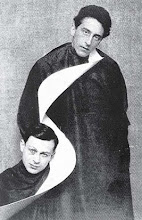
Odilon RedonStreet in Samois (upper) and Silence (lower)


Note:  Yes, I.  At least my words are few.

Sunday, November 18, 2012

SERMON: DESTRUCTION & QUIESCENCE


One evening Morton Feldman said that when he composed he was dead; this recalls to me the statement of my father, an inventor, who says he does his best work when he is sound asleep. The two suggest the "deep sleep" of Indian mental practice. The ego no longer blocks action. A fluency obtains which is characteristic of nature. The seasons make the round of spring, summer, fall, and winter, interpreted in Indian thought as creation, preservation, destruction, and quiescence. Deep sleep is comparable to quiescence. Each spring brings no matter what eventuality. The performer then will act in any way. Whether he does so in an organized way or in any one of the not consciously organized ways cannot be answered until his action is a reality. The nature of the composition and the knowledge of the composer's own view of his action suggest, indeed, that the performer act sometimes consciously, sometimes not consciously and from the Ground of Meister Eckhart, identifying there with no matter what eventuality.
 

From:  "Indeterminacy" in "Silence: Lectures and Writings by John Cage" (Wesleyan University Press, 1961)

 
 * * *


* * *


Illustrations:  John Buckland Wright, 1919, wood engravings from Le Sphinx (Iwan Gilkin)
 

Sunday, September 9, 2012

SERMON: LULLABYE LETTER


    The English saw these things happening around them, and with a war-cloud growing blacker and bigger and always more threatening on their own threshold they sat down to grow soft and peaceful.  They grew soft and accommodating in all things in religion—”


      “In religion?” said Yeovil.


    “In religion, yes,” said his companion emphatically; “they had come to look on the Christ as a sort of amiable elder Brother, whose letters from abroad were worth reading.  Then, when they had emptied all the divine mystery and wonder out of their faith naturally they grew tired of it, oh, but dreadfully tired of it.  I know many English of the country parts, and always they tell me they go to church once in each week to set the good example to the servants.  They were tired of their faith, but they were not virile enough to become real Pagans; their dancing fauns were good young men who tripped Morris dances and ate health foods and believed in a sort of Socialism which made for the greatest dullness of the greatest number.  You will find plenty of them still if you go into what remains of social London.”


    Yeovil gave a grunt of acquiescence.


    “They grew soft in their political ideas,” continued the unsparing critic; “for the old insular belief that all foreigners were devils and rogues they substituted another belief, equally grounded on insular lack of knowledge, that most foreigners were amiable, good fellows, who only needed to be talked to and patted on the back to become your friends and benefactors.  They began to believe that a foreign Minister would relinquish long-cherished schemes of national policy and hostile expansion if he came over on a holiday and was asked down to country houses and shown the tennis court and the rock-garden and the younger children. 


 Soft Machine -- Lullabye Letter (1967 BBC Performance) (Link)


"The seasons make the round of spring, summer, fall, and winter, interpreted in Indian thought as creation, preservation, destruction, and quiescence.”  


         -- John Cage, Silence, 1961


Text:  When William Came by Saki, Ch. XII, The Traveling Companions