Wednesday, February 23, 2011

Imitation of Life: No-Man's Land Part 1 (John Buchan)


        In time things rose and moved around me, a few ragged shapes of men, without clothing, shambling with their huge feet and looking towards me with curved beast-like glances. I tried to marshal my thoughts, and slowly, bit by bit, I built up the present. There was no question to my mind of dreaming; the past hours had scored reality upon my brain. Yet I cannot say that fear was my chief feeling. The first crazy terror had subsided, and now I felt mainly a sickened disgust with just a tinge of curiosity. I found that my knife, watch, flask, and money had gone, but they had left me a map of the countryside. It seemed strange to look at the calico, with the name of a London printer stamped on the back, and lines of railway and highroad running through every shire. Decent and comfortable civilization! And here was I a prisoner in this den of nameless folk, and in the midst of a life which history knew not.


        Courage is a virtue which grows with reflection and the absence of the immediate peril. I thought myself into some sort of resolution, and lo! when the Folk approached me and bound my feet I was back at once in the most miserable terror. They tied me, all but my hands, with some strong cord, and carried me to the centre, where the fire was glowing. Their soft touch was the acutest torture to my nerves, but I stifled my cries lest some one should lay his hand on my mouth. Had that happened, I am convinced my reason would have failed me.


        So there I lay in the shine of the fire, with the circle of unknown things around me. There seemed but three or four, but I took no note of number. They talked huskily among themselves in a tongue which sounded all gutturals. Slowly my fear became less an emotion than a habit, and I had room for the smallest shade of curiosity. I strained my ear to catch a word, but it was a mere chaos of sound. The thing ran and thundered in my brain as I stared dumbly into the vacant air. Then I thought that unless I spoke I should certainly go crazy, for my head was beginning to swim at the strange cooing noise.


        I spoke a word or two in my best Gaelic, and they closed round me inquiringly. Then I was sorry I had spoken, for my words had brought them nearer, and I shrank at the thought. But as the faint echoes of my speech hummed in the rock chamber, I was struck by a curious kinship of sound. Mine was sharper, more distinct, and staccato; theirs was blurred, formless, but still with a certain root resemblance.


        Then from the back there came an older being, who seemed to have heard my words. He was like some foul grey badger, his red eyes sightless, and his hands trembling on a stump of bog oak.


        The others made way for him with such deference as they were capable of, and the thing squatted down by me and spoke.


        To my amazement his words were familiar. It was some manner of speech akin to the Gaelic, but broadened, lengthened, coarsened. I remembered an old book tongue, commonly supposed to be an impure dialect once used in Brittany, which I had met in the course of my researches. The words recalled it, and as far as I could remember the thing, I asked him who he was and where the place might be.
He answered me in the same speech—still more broadened, lengthened, coarsened. I lay back with sheer amazement. I had found the key to this unearthly life.


Note To Reader:  "Why, Sir, you find no man, at all intellectual, who is willing to leave London. No, Sir, when a man is tired of London, he is tired of life; for there is in London all that life can afford."
— Samuel Johnson, September 20, 1777


Note 2 To Reader:  This post is dedicated to Irish storyteller Yvonne Healy. 

Note 3 To Reader:   For another view of No-Man's Land, see Here.

Tuesday, February 22, 2011

Soul Deep (A Day At The Philadelphia Museum)


        I made the acquaintance of this German vise (ca. 1500) two days ago at the Philadelphia Museum of Art. 

        We spent several hours at PMA on Saturday, while Jane was in Puerto Rico, and for reasons I can’t be entirely sure about (the quality of light that day?, rearrangements in the galleries?, mood and state of mind?), it was my most enjoyable visit there in a very long time, and had some of the unexpected and appealing qualities of the first Night At The Museum movie, i.e., there was a palpable feeling of life, animation and expectant greeting in the artworks, which set aside usual "casting" priority relationships and found typically supporting player pieces (like this vise) sometimes assuming leading roles. 


        As additional examples, please see Pablo Picasso's marvelous small  Owl sculpture (1950)  above, perched on its lintel in a high corner of one of the Cubist galleries, or Andre Masson's Italian Postcard (1925) below, in its exquisite and unique wooden frame by Pierre Legrain.  Italian Postcard is an odd, uncharacteristic example of Masson's work, obviously derivative of major Cubist painting, but accomplished and affecting nonetheless (especially seen in conjunction with its wooden surround and in proper lighting showing its rich and subtle coloring, rather than the washed-out, slightly denatured image presented here). Viewed in person, the painting clearly anticipates Masson's more effectively inward-outward mature works.


        I wish I could find an illustration of the German craftsman Urban Holtzwarm's ca. 1500 massive, but elegant wooden door frame with black metal jambs and ornaments. Set into the museum's ochre walls, it is an image of what I believe my mind looks like on its (rare) best days.  I can show, however, below PMA's newly acquired Grant Wood chalk and charcoal (with small amounts of painting) drawing, Plowing (1936), an impressive American dreamscape, and another new acquisition, Juan Gris' 1909-10 charcoal Self-Portrait No. 1, a small work that on Saturday stood out among the impressive company of Cezannes, Monets, Manets, Braques and Brancusis, for its gravity, truth, skill and promise of the greatness that lay ahead.


        Five well-known works, all famous masterpieces, obviously, kept me up most of the night thinking in bed after our revisit.  Pierre-Auguste Renoir's Mademoiselle Legrand (1875) affected me both as someone who loves Renoir's painting (especially following intervals away from it) and as a lonely father missing his daughter badly. Renoir's Les Grands Boulevards (1875) prompts hope for life in an eternal Paris in springtime or summer of the mind, as well as regret for a New York City that seems lost forever.


        Rogier van der Weyden's 1460 Crucifixion and Thomas Eakins' 1880 Crucifixon both serve to remind of the conventions and artifice of painting, and the intersections of realism and abstraction, while powerfully and dramatically presenting their important subject.


        Along with Peter Paul Rubens' Prometheus Bound (1611-18), they also remind and state in certain terms what great vision, surpassing talent and supreme achievement are, i.e., how good good needs to be before we are compelled to recognize its quality.  (They and the other works featured here also remind how lucky one is to live in the neighborhood of a world-class museum of art.) 


        Bob Dylan wrote perceptively in Visions of Johanna: "inside the museums, infinity goes up on trial/voices echo 'this is what salvation must be like after a while'".  Saturday's visit to Philadelphia Museum seemed to indicate that infinity continues to make a convincing case for its existence. I am grateful for this, small gnat-like impediments like Bruce Nauman's 1967 neon work  The True Artist Helps the World by Revealing Mystic Truths (Window or Wall Sign), a fairly recent PMA acquisition,  notwithstanding.


My People Raised Me On Pure Superstition, The Stars Were Put Up There For Us To Wish Upon


I.

SF May Ban Infant Circumcision


II.  

Egyptian Man Names Daughter "Facebook"


III.   


Monday, February 21, 2011

"Wyvern" -- Peach Fritters and Pickled Steak (From Culinary Jottings From Madras)


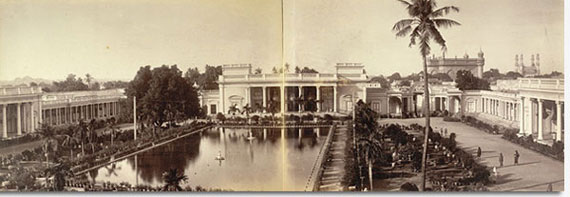
Hyderabad, 1893, Lord and Lady Wenlock; Lord Compton


        I began the year (referring to January 2nd's post) with a short excerpt from "Wyvern"'s extraordinary 1878 volume, Culinary Jottings From Madras, and his comments on hors d'oeuvres.   

        "Wyvern", you may recall,  was the nom-de-plume of Colonel Arthur Robert Kenney-Herbert (b. 1840 - d. 1916), a British Indian Army officer who served in Bangalore in the south, Secunderabad (or Sikandarabad, British cantonment and neighbor to the royal city to Hyderabad) in the north, and other postings beginning in the 1860s, who wrote memorably and penetratingly about cooking and household management in a number of books, as well as in articles published in the Madras Athenaeum and the Daily News (India). 


Cubbon Hotel, Bangalore, late 19th century 


        Like most people interested in his Wyvern, I imagine, I first discovered him via Elizabeth David's books.  Rescuing and reviving interest in Colonel Kenney-Herbert and his Culinary Jottings From Madras is yet another reason we need to be grateful to Mrs. David and her pioneering, highly original work.


Willoughby Wallace Cooper, Stick Carriers, 1870


      The other day Caroline found the following recipe for Peach Fritters, which looks delicious and is also surprising because of its complimentary words about the tinned American peaches in syrup (a staple of both our childhoods), which were then available and highly esteemed in India.  Following, in a sleepy state, I was energized reading the recipe for Pickled Steak.  These two were not paired as part of the the same menu (Wyvern's menus for various occasions make excellent, stimulating reading), but I think they would go well together and we intend to try them out shortly.   They sound both traditional and contemporary, without seeming at all "retro", a term that would, I think, have repelled Wyvern, who was practical,  unpretentious and an enemy of the precious and frou-frou.


 Frederick Fiebag, Mosque in Madras, 1870


        As Caroline and I did two days ago, I'll begin with dessert, moving backwards to the entree:


Peach Fritters


 I. Beignets de Peche
(Peach Fritters)

        Wyvern's peach fritters sound sensational.  So do all his fritters -- sweet and savoury.  First, I think it would be wise to pass along his basic fritter advice: 

        "Failure in the accomplishment of the many excellent dishes which come under the head of 'fritters' may be fairly attributed to three things: the first, ignorance in making the batter; the second, a wrongly shaped utensil;  and the third, an insufficient use of the frying medium.  If you once master these cardinal points and can drum them into the head of your Ramasamy, you will have at your hand a tasty and, indeed, artistic method of cookery upon which you can always rely with confidence.  The charm of fritter cooking is its simplicity.  The mixing of a good batter merely depends upon the accurate following of the recipe before you, whilst the culinary operation itself presents no difficulty whatever, provided a liberal supply of fat be given out, and the vessel used a proper one.  The beginner, as a rule, overcomes this part of his education after a few trials, and thenceforward has no apprehension concerning success."

Now, on to:


         1. The Batter

        "I have adopted as a standard batter in my own kitchen one recommended by the 'G.C.', whose advice I have so often quoted in these pages.  Friends who have tried it at my recommendation have generally commended it.  You must proceed in this way:

        Beat up the yolks of three eggs with two table-spoonsful of brandy, one table-spoonful of the best salad oil, and four or five table-spoonsful of cold water.  Incorporate with this mixture three table-spoonsful of flour and a salt-spoonful of salt.  The flour should be dry, and the best imported.  Work this now, with care to a smooth paste, and continue to beat it for at least ten minutes.  If the batter appear too thick, add a little water until its consistency be satisfactory, i.e., it should cover the spoon when lifted out of it with the coating about an eighth of an inch thick.  This stage having been reached, take the whites of the three eggs, and whip them to a stiff froth; stir this into your batter at the time of using.

        Another good batter is made thus: -- Beat up equal parts of salad oil, and brandy, -- say a table-spoonful of each; and the yolk of an egg and incorporate with this, sufficient flour to make a thick paste which you thin to the required consistency by the addition of water, reserving the whipped white of the egg to finish with."

2. The Fritters

        "Cut the peaches (American ones in tin are excellent) into neat pieces; dust them with powdered sugar, and let them lie in a little maraschino, or any nice liqueur till wanted, then dip them in your batter, and fry them in abundance of boiling fat; drain them on blotting paper, and serve them dusted over with pounded loaf sugar finely sifted.  In the case of raw fruit, the peaches cut in halves, peeled and stoned, should be carefully stewed in syrup with a dash of liqueur and a little lime juice first, then set to get cold, and after being drained, dipped in batter, &c., as above explained.  All fritters should be served without delay."


Bangalore, late 19th century


II. Pickled Steak or Chops


        "Place a steak in a deep dish with a couple of onions sliced, a clove of garlic, pepper corns, salt, some leaves of thyme and marjoram, a bunch of parsley, and some lime peel.  Add oil and vinegar (two table-spoonsful full of former to one of the latter) sufficient to soak the meat well without actually covering it.  Let it soak all day; lift it, when wanted, from the marinade, and fry lightly in butter : then (when coloured on both sides nicely) pour in the marinade, with a breakfast cup of made gravy, and stew the steak gently till thoroughly done.-- Strain the liquor, free it from fat, reduce it a little over the fire, pour over the steak and serve.  This is just as good with a nice mutton steak, or a few juicy chops."


Upper:  Nizam of Hyderabad and Suite, 1870 
Lower: Nizam's Chowmahela Palace, Hyderabad


Wyvern excerpts taken from Culinary Jottings From Madras (5th edition, 1885; republished London, Prospect Books, 2007, ed. Leslie Forbes)

Sunday, February 20, 2011

Cleaning Is Finding


Gutian Ziggurat, Sumer, ca 2000 BC

 
        Several years ago, when we were engaged in a long round of strenuous and sweaty house cleaning, she said to me:  “Cleaning is finding.”  I don’t recall what valuable object or memory token had just been uncovered, but I immediately recognized and acknowledged that this was correct.  Cleaning does invariably lead to finding long-lost, valuable (by some measure) treasures.  This provides the impetus for doing more cleaning and also for inevitable nostalgia and (not as inevitable) self-examination.  


Man Ray, Dust Breeding, 1920


        Two weeks ago, cleaning and finding again (I uncovered a pair of lost hiking boots that went neglected and then missing for a decade for want of replacing a single broken shoelace), she said that this current period of our lives, with its constant and acute tensions, is really no different from earlier periods, which we tend in retrospect to see through “rose-colored glasses” as being somehow happier, more ordered and logical than they seemed when we were actually living through them.


Rendering of Babylonian Temple, ca. 1800 BC


         The act of putting our estates’ various Augean stables in order, turning over pieces we had let lie dormant for so long, confirms this.  If I were to draw pictures of the process, they would progress from an initial stage showing a kind of dusty, weedy, unpopulated Mesopotamian bluff to one where the archeologist (beginning  with rough energetic spadework before moving on to finer digging and analytical tools) is finally able to capture and render clearly in several types of schematic views an ancient temple mound in successive chronological states, identifying with precision the evolving activities that occurred in all of the structures' rooms over millennia, as thinking turned into re-thinking and, of course, slings were shot and arrows flew.


Catacombs (l'Ossuaire Municipal), Paris


        I am grateful having a partner to parse through all the layers and the rubble because my own tendency is to help other people parse through their messes (I do this professionally), simply adding new layers to my own.   I haven’t been out of those hiking boots since finding them, by the way.


Statuettes of two worshippers, from the Square Temple at Eshnunna (modern Tell Asmar), Iraq, ca. 2700 CA. 2700 BCE. Gypsum inlaid with shell and black limestone, male figure approx. 2'6" high. Iraq Museum, Baghdad


Saturday, February 19, 2011

Mr Brown (Glen Adams 1945-2010)


        Behind in my reading, I only learned yesterday that Glen Adams, the pioneering Jamaican musician and former member of Lee "Scratch" Perry's seminal Upsetters band, passed away in December after a long illness.


Glen Adams, 1969

 
        Originally known as a backing musician (keyboards) and later as an innovative record producer, both in Jamaica and the United States, I mainly think of Glen Adams as the composer of one of the best songs ever, the unforgettable Wailers track Mr Brown.  Written in 1969, Adams had originally intended to record and release the song himself, but Scratch persuaded him to let the Wailers record it for inclusion on their pivotal Soul Revolution lp, two years before the group broke through worldwide with Catch A Fire


        Known for its "spooky" (really spooky; really burning) organ sound (provided by Adams and Wailer Peter Tosh), Mr Brown's fabulous, striking lyrics and Bob Marley's great lead vocal performance, Mr Brown has always been on my personal Top Ten list.  Jamaican folklore and news-based interpretations have occasionally been advanced to explicate the Mr Brown ghost story, but they remain marvelously incomplete and unconvincing.  Mr Brown, as they say, is what it is.  (Please click on link in the first line of the song below to enjoy the performance.)

        Less well-known, except to reggae aficionados, is the fact that Glen Adams was one of the several musicians who recorded as melodica master "Augustus Pablo" for producer Herman Chin-Loy before the late and greatly missed Horace Swaby permanently assumed the role and enlarged the artistic identity of Augustus Pablo.  

        That, of course, is another, equally important story.   

        But first -- Mr Brown:


Who is Mr Brown?
Mr Brown is a clown who rides through town in a coffin. 
Where He be found? 
In the coffin where there is 
Three crows on top and Two is laughing. 
What a confusion! 
What a botheration!  


Mandeville Market, Manchester Parish, ca. 1900


Who is Mr Brown? (I want to know now!) 
He is nowhere to be found.  
From Mandeville to Sligoville, coffin running around. 
Upsetting, upsetting, upsetting the town, 
Asking for Mr Brown.
I want to know Who -- 
Is Mr Brown?  


Kingston Tram, Parade & Orange Streets, ca. 1900


Is Mr Brown controlled by remote?  

Calling Duppy Conqueror -- 
I'm the Ghost Catcher. 
This is your chance -- Prove Yourself! 


Down in Parade, 
People running like a Masquerade.  
The police make a raid 
But The Thing get fade.   
What a thing in town! 
Crows chauffeur-driven around. 
Skanking as if they never had known 
The man they call Mr Brown


Jonkanoo Masquerade, Kingston, ca. 1960


Sligoville, First "Free Village" in Jamaica (1834) , St. Catherine's Parish, mid-19th century 


Glen Adams w/The Slackers, 2002 


Big Youth, Natty Warning (Glen Adams/Manley Buchanan), produced by Glen Adams


In this great future, you can't forget your past -- Peter Tosh & Bob Marley ("Get Up, Stand Up").

Friday, February 18, 2011

Separated At Birth? -- Cindy Sherman and Sylvester Stallone (From ArtDaily.org)


Cindy Sherman, Untitled #474. 2008. Chromogenic color print, 90 3/4 x 60" (230.5 x 152.4 cm). Courtesy the artist and Metro Pictures, New York © 2011 Cindy Sherman.


NEW YORK, N.Y.- The Museum of Modern Art will present the exhibition Cindy Sherman, a retrospective survey tracing the groundbreaking artist's career from the mid 1970s to the present, from February 26 through June 11, 2012. The exhibition will bring together more than 170 key photographs from a variety of the artist's acclaimed bodies of work, for which she created myriad constructed characters and tableaus. The first comprehensive museum survey of Sherman's career in the United States since 1997, it will draw widely from public and private collections, including the collection of The Museum of Modern Art. The exhibition is organized by Eva Respini, Associate Curator, Department of Photography, The Museum of Modern Art.   


US Actor Sylvester Stallone in front of one of his artworks poses during a press conference ahead of an exhibition, entitled Sylvester Stallone. 35 Years of Painting. EPA/ARNO BALZARINI.


ST. MORITZ.- From February19th until March 15th 2011, artworks by Sylvester Stallone will be exhibited at Galerie Gmurzynska, St. Moritz. Stallone’s exhibition at Galerie Gmurzynska is a retrospective of his work. The pictures will document different periods of the creative work. About 30 pictures of the action star will be presented, including various self-portraits. Stallone’s pictures are as action-packed as his movies: colorful, expressive and abstract. Referring to Automatism and abstract Expressionism, his paintings merge to a new, very personal expressive style. Thereby the Hollywood star uses the Expressionism concept of presenting art in a spontaneous manner without caring about conventional shapes.