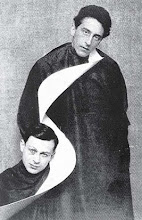
Saturday, July 7, 2012

Julian Maclaren-Ross At 100: July 7, 2012


 1. No memoir of metropolitan literary life in the 1940s and 1950s would be complete without a vivid  supporting part for him, invariably one where he wreaks inadvertent havoc on the memoirist's hitherto orderly existence.  No earnest study of London’s artist demi-monde would be complete without quotations from Memoirs of the Forties, his classic paean to the vanished world of the blackout, “buzz-bombs,” and boozy nights with Dylan Thomas.  And no misty-eyed portrait of mid-century Soho would be complete without an appearance from him.  Tall and aloof, he’s more often than not seen standing at the bar of the Wheatsheaf pub  or some shadowy  dive.  Resplendent in his trademark camelhair coat, worn over an immaculate suit, a fresh carnation in his buttonhole, a malacca cane propped beside him, a cigarette holder clenched between his teeth, mirror-sunglasses lending him a gangsterish demeanour at odds with his otherwise dandified costume, he cuts an incongruous figure.  Around him, a gaggle of fawning cronies provide an attentive audience for a relentless, well-rehearsed monologue, declaimed in a distinctively deadpan drawl.


    For Maclaren-Ross, the pubs and clubs offered an atmospherically lit film set on which he could perform.  Immersing himself as thoroughly as any Method actor in the role he’d chosen, he projected an unforgettable persona, part Oscar Wilde, part Hollywood heavy.


2. Back at his flat in Maida Vale, he’d uncap the Hooded Terror, light up the first in a succession of cigarettes, and open one of the notebooks in which he did most of his writing.  The rest of the night would be spent copying out the stories he’d rehearsed earlier in the day, his handwriting as lilliputian and fanatically neat as ever, his faculties apparently unimpaired by the booze he’d consumed.  Only at dawn would he grab a few hours sleep before summoning the taxi that would carry him back to the Wheatsheaf.


To ward off fatigue, he began using benzedrine, a stimulant that could be obtained without a prescription . . . . It wasn’t long before he’d graduated to the vastly more potent methedrine capsules, only available on prescription . . . . These, he explained to Dan Davin, ‘had the useful property of simultaneously pepping you up and calming you down.’


From Paul Willetts, Fear & Loathing In Fitzrovia, The Bizarre Life of Writer, Actor, Soho Raconteur Julian Maclaren-Ross, Stockport, Dewi Lewis Publishing, 2005.


For more Julian Maclaren-Ross on ACravan, please see these links:


1.  Of Love And Hunger (Julian Maclaren- Ross)

2.  Crossed Cheque (A Writer's Life)

3.  From "The Metamorphosis of Peter Brook" (Julian Maclaren-Ross)


4.  A Soldier Dresses (Julian Maclaren-Ross)

5.  Foretold -- Easter Monday (Zeppelin Over Ramsgate)

6.  Respirators Will Be Worn; Mercer's Cafe


7.  The Party For Picasso (Excerpt) -- Julian Maclaren-Ross

8.  Major Minor

9. The Monastery of Information


My friend Gerry Howard introduced me to  Julian Maclaren-Ross' work many years ago, an encounter and discovery that have given me a great deal of pleasure as well as the wonderful autograph letter pictured in second position above (click on photo to enlarge and enjoy), written using the trademark gold-nibbed, black-barreled  "Hooded Terror" Parker fountain pen that originally belonged to his father.    


I would like to offer a 100th birthday salute to the author of Of Love And Hunger, A Bit Of A Smash In Madras and Some Time I Shall Sleep Out.

Friday, July 6, 2012

A Strong Tone II: Minamoto no Sanetomo (源 実朝)


Hail strikes
the warrior’s wrist guard
as he straightens his arrows
on the bamboo field of Nasu


mononofu no
yanami tsukurou
kote no ue ni
arare tabashiru
Nasu no shinohara


Shinto Temple Hachiman, at Kamakura, photograph ca. 1890, coll. New York Public Library.  Site of Sanetomo’s assassination, February 13, 1219.

Thursday, July 5, 2012

A STRONG TONE: LUCIUS EXHORTS HIS ARMY


They broached wine bountifully and drank it together,

Dukes, distinguished peers and newly dubbed knights;

W
ith the dancing of Germans and the din of piping

The vale reverberated and the valiant men waited.

Then Sir Lucius spoke aloud with lofty words:

‘Ponder the prowess of your proud forefathers,

Those Roman ravagers ruling through their lords,

Who overran the earth’s regnant powers,

Conquering all Christendom by craft of arms;

Every expedition was hailed a victory.

In seven seasons the Saracens were beaten

In all parts from Port Jaffa to Paradise Gates.

We little care if a land launches revolt:

It is reason and right that rebels be restrained!


So let us address that deed, delaying no longer,

Since doubtless the day shall be deemed ours!’

   With these words were said, the Welsh King himself

Was aware of this warrior who had made war on his knights,

    And valiantly in the vale he voiced his challenge:

‘Viscount of Valence, envious of deed,

That adventure at Viterbo shall be avenged today;

I shall never fly unvanquished from this field of battle!’

   Then the Viscount valiantly voiced a command,

And advanced from the vanguard, veering on his horse.

He held up his hateful shield edged with sable

On which a dragon ghastly to see with its gaping maw

Was devouring a dolphin of doleful aspect

As a sign our sovereign would be destroyed

And done out of his days with dread sword-strokes;

For death alone is due when the dragon is raised. 


From Morte Arthure (Alliterative), lines 2028-2057, King Arthur’s Death, London, Penguin Books, 1988, trans. Brian Stone


Wednesday, July 4, 2012

Ball Lightning -- A Personal True Eyewitness Account -- Happy July 4th


 A 19th century depiction of ball lightning.


When I was 11 and attending summer camp, I had the opportunity to see and feel the effects of ball lightning.


For anyone unfamiliar with ball lightning, Wikipedia includes an accurate summary, describing it as: 


“ an unexplained atmospheric electrical phenomenon. The term refers to reports of luminous, usually spherical objects which vary from pea-sized to several meters in diameter. It is usually associated with thunderstorms, but lasts considerably longer than the split-second flash of a lightning bolt. Many of the early reports say that the ball eventually explodes, sometimes with fatal consequences, leaving behind the odor of sulfur…..The presumption of its existence is based on reported public sightings, and has therefore produced somewhat inconsistent findings. Given inconsistencies and the lack of reliable data, the true nature of ball lightning is still unknown.”


This spring, Jane mentioned that her physics class discussed ball lightning.  When her teacher asked whether any students had heard of it or seen it, Jane recounted my Camp Androscoggin experience in Wayne, Maine many years ago.  While Dr. Goldader was apparently impressed, amazed and (he admitted) jealous, Jane’s classmates were interested, but somehow not surprised.  After Methuselah years seeing and believing myself Mr. Bland, I think I’m finally acquiring a “reputation.”


A ball lightning-type effect produced by discharging a high-voltage capacitor in a tank of water.


Camp Androscoggin is on a lake of the same name.   The senior camp for teenagers resided on a beautiful island originally called Sans Souci at lake's center.   I recently realized that the camp's alma mater (which, astonishingly, I can still sing even though most song lyrics escape my memory), with its "camp without a care" refrain, incorporates this historical reference.  Junior camp, attended by 7 through 11 year olds, occupied part of the lake’s shore.  In "ball lightning summer",  I was in the last year of my long slog through that place. It was by no measure a carefee journey for a quiet non-athlete, but the gorgeous lake and forest, good food and lovely fragrances offered some pleasures, notwithstanding the distinct underlying Lord Of The Flies vibe. 

Androscoggin also taught me healthy sunrise/sunset lessons about flag etiquette and protocol (presentation, rising and lowering, folding), which have stayed with me and unfortunately seem to mean less than nothing now in the U.S., judging by the oversized frayed national standards adorning every car dealership between Chester County, Pennsylvania and Orange County, New York.


Campers slept in pleasant wooden cabins arrayed down a longitudinal alley at the crest of a gentle hill descending to the waterfront.  At the beginning of every camp season, we were made to spend the first two or three days wading in sneakers in the camp’s swimming area removing the winter mussel population that had accumulated in the lake bed.  (As a kid unfamiliar with mussels, I found the experience sci-fi nightmarish, which in retrospect was silly.  I have no idea what became of the mussels, but I expect they were put to some good use by the cooks and counselors.)    Each cabin was divided down the middle into two numbered bunks with four or five campers housed in each.  My bunk was in the last cabin – Bunk 23 – at the end of the allée at the farthest distance from the dining hall, flag pole, tennis court and playing fields.  


Summer weather in our part of Maine tended toward the divine, but we always experienced a few intense summer storms whose effects were amplified by our relatively rustic shelter.  One afternoon after lunch, we were told to return to our cabins and not come out.  A BIG lightning storm was expected.


Contemporary woodcut showing The Great Thunderstorm at a church in Widecombe-in-the-Moor, Devon, England, on October 21, 1638.


When the maelstrom arrived, it didn’t disappoint.  The natural “atmospherics” (you could feel pressure changes in your ears and throughout your body) put contemporary fancy movie SFX to shame.   Never before or since have I seen sky color palette changes like the ones I saw that day, a transitional pitch black eventually resolving into an expansive aerial bed-linen of purple, green and gray moiré.  First came light and then suddenly beating-on-sheet metal heavy rain, and when the lightning started (followed by hail -- something I had never heard of, let alone seen), it was plasma-clear, knife-sharp, terrifying and seemingly unending.  Icy pellets landed hard and constantly on the cabin's roof and steps, electricity cracked the sky and thunder boomed as it would have, I imagine, in Zeus's neighborhood.  Very sternly we were told to lie on our beds, hands at our sides, and not to touch the metal frames of our cots.  I can’t remember whether any campers in my bunk spoke at all (I didn’t have a lot to say to them under the best of circumstances), but I think I heard murmuring through the wall from Bunk 24.


Waterfront at Camp Androscoggin, Junior, with Androscoggin Island seen in background.


A darkness fell and a crescendo moment arrived when suddenly I felt pinned and pressed down to my bed.  Through a knothole in one of the floor boards in front of me an electric bowling ball (that’s the only way to describe it and the illustrations here, especially the one in first position, depict its appearance pretty accurately) levitated, hovered and spit sound, light and heat for an indeterminate time like a miniature sun.  As the sphere hung unsupported in space, I heard a loud smashing from the other side of the building and someone scream: "Keep down; Stay where you are." 


The ball vanished through the floor leaving an electric fire odor and a slight scorching mark.  The pressure lifted and vanished.  It was raining harder than ever and we heard sobbing noises from Bunk 24 and sounds on the front steps as people entered that section of the cabin. 


Lightning had struck the far side of Bunk 24, rending a jagged, gaping hole in the outer wall.  The bolt actually hit one of the campers in the foot, but his rubber sneaker grounded the strike and protected him, although he and his cabin-mates were all terribly shocked and upset.


End of camp season bonfire, Androscoggin Island.


The kids in Bunk 24 spent a week sleeping in the camp infirmary while their cabin wall was replaced.  I can still see in my mind the blue tarpaulin they used for temporary covering while they were making repairs.  The camp immediately installed lightning rods on all cabins. 


In the excitement, terror, sadness and (eventual) relief, I don’t recall anyone at the camp ever mentioning or wishing to discuss the ball lightning episode with me, even though it stands out, as the illogical and ungrammatical are wont to say, as the “most unique” aspect of this story.

I saw and felt ball lightning.  Happy July 4th


Tuesday, July 3, 2012

Superior Intelligence (Summer Lightning)


  "A certain critic--for such men, I regret to say, do exist--made the nasty remark about my last novel [Heavy Weather] that it contained `all the old Wodehouse characters under different names'. He has probably by now been eaten by bears, like the children who made mock of the prophet Elisha; but if he still survives he will not be able to make a similar charge against Summer LightningWith my superior intelligence, I have outgeneralled the man this time by putting in all the old Wodehouse characters under the same names. Pretty silly it will make him feel, I rather fancy."


Monday, July 2, 2012

Gelsey Kirkland: It's All Good If You Make It So


  For whatever reasons, Mr. B seemed to favor me, and I was determined to prove myself worthy of his affection.  During the fourth year of my training, he assembled a number of teachers in the school for a review of my class.  Accompanied by piano, he demonstrated a combination of steps across the floor of the studio and asked the students to follow his example in a line.  His special instructions called for us to perform the steps with "energy," one of his pet concepts.  When my turn arrived, I took off with such speed and exuberance, so anxious was I to please, that I took a nasty spill.  With the resounding tumble of my body on the wood, the music stopped and all eyes glared at me. as if I interrupted a church service with some blasphemous utterance.  The exception was Balanchine.


     In the midst of my terrible embarrassment, he applauded, saying, "You see, everybody, this girl is the only one who understood.  I ask for energy, and all of you were lazy, lazy, lazy.  But Gelsey has it -- energy!"


NOTE:  The text appearing above is excerpted from Dancing On My Grave, Gelsey Kirkland's remarkable first volume of autobiography, co-written with Greg Lawrence.  I mostly distrust and devalue young people's (usually young celebrities') autobiographies, but this book, published when Ms. Kirkland was only 34 years old, is a distinct exception.  Kirkland had, by that point in her life, been working as a professional dancer for twenty years and had achieved and nearly destroyed a spectacular, highly dramatic career.


Caroline recently reminded me of this Kirkland anecdote and I wanted to present it because earlier today a friend recalled that idiotic expression "it's all good."  It isn't, obviously.  Achieving quality requires hard work.  (I'm reminded of the Proust galley proof page showing revisions that same friend posted Here. Here's another.) Although Gelsey Kirkland's story about "falling/failing up" for Balanchine might seem self-aggrandizing in isolation, the succeeding two paragraphs (found on p. 36 of the hardcover edition of the book) show that it isn't, and Kirkland's autobiography is a mercilessly honest self-examination of and by a great artist.  


It is marvelous that Gelsey Kirkland is back teaching and sometimes dancing in New York and that her career didn't end with Dancing On My Grave.


Sunday, July 1, 2012

NOT PAINT BY NUMBERS (VENUS)


Regarding these two student exercises – an arcing line drawn repeatedly with eyes closed to awaken internal connections and prompt fluidity and a driftwood "life study" reminds me of my own awkwardness, to which I feel very connected and which is absolutely fluid in execution, & recalls that old SCTV punchline (Eugene Levy as Sid Dithers?): “Makes you think.”  (I guess you had to be there. It makes me think.)