Tuesday, April 3, 2012

We Gotta Get Out Of This Place (From Like Real People)


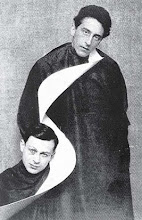
Morden Tower, Newcastle, 1920


Hearing of a budding poetry scene in the far north of England, Andrew and I hitchhiked together from Cambridge to Newcastle, a bleak, gray city then economically devastated by the decline of its traditional shipbuilding industry.  There we found a little enclave of youthful working-class poets led by a dashing blond-mopped teenager named Tom Pickard, who on his miniscule weekly dole stipend was not only raising a family but running a poetry-reading series in the Morden Tower on the city’s old medieval wall.  (This enterprising youth had single-handedly spurred back into verse-writing the long-silent Basil Bunting, former Objectivist colleague of Pound and Louis Zukofsky, and though totally disregarded at that time, still one of England’s finest living poets.)    The lack of electric lights at our reading in the medieval tower was not for quaintness’ sake but because impoverished young entrepreneur Pickard hadn’t been able to foot the bill that month.  We went ahead anyway with candles, and it felt like poetry was meant to be read that way.  To college boys Andrew and me this trip was an altogether marvelous adventure.  We were invited to read our poems on local television – certainly a first for both of us.  We drank dark brown ale with young Geordi poets in Tyneside pubs rocking with a life and atmosphere that defied the gloom of  the streets outside, and went dancing in a subterranean club filled by long-haired boys with the throbbing din of Marshall amps and flashing with the pulse of black-light strobes.  This, too—so far from our world of Oxbridge and London—was England,  perhaps much closer to the “real” England circa 1964.


 Tom Pickard reading at Morden Tower, 1973
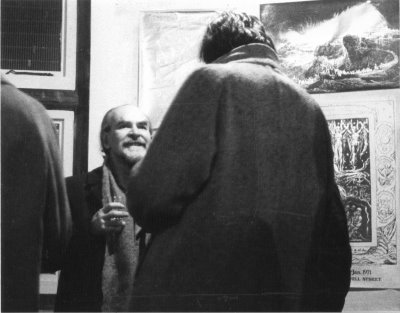


Basil Bunting, Morden Tower, 1977


      Eric Burdon’s then-popular song “We Gotta Get Out of This Place” made a particular kind of poetic sense in that context.  Obvious differences in scale notwithstanding, the tiny underground poetry movement and the exploding electric rock minstrelsy of the period were essentially linked, the former as it were standing on the latter’s shoulders;  both constituted expressions of a generalized resistance against England’s dead-end prospects.


From:  Tom Clark, Like Real People, Santa Rosa, Black Sparrow Press, 1995


The Animals, Newcastle Castle Keep, 1964 (l-r:, Eric Burdon, Alan Price, Chas Chandler, Hilton Valentine, John Steel)


NOTE:   Reading this section of Tom Clark’s Like Real People a couple of nights ago knocked me a little bit sideways and cocked my head, giving new perspective on an era  I’ve thought about a lot (my wife thinks far too much), but never in quite this way.  

As a young British Invasion music fan, I remember  when my father bought me a book called The Liverpool Poets, featuring the work of Roger McGough, Adrian Henri and Brian Patten (who, as I recall, later joined Mike McGear né Michael McCartney and some ex-Bonzo Dog Band musicians in GRIMMS).  The poems didn’t  grip me then and for some reason the photos  got under my skin in a bad way.

Reading here about Clark’s journey north and slightly west (and remembering unforgettable Newcastle accents I’ve heard) , however, made it irresistible to essay some photo research and it was terrific to find the scene Clark describes (including photographs of Morden Tower, dashing Tom Pickard and Basil Bunting) documented in some considerable volume in glorious black & white.

I was struck by the reference to the great Mann-Weill song We Gotta Get Out Of This Place, which The Animals immortalized.  For the same reason Steppenwolf singer John Kay once said that Born To Be Wild claimed its bright permanent place in the rock  song firmament  (Kay said that everyone feels they were born to be wild), I think We Gotta Get Out Of This Place resonates deep in the heart of anyone with a heart who has ever heard it.

Ray Davies of The Kinks (among others properly credentialed  to speak on this subject)  said that it’s the best record ever made.  I once read a moving interview with Newcastle boy made good Bryan Ferry confirming exactly the poetic sense Clark describes and the song’s effect on him seeing The Animals performing in situ when he was a teenager on the verge. 

The rest of Like Real People, a book of poetry and prose, is also excellent.  I highly recommend it.


Eric Burdon’s Corvette (courtesy The House of the Rising Sun, It’s My Life, We Gotta Get Out Of This Place, Please Don’t Let Me Be Misunderstood, etc., etc.)


Monday, April 2, 2012

Buyer's Market: Apple's Chinese iPhone Plants Employ Forced Interns, Claim Campaigners


Yellow River Scenic Near Zhengzhou


Juliette Garside  guardian.co.uk,
Sunday 1 April 2012 14.50 EDT


Students told to man production lines at Foxconn if they want to graduate, says Hong Kong-based nonprofit

   A production line at the Foxconn factory in Shenzhen, southern Guangdong province. Photograph: AFP/Getty Images

   Apple's factories in China are employing tens of thousands of students, some of them on forced internships, according to campaigners lobbying for better labour conditions at Foxconn plants, which assemble iPhones. Some students could be as young as 16.


Employees work on the assembly line at the Foxconn plant in Shenzhen, China. Photograph: Bloomberg via Getty Images


The Foxconn chairman, Terry Gou, head of China's largest private-sector employer – with 1.2 million workers – promised on Sunday to reduce hours and improve pay after an independent audit found multiple labour law violations at his factories.

   But campaigners have accused Apple, Foxconn and the Fair Labor Association (FLA), a charitable organisation that carried out the audit published on Friday, of ignoring the issue of forced internships, where students are told they will not graduate unless they spend months working on production lines during holidays.

   In December, 1,500 students were sent by just one vocational college in Henan, China's most populous province, for internships at Foxconn's Zhengzhou plant, which Apple chief executive, Tim Cook, visited last week. The Yancheng Evening News, which exposed the practice, interviewed students who said they were going against their will and that their schools were acting as "labour agencies".


Zhengzhou (Simplified Chinese: 郑州, Traditional Chinese: 鄭州; pinyin: Zhèngzhou; old form: Chengchow); Location: Capital of Henan province, People's Republic of China; Population: 7,082,000 (2004); History:  Early capital of the Shang dynasty (16th - 11th century BC).


"The gross violation of forced internship was not addressed at all," said Debby Cheng, project officer of Students and Scholars Against Corporate Misbehaviour (Sacom), of the Foxconn audit. "They tried to water down the problem."

   Students of nursing, languages, music and art are being corralled into internships of between three and six months, during which 10-hour days and seven-day weeks are not unusual, according to Sacom and a number of Chinese media reports, which claim colleges and universities are acting as employment agencies, sending their pupils to Foxconn not for relevant training, but to bolster the workforce during summer and winter holiday periods.

   In the summer of 2010, when Foxconn was in crisis after several suicides among the workforce at its largest plant in Shenzhen, 100,000 vocational school students – mostly in their late teens – were sent from Henan for three months.


Permanent Hall-Pass Recipient; His Beyond-Reproachness; Query: How many rivers do we have to cross before we can talk to the boss?


China Daily reported that some students at a vocational school in Henan's capital, Zhengzhou, were not told of the work until nine days before they were due to leave home. Teachers told students they must leave "as ordered by the provincial government" and that all those who refused would have to drop out of school.

   The FLA found that at a peak period in August 2001, 5.7% of the labour force – some 68,000 workers – at Foxconn Group were interns. Its assessors found "interns worked both overtime and night shifts, violations of regulations governing internships".

   The FLA, which described the hiring of interns as "the source of much controversy" and of "major concern to external stakeholders" in its Apple audit, has agreed measures to improve the treatment of students with Foxconn and Apple.

   These include making sure the job relates to the intern's field of study, procedures allowing interns to resign so that they do not feel that they are working against their will, and publishing evaluations of internships, including an annual report.

   The FLA found Foxconn hired an average of 27,000 interns a month, for an average tenure of three and a half months. It said the interns' working day should not exceed eight hours for five days a week, and they should never work seven days in a row.


Nightlife in Zhengzhou:  Baby Body Club


But Sacom and the Guardian's own inquiries have confirmed that 10-hour days and six-day weeks are standard. The FLA said conditions for students were difficult to regulate because under Chinese law they were not defined as employees and no employment relationship exists between the factory and interns.

   This meant some of Foxconn's most vulnerable workers were the least protected, with the FLA concluding "their employment status remains vague and represents a major risk".

   "These students should be studying, but rather they now work 10 hours a day, six to seven days a week, taking on night shifts for months at a time, equivalent to adult workers," said Cheng. She criticised the audit for not highlighting the forced labour issue. "They tried to water down the problem. They used the word 'controversial' without mentioning that these students were forced to work at Foxconn."


Zhengzhou was the first notable city surrounded by a city wall in Chinese history. It is full of vitality, exemplified by the Zhengdong development zone. The city is an important communications hub for China. 


Sacom was set up by Hong Kong academics to highlight working conditions at plants making toys for Disney when Hong Kong Disneyland opened in 2005. It has now expanded to focus on the electronics sector. In March, it issued a public letter to Cook calling on Apple to stop using student workers. 

   It said: "Students who major in subjects such as pharmacy, tourism and language end up working as interns at Foxconn. Some students even complain that if they refuse the 'internship' at Foxconn, they will be forced to drop out of school. This is a form of involuntary labour, which is approved by Apple in producing its products."

   On Sunday, Gou said at a business forum in Hainan province that he would address Foxconn's long-hours culture. "We are saying now in the company, 'You work fewer hours, but get more pay.'"

   Foxconn, Apple and the FLA have not responded to requests for comment.


NOTE:  Sadly, another part of a continuing series that I expect will never, ever end. I suppose we should be grateful that this article doesn't mention students subjected to involuntary servitude killing themselves.  Perhaps that's being saved for The Inevitable Sequel.  The practice, instituted sometime during my mid-career, of having unpaid internships in the U.S. has always irritated me a great deal.  Yes, it provides a “foot in the door,” as well as experience (and possibly course credit), but people should be paid for their work (fairly and on-time).  This, of course, is another kettle of fish entirely, shocking and utterly repellent.  It will receive no attention whatsoever here from our insincere, indifferent and pre-occupied with self-promotion and virtue-guarding (yours as they see it) governing class.  It would be nice to hear people like Elizabeth Warren, Cass Sunstein, Van Jones, Hillary Clinton, Susan Rice and the president weigh in on this (not to mention our organized labor leaders), but I’m not holding my breath.  Readers who care to are free to add any Republican names they wish to this list.


From The Naturalist's Journal -- April 2, 1791


April 2.  Crown imperials begin to blow.  Pronged the asparagus beds.  Wheat looks well.  Mrs. B. White [1] & Hannah White come from London.


[1] The widow of the Rev. Richard Yalden, Vicar of Newton Valence, who married Benjamin White, en secondes noces.  Her stepson, Edmund White, succeeded Richard Yalden.


 \


    NOTE:  The closest I could come to matching Gilbert White's description of April 2, 1791 with something homegrown are these photographs taken yesterday at our wondrous, just re-opened Chanticleer Gardens in Wayne, Pennsylvania (link).

    Not crown imperials, asparagus or wheat, but I think these will do for now.  It's a pity Chanticleer wasn't open two weeks ago when the weather was incredibly warm and spectacular.  Still, it's an amazing spot, a sort of "pocket" version of Longwood Gardens and a beautiful place to stroll, read and think.

    Crown imperials are spectacular.  I'll try to get around to putting some up here soon.


Sunday, April 1, 2012

The Goddess Aphrodite Goes West (To The Getty)


Head of Aphrodite ("The Bartlett Head"), Greek, Late Classical or Early Hellenistic Period, about 330–300 B.C. Parian marble.


Typically associated with beauty and erotic desire, Aphrodite is one of the most compelling and powerful of ancient Greek divinities. Aphrodite and the Gods of Love, on view at the Getty Villa from March 28 through July 9, 2012, presents the goddess in her manifold aspects, exploring her precursors in the ancient Near East, her devotees, her companions and offspring, and culminates with her adaptation in Roman religion as Venus. 


“We are thrilled to have worked collaboratively with our colleagues at the Museum of Fine Arts, Boston to present this first U.S. museum exhibition devoted to Aphrodite, which includes many important works from the collections of both museums as well as from Italian institutions,” says David Bomford, acting director of the J. Paul Getty Museum. “This exhibition is an opportunity for a broader examination of the goddess, a favored subject of J. Paul Getty himself.” 


Oil flask (lekythos) in the form of Aphrodite, Greek, Late Classical Period, mid-4th century B.C. Ceramic, Figural.


David Saunders, assistant curator of antiquities at the J. Paul Getty Museum and curator of the exhibition at the Getty adds, “This exhibition goes beyond the conventional preconceptions of Aphrodite as simply the goddess of love. It reveals other sides of her that deserve attention—her role as a protectress in certain cities, for example, or her care for sailors and merchants. Furthermore, we demonstrate that she was not always benevolent. There are numerous cases in which she and Eros manipulate the desires of both men and gods.” 


Statuette of Aphrodite untying a sandal (Sandalbinder), Greek, East Greek, Late Hellenistic Period, 1st century B.C. Terracotta.


The exhibition begins with Aphrodite as we expect her—nude, beautiful, and seductive. Her naked body was first depicted by the Greek sculptor Praxiteles around 350 B.C., and his sensational cult statue for her temple at Knidos (in present-day Turkey)—now lost— proved enormously influential. In the exhibition, sculptures showing Aphrodite bathing and dressing herself represent the major variations of the female nude. In addition, perfume vessels, storage jars, and mirrors demonstrate how the goddess served as a model for women in their boudoirs and baths. 


Sleeping Hermaphrodite, Roman, Imperial Period, 1st century B.C. Marble. Palazzo Massimo alle Terme, Soprintendenza Speciale per i Beni Archeologici di Roma.


 Having outlined what is familiar about Aphrodite, the exhibition turns to lesser known themes. First is the vexed question of her origins. She was not native to early Greek religion but evolved over centuries, influenced by a variety of Near Eastern goddesses associated with power, fertility, and war. Figurines from Cyprus and the Near East dating as far back as the third millennium B.C. are used to explore the complex story of the goddess’s genesis. The next section of the exhibition looks at Aphrodite’s involvement in affairs of the heart, most notably in the mythical Judgment of Paris, when she offered Helen, queen of Sparta, as her prize. 


The Judgment of Paris, Roman, Imperial Period, 45–79 A.D. Fresco. Soprintendenza Speciale per i Beni Archeologici di Napoli e Pompei. Museo Archeologico Nazionale di Napoli.


Aphrodite was hardly a model wife herself, and the child of her liaison with Hermes was Hermaphroditos, represented in the exhibition by the magnificent sculpture of the Sleeping Hermaphrodite from the Palazzo Massimo in Rome. The fickle nature of Aphrodite’s companion, and in some sources, son, Eros is also explored in this section. He is a child who toys with lovers, and is often described in ancient texts as capricious and troublesome. Many of the depictions of Eros in the exhibition reinforce this notion. One terracotta statue portrays him as a young boy wearing a lion-skin, just like Herakles. The combination looks endearing, but conveys how powerful and potentially destructive desire can be. 


Statuette of Eros wearing the lionskin of Herakles, Greek, East Greek, Hellenistic Period, 1st century B.C. Terracotta.

 
The final section of the exhibition focuses on Aphrodite’s worship, using material from sites such as Athens, Cyprus, Naukratis, and Aphrodisias to examine the identity of her devotees, the kinds of offerings they made, and regional cults. On display only at the Getty Villa are votive offerings from Aphrodite’s sanctuary at the Etruscan port of Gravisca. 


Statuette of Aphrodite emerging from the sea, Greek or Roman, Eastern Mediterranean, Hellenistic or Imperial Period, 1st century B.C. or 1st century A.D. Marble probably from the Greek island of Paros.


These demonstrate her importance to merchants, for her powers over the sea meant that she could permit smooth-sailing for travelers. At the center of this section stands the Capua Venus, an over life-size Roman statue discovered in the amphitheater at Capua. This imposing figure originally held a shield, a symbol of Aphrodite’s much-debated martial nature. The statue also looks forward to the final section of the exhibition—the similarities and differences between the Greek goddess, and Venus, her Roman counterpart.


Votive Relief with Aphrodite and devotees, Greek, Late Classical period, 4th century B.C. Marble. Soprintendenza Speciale per i Beni Archeologici di Napoli e Pompei. Museo Archeologico Nazionale di Napoli. 


NOTE:  

This exhibition looks splendid.  I’m sorry I didn’t see it in Boston, but my travels lately have been tightly circumscribed.  If you are looking for me (unlikely, but possible), I’m easy to find.    I answer to several names, however.  

Spring is here and the time is righter than ever (as Cliff Richard used to say in response to nagging questions about when he would finally marry)  for Aphrodite.  If I were in Los Angeles, I would make tracks to the Getty Villa  to visit this show.

April 1, 1791 (From The Naturalist's Journal -- Gilbert White)


April 1.  The bearing cucumber-bed becomes milder & more mellow ; & the plants shoot & blow well.  Daffodills make a show.  Planted potatoes in the meadow garden, ten rows.


Rabbit ! Rabbit !! Rabbit !!! (Three Rabbits)


I.        
 I.                 I.    Scotch Rabbit


This recipe, from The Cook and Housewife’s Manual (1826) by Meg Dods (nom de plume of Scotswoman Christian Isobel Johnstone); other sources give her name as Christina Jane Johnstone), seems at first sight very similar to the last (ed. note: a recipe for Lady Sysonby’s Toasted Cheese, to be posted at a later date).  But a very different taste is produced by the beer (stout) and the cheeses (Stilton, Gouda or Dunlop) she calls for.  Unfortunately, genuine farmhouse Dunlop, a subtle Scottish relative of Cheddar, is now no longer made.  It is to be hoped that, with the explosion of real-cheese-making in Britain, that state of affairs will soon be remedied.  [1]


  FOR 4
 
            300 g ( 10 ½  oz. Stilton or
            or Gouda) or possibly Dunlop –
            see above), diced.
            140 ml (5 fl oz) porter (stout)
            2 tsp mde mustard
            freshly ground pepper
  good white bread, toasted and buttered

Put the cheese, stout, mustard and plenty of finely ground pepper into a fireproof or gratin dish.  Place over a low heat and stir until the cheese melts and a smooth consistency is obtained.  Put the dish under a fierce grill for a few minutes to brown.   Serve with hot buttered toast on a separate plate.

Meg Dods concludes her recipe as follows: 

“Observation:  this is one of the best preparations of the kind that we are acquainted with.  Some gourmands use red wine instead of porter, but the latter liquor is much better adapted to the flavor of cheese.  Others use a proportion of soft putrid cheese or the whole of it in that state.  This is, of course, a matter of taste, and beyond the jurisdiction of any culinary dictator.  To dip the toasts in hot porter makes another variety of this preparation."

The best kind of stout for this recipe is not Guinness, whose bitterness is accentuated by the heat, but sweet Scotch stout such as Mackeson’s. 


     II.    English Rabbit


Pace Meg Dods (see preceding recipe), red wine, like stout, is also very good with toasted cheese, as in this recipe, which dates from the eighteenth century.

            FOR 4

            good white bread, rather thickly sliced
            and toasted
            2 tsp made mustard
            225 mil (8 fl oz) good red wine
            300 g (10 1/2 oz) Cheddar or Cheshire, thinly sliced

Put the toast into a large shallow gratin dish or baking tin.  Smear with mustard.  Pour the wine into the dish and leave for 5 minutes while the toast soaks it up.  Cover the pieces of toast with the cheese and put under a moderate grill until it has completely melted and is golden brown on top.


        III.   Garlic Rabbit

A dish my mother often used to make for supper, using the delicious wholemeal bread she baked herself.  My grandmother (her mother in law) delighted in saying how much she detested garlic.  So whenever she was present on such occasions, my mother deviously announced "cheese on toast" (and included a little less garlic).  Grandmother always came back for more.

            FOR 4
   
           300 g freshly grated Cheddar
           100 ml (4 fl oz) dry white wine
           3 cloves garlic, finely chopped
           freshly ground pepper
           toasted wholemeal bread

Mash the cheese, wine, garlic and plenty of pepper to a paste.  Spread thickly on pieces of toast.  Put under a moderate grill until the cheese has completely melted and is golden brown on top. When no white wine was to hand, my mother used milk instead.  


[1] From Wikipedia:  "Dunlop is a mild cheese or 'sweet-milk cheese' from Dunlop in East Aylshire, Scotland.  It resembles a soft Cheddar cheese in texture.  It fell out of favour some time after the end of the Second World War, however it has now appreciated for its value in various recipes and for eating on its own or with a dram of whisky.  The local production of Dunlop cheese ceased in around 1940, and has only been sporadic since the Second World War, however Dunlop and other cheeses are as of 2007 made in West Clerkland Farm just outside Stewarton on the Dunlop Roa, and are also produced on Arran, Islay and elsewhere.  The Dunlop Cheese factory was sited near the Dunlop railway station in what is now a housing estate, the memory of Dunlop cheese production being kept alive by the name 'Creamery Row.'"   Dunlop cheese was the invention in the early 18th century of Barbara Gilmour, a cheese genius who used the unskimmed milk of Aylshire cows to create a cheese that, since its introduction was greatly valued for roasting.  It was often served on breakfast bread (a "farl of oatcake or supple scone"), substituting for the more traditional bacon. 

My own research shows that Dunlop cheese production, while still artisinal in scale, is on the rise and that Dunlop may be purchased from time-to-time from London's (Seven Dials) remarkable Neals Yard Dairy (link), who import into the U.S.


Recipes from Peter Graham, Classic Cheese Cookery, London, Penguin, 1988, 1995