Sunday, March 6, 2011

Brighton Three Ways From Sunday

Trudging slowly over wet sand,
Back to the bench where your clothes were stolen.
This is the coastal town
That they forgot to close down :
Armageddon - come Armageddon!
Come, Armageddon! Come!

Every Day is silent and grey.

Hide on the promenade,
Etch a postcard :
"How I Dearly Wish I Was Not Here."
In the seaside town
...That they forgot to bomb :
Come, Come, Come - Nuclear Bomb.

Every Day is silent and grey.

Trudging back over pebbles and sand,
And a strange dust lands on your hands
(And on your face...)

Every Day is like Sunday.
"Win Yourself A Cheap Tray."
Share some greased tea with me.
Every Day is silent and grey.


II.

Hale knew, before he had been in Brighton three hours, that they meant to murder him.  With his inky fingers and his bitten nails, his manner cynical and nervous, anyone could tell he didn’t belong – belong to the early summer sun, the cool Whitsun wind off the sea, the holiday crowd.  They came in by train from Victoria every five minutes, rocked down the Queen’s Road standing on the tops of the little local trams, stepped off in bewildered multitudes into fresh and glittering air: the new silver paint sparkled on the piers, the cream houses ran away into the west like a pale Victorian watercolour;  a race in miniature motors, a band playing, flower gardens, in bloom below the front, an aeroplane advertising something for the health in pale vanishing clouds across the sky.


        It had seemed quite easy to Hale to be lost in Brighton.  Fifty thousand people besides himself were down for the day, and for quite a while he gave himself up to the good day, drinking gins and tonics whenever his programme allowed.  For he had to stick closely to a programme: from between ten and eleven Queen’s Road and Castle Square;  from eleven till twelve the Aquarium and Palace Pier, twelve till one on the front between the Old Ship and West Pier, back for lunch between one and two in any restaurant he chose round the Castle Square, and after that he had to make his way to the station by the Hove streets. These were the limits of his absurd and widely advertised sentry-go.


        Advertised on every Messenger poster: ‘Kolley Kibber in Brighton today.’  In his pocket he had a pack of cards to distribute in hidden places along his route;  those who found them would receive ten shillings from the Messenger, but the big prize was reserved for whoever challenged Hale in the proper form of words and with a copy of the Messenger in his hand:  ‘You are Mr Kolley Kibber.  I claim the Daily Messenger prize.’


III.

 
        These two girls were walking from the direction of the Palace Pier towards the West Pier, which they had nearly reached.  

        At about a hundred yards’ distance from the West Pier some sort of suggestive nudging took place between their interlocked arms and they turned away to the left to the railing overlooking the sea.  They leaned over these railings and gave an imitation of observing the beauties of what remained of the sunset. 

        ‘Go on,’ said the pretty girl to her companion.  ‘Have a look now.’

        ‘No,’ said the ugly girl.  ‘You look.’


        ‘No – you look,’ said the pretty girl, and she was in due course obeyed.  The pretty girl is usually ultimately obeyed on such occasions, for, in addition to her ascendancy for other reasons, she is the initiator, the senior officer, the skilled and experienced campaigner in operations of this nature.

        ‘Yes,’ said the ugly girl. ‘Here they come.’

        She was alluding to three young men whom they had believed to have been following them.  

        ‘All right.  Just pretend to be looking out at the sea,’ said the mature strategist, in a quiet, steady tone which in fact betrayed some nervousness by virtue of its quietness and steadiness.

        ‘It’s a lovely evening,’ she added.  ‘Ain’t it?’


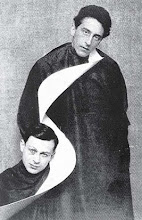
Reader Key:  I. Everyday Is Like Sunday (Morrissey-Stephen Street); II. Excerpt from Graham Green, Brighton Rock (N.b., Lobby Lud pictured above is the actual newspaper promotion contest that Graham Greene used as the basis for Kolley Kibber); III.  Excerpt from Patrick Hamilton, The West Pier. (Graham Greene once described The West Pier as the best novel ever written about Brighton, a place I've visited several times and love. I have had no sinister experiences there, however, just rough late winter weather.)

Saturday, March 5, 2011

News From The Universe Worth Noting: NASA Scientist Claims Evidence of Alien Life on Meteorite


Riccardo Guerrero / Richard B. Hoover / Journal of Cosmology
A photograph taken through a scanning electron microscope of a CI1 meteorite (right) is similar in size and overall structure to the giant bacterium Titanospirillum velox (left), an organism found here on planet Earth, a NASA scientist said.


By Garrett Tenney


        We are not alone in the universe -- and alien life forms may have a lot more in common with life on Earth than we had previously thought.

        That's the stunning conclusion one NASA scientist has come to, releasing his groundbreaking revelations in a new study in the March edition of the Journal of Cosmology.

        Dr. Richard B. Hoover, an astrobiologist with NASA’s Marshall Space Flight Center, has traveled to remote areas in Antarctica, Siberia, and Alaska, amongst others, for over ten years now, collecting and studying meteorites. He gave FoxNews.com early access to the out-of-this-world research, published late Friday evening in the March edition of the Journal of Cosmology. In it, Hoover describes the latest findings in his study of an extremely rare class of meteorites, called CI1 carbonaceous chondrites -- only nine such meteorites are known to exist on Earth.

        Though it may be hard to swallow, Hoover is convinced that his findings reveal fossil evidence of bacterial life within such meteorites, the remains of living organisms from their parent bodies -- comets, moons and other astral bodies. By extension, the findings suggest we are not alone in the universe, he said.

        “I interpret it as indicating that life is more broadly distributed than restricted strictly to the planet earth,” Hoover told FoxNews.com. “This field of study has just barely been touched -- because quite frankly, a great many scientists would say that this is impossible.”

        In what he calls “a very simple process,” Dr. Hoover fractured the meteorite stones under a sterile environment before examining the freshly broken surface with the standard tools of the scientist: a scanning-electron microscope and a field emission electron-scanning microscope, which allowed him to search the stone’s surface for evidence of fossilized remains.

        He found the fossilized remains of micro-organisms not so different from ordinary ones found underfoot -- here on earth, that is.

        “The exciting thing is that they are in many cases recognizable and can be associated very closely with the generic species here on earth,” Hoover told FoxNews.com. But not all of them. “There are some that are just very strange and don’t look like anything that I’ve been able to identify, and I’ve shown them to many other experts that have also come up stumped.”

        Other scientists tell FoxNews.com the implications of this research are shocking, describing the findings variously as profound, very important and extraordinary. But Dr. David Marais, an astrobiologist with NASA’s AMES Research Center, says he’s very cautious about jumping onto the bandwagon.

        These kinds of claims have been made before, he noted -- and found to be false.

        “It’s an extraordinary claim, and thus I’ll need extraordinary evidence,” Marais said.

        Knowing that the study will be controversial, the journal invited members of the scientific community to analyze the results and to write critical commentaries ahead of time. Though none are online yet, those comments will be posted alongside the article, said Dr. Rudy Schild, a scientist with the Harvard-Smithsonian's Center for Astrophysics and the editor-in-chief of the Journal of Cosmology.

        "Given the controversial nature of his discovery, we have invited 100 experts and have issued a general invitation to over 5,000 scientists from the scientific community to review the paper and to offer their critical analysis," Schild wrote in an editor's note along with the article. "No other paper in the history of science has undergone such a thorough vetting, and never before in the history of science has the scientific community been given the opportunity to critically analyze an important research paper before it is published, he wrote."

        Dr. Seth Shostak, senior astronomer at the SETI Institute, said there is a lot of hesitancy to believe such proclamations. If true, the implications would be far-reaching throughout the fields of science and astronomy, the suggestions and possibilities stunning.

        “Maybe life was seeded on earth -- it developed on comets for example, and just landed here when these things were hitting the very early Earth,” Shostak speculated. “It would suggest, well, life didn’t really begin on the Earth, it began as the solar system was forming.”

        Hesitancy to believe new claims is something common and necessary to the field of science, Hoover said.
“A lot of times it takes a long time before scientists start changing their mind as to what is valid and what is not. I’m sure there will be many many scientists that will be very skeptical and that’s OK.”

        Until Hoover’s research can be independently verified, Marais said, the findings should be considered “a potential signature of life.” Scientists, he said, will now take the research to the next level of scrutiny, which includes an independent confirmation of the results by another lab, before the findings can be classified “a confirmed signature of life.”

        Hoover says he isn’t worried about the process and is open to any other explanations.

        “If someone can explain how it is possible to have a biological remain that has no nitrogen, or nitrogen below the detect ability limits that I have, in a time period as short as 150 years, then I would be very interested in hearing that."

        "I’ve talked with many scientists about this and no one has been able to explain,” he said.

ACravan Reader Note

From Journal of Cosomology:  

Journal of Cosmology, 2011, Vol 13,
JournalofCosmology.com March, 2011


Fossils of Cyanobacteria in CI1 Carbonaceous Meteorites
 
Richard B. Hoover, Ph.D. NASA/Marshall Space Flight Center

Synopsis 
 

Dr. Hoover has discovered evidence of microfossils similar to Cyanobacteria, in freshly fractured slices of the interior surfaces of the Alais, Ivuna, and Orgueil CI1 carbonaceous meteorites. Based on Field Emission Scanning Electron Microscopy (FESEM) and other measures, Dr. Hoover has concluded they are indigenous to these meteors and are similar to trichomic cyanobacteria and other trichomic prokaryotes such as filamentous sulfur bacteria. He concludes these fossilized bacteria are not Earthly contaminants but are the fossilized remains of living organisms which lived in the parent bodies of these meteors, e.g. comets, moons, and other astral bodies. The implications are that life is everywhere, and that life on Earth may have come from other planets. 

Members of the Scientific community were invited to analyze the results and to write critical commentaries or to speculate about the implications. These commentaries will be published on March 7 through March 10, 2011.


Official Statement from Dr. Rudy Schild,
Center for Astrophysics, Harvard-Smithsonian,
Editor-in-Chief, Journal of Cosmology. 
 

We believe Dr. Hoover's careful analysis provides definitive evidence of ancient microbial life on astral bodies some of which may predate the origin of Earth and this solar system.
Dr. Richard Hoover is a highly respected scientist and astrobiologist with a prestigious record of accomplishment at NASA. Given the controversial nature of his discovery, we have invited 100 experts and have issued a general invitation to over 5000 scientists from the scientific community to review the paper and to offer their critical analysis. Our intention is to publish the commentaries, both pro and con, alongside Dr. Hoover's paper. In this way, the paper will have received a thorough vetting, and all points of view can be presented. No other paper in the history of science has undergone such a thorough analysis, and no other scientific journal in the history of science has made such a profoundly important paper available to the scientific community, for comment, before it is published. We believe the best way to advance science, is to promote debate and discussion.

 Additional Journal of Cosmology material, including article abstract and illustrations, to be found at:  

http://journalofcosmology.com/Life100.html


Fullcircle Part 1 (John Buchan)


Between the Windrush and the Colne
I found a house of stone –
A little wicked house of stone.


        The October day was brightening toward late afternoon when Leithen and I climbed the hill above the stream and came in sight of the house.  All morning a haze with the sheen of pearl in it had lain on the folds of downland, and the visions of far horizons, which is the glory of Cotswold, had been veiled so that every valley seemed as a place enclosed and set apart.  


        The stone of the Cotswold takes curiously the colour of the weather.  Under thunderclouds it will be as dark as basalt; on a grey day it will be grey like lava but in sunshine it absorbs the sun.  At the moment the little house was pale gold, like honey.


        Leithen swung a long leg across the stile.

        “Pretty good, isn’t it? “ he said.  “It’s pure authentic Sir Christopher Wren.  The name is worthy of it too.  It is called Fullcircle.”


Friday, March 4, 2011

Out Of Dream (Road)


Note:  Although nothing could be more "real world physical" than artist Gordon Matta-Clark's "building cut" works, his images (like Conical Intersect above, made in Paris in 1975) are as surreal and dreamlike as anything in the work of his father, the Chilean Surrealist painter Matta, or any of the artists one associates with Matta. The title of this post is a variation of one I used recently, Out Of Road (Dream), which was suggested by one of my own dreams.  I'm sure I have had dreams resembling Gordon Matta-Clark's images; I'm just not sure whether they came before or after seeing his work.  I'm sure seeing his images affected my future dreaming.

Thursday, March 3, 2011

Tempur-Pedic (2011: A Sleep Odyssey)


         The Tempur-Pedic system (mattress and pillow) is by far the most comfortable bedding I have ever lain awake on all night almost every night.  It makes sleeplessness a restful and infinitely fascinating place on the map, one I always look forward to (re)visiting.  This luxurious product is well well worth the expense.


        I believe that you could actually jump energetically on the Tempur-Pedic memory foam mattress and complete a round of calisthenics without upsetting a glass of red wine as they suggest in their commercials, but I'm not going to try.


        But, please, don't take my word for the benefits of Hypnos' and King Croesus' greatest gift to humanity.  

        Consult instead with our panel of sleep experts.


Eddie (l), Felix (r) evaluating


     "Pataphysics is the science." -- Alfred Jarry, Exploits and Opinions of Dr. Faustroll Pataphysician.


 King Croesus on the pyre, Attic red-figure amphora, 500-490 BC, Louvre, Paris


Fernand Khnopff, Une aile bleue (A blue wing), 1894, Oil on canvas, Private collection

Painting includes Khnopff's Head of Hypnos, inspired by Scopas' 350 BC sculpture in the British Museum.  Khnopff made several versions of Hypnos, in both sculpture and painting, and included an altar to Hypnos in his Brussels studio.

Wednesday, March 2, 2011

T.E. Lawrence by Lorine Niedecker


T.E. Lawrence


How impossible it is

to be alone

the one thing humanity

    has never really

moved towards


From Lorine Niedecker, Collected Works (ed. Jenny Penberthy), Berkeley, University of California Press, 2002

Tuesday, March 1, 2011

From A Window (John Lennon -- Paul McCartney)


Late yesterday night, I saw a light shine from a window,
And as I looked again, your face came into sight.
I couldn't walk on until you'd gone from your window.
I had to make you mine, I knew you were the one.
Oh, I would be so glad just to have a love like that,
Oh, I would be true and I'd live my life for you.
So meet me tonight, just where the light shines from a window,
And as I take your hand, say that you'll be mine tonight.