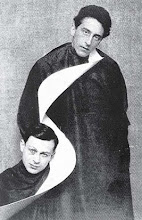
“They talked of Yves’ aestheticism and his constant search for visual perfection, which led Bianca to ask, ‘Aren’t there qualities you look for in people?’ Yves’ reply is perhaps the most revealing public statement he has ever made about himself. ‘No’, he said, ‘because ultimately the qualities I see in people are what I perceive them to be. It is my vision of people that counts. It’s all projection. If I am deceived it’s my own doing. What interests me is my vision of others’.
‘Like all creators he has an appalling ego and so others don’t really count much for him because of that’, admits Pierre Berge now. ‘I am someone generous. Yves is not. I do not mean he is miserly. I mean he is someone who can only live wrapped up in himself. The outside world does not interest him. Voila! You know it is like every artist, every creator; they invent their own solar system just as he has done and the whole world turns around this sun and the sun is him. Voila! And the sun is not there to ask how the satellites are doing. He could not care less. But I do not mean that as a criticism.’”
I wanted badly to add an "Yves Saint Laurent" cocktail as an addendum to this post, but couldn't find one. Then I thought "why not find a "Marcel Proust" cocktail, since Saint Laurent was, for reasons I can't totally understand, obsessed with Proust. Although I determined that such a cocktail did exist and was served at Le Grand Cabourg Hotel in Cabourg, Normandy, a former Proust haunt, I couldn't track down the recipe. Therefore, I decided to include the Serendipity cocktail, as prepared by Colin, the bartender at the Ritz in Paris, apparently another place Proust liked to patronize. It looks beautiful and delicious and it does include Calvados, which seems to be in right spirit:
Serendipity, the cocktail
Fresh mint
Ritz Champagne, ½ glass
Calvados 1/10th
Apple Juice
"Colin breaks off a handful of mint leaves and puts them in the bottom of the glass, using tongs to gently release the flavour, but taking care not to muddle them, which he says is very important: if you muddle them you crush and bruise the leaves, which is not good. He pours in the Calvados and then half a glass of Champagne, and then tops it up with clarified apple juice from Normandy. The finishing touch is a white orchid, or a red rose if it’s for a lady.
Serendipity is sublime. It’s a little bubbly, it’s light, it’s refreshing, and it goes down very easily. It’s a perfect drink if you’re in Paris in the spring."
Lately in our house we've been discussing what the cicadas who speak loudly in Tuxedo every evening are saying.
My own surmise has always been that they're saying "Goodbye, hello", like in the Beatles song "Hello, Goodbye". It's only a surmise; I've been concerned that I had oversimplified the subject.
This morning I discovered the website cicadaspeak.com, which covers part of the work of Dr. Kim Ogden, animal communicator.
This is what Dr. Ogden thinks:
"Welcome to the world of cicadas -
from the cicadas point of view!
How can someone "know" what cicadas are thinking and saying?
I can! I'm Dr. Kim Ogden, an animal communicator.
A real - life Dr. Doolittle
It's what I do 12 - 15 hours a day. Everyday. And I've helped thousands of people and their animals solve problems and renew relationships.
(See www.Kimogden.com)
When the cicadas came to Illinois this year, (2007), I spent a week, a glorious week, communicating with them.
I learned that they are just about the smartest, joy - filled, innocent, and sacred species I have ever had the pleasure of communicating with.
It was an honor. And now that it is almost over, I would like to share with you what they have communicated. Communicated three ways - by sending me their thoughts, their feelings and even images. It was a heart to heart and a consciousness to consciousness communication. From one sentient being to other sentient beings - the cicadas.
This was a learning and sharing experience for both me and for the cicadas. A time when we both grew in understanding each other as a species, each other as friends.
And when it was done, and when the last cicada "went to sleep", I cried. I cried because I knew I had touched the hem of something so sacred, so God-like and so joyful, that I knew I would miss them. Until they returned 17-years into the future.
Here are the highlights. Cicadas are:
* Trusting
* Innocent
* Joy-filled
* Loving (they all like each other, they all get along)
* Knowing (somehow they know what is happening to their kin even in other parts of the country)
* Intelligent (When I would introduce a concept or a word, they would immediately understand, or ask questions for clarification)
* Sharing (Once a concept or word was introduced, I would be amazed to find that the next day, a different cicada would use that concept or word in a conversation - so one cicada must have "told" another cicada who must have "told" another cicada, etc.)
* Believe humans are very important to them
* Wish humans would "get outside" more to understand them and nature
* Concerned about their survival and the survival of this planet"
Two days ago, when the world was still spinning too fast and I was struggling to put my thoughts in order (it was a busy week; I’ve also found this summer’s extreme heat disorienting), I stared into my Blackberry’s tiny screen (to my family’s annoyance) and learned that on October 4th EMI Records will be releasing “An Introduction To Syd Barrett”.
Although on some levels, the burgeoning post-mortem Syd Barrett industry is crass and annoying, it is understandable why the formerly august (and now apparently permanently broke and damaged) EMI label would wish to dust off (again) the Syd Barrett archives, and it is to their great credit to have engaged David Gilmour, Syd’s friend and the musician who both replaced him in Pink Floyd and acted as amanuensis and midwife on Syd’s two “official” career solo lps, to oversee the project. The album collects and chronologically connects Syd’s brilliant early Pink Floyd compositions/recordings and the still revolutionary tracks included on “The Madcap Laughs” and “Barrett”, the “live-est”, most present tense studio recordings ever made in the rock era. A newly discovered, long instrumental called “Rhamadan” and the ok, but inessential “curiosity” track “Bob Dylan Blues”, are also included.
Inevitably, the digital “sprucing up” will cause some changes in the sound (I recently heard what was an apparently newly remastered version of Pink Floyd’s “See Emily Play” on satellite radio, featuring increased separation of instruments and greater clarity than the original, and it sounded all wrong) and one can only hope that these are not too jarring. Based on David Gilmour’s own body of work and his perceptive, empathetic comments over the years about Syd Barrett, I am confident that “An Introduction To Syd Barrett” will successfully introduce this unique and unforgettable artist to a new generation of lucky young people, who will find it inspiring.
Thinking about Syd and the tragic aspects of a talent and career cut short by mental illness made my mind turn to Syd’s contemporary and friendly rival, Kevin Ayers, also a composer and lyricist of great acuity, charm and power, whose career took a different course. Kevin is still alive and well and living in southwestern France, his enormous talent intact. His Soft Machine albums and his many solo records are all still in print (Kevin’s records, like Syd Barrett’s, are jewels in the EMI library), a considerable achievement for a commercially unsuccessful musical artist, and a sign that even in the current “diminished, but not finished” (a Kevin song title) recording industry, the special and unique qualities of Kevin’s work are acknowledged.
Two years ago, Kevin released “The Unfairground”, which in some ways is the best record of his long career. Unlike Syd Barrett, Kevin was granted (or, rather, achieved through prodigious talent and diligent effort) his “late Rembrandt/late Titian” moment. “The Unfairground” is an “old age” record that belies the idea of old age by showing surpassing energy, inventiveness and wisdom gained through experience. It’s high art and a record that one treasures and can learn from. Released into an increasingly bland-across-all-genres market, “The Unfairground” was an “old-style” record featuring live musicians, complex, detailed arrangements, a varied international flavor (a Kevin Ayers trademark), plus the indispensable ingredients of catchy tunes, sharp and clever lyrics, humor, humanity and empathy.
Like the turntable two-sided records from the pre-CD era, “The Unfairground” proceeds like a poem or a novel and takes you on a journey. As with Syd Barrett’s solo lps, “The Unfairground” also had a midwife in the person of Kevin’s manager, Tim Shepard, an Anglo-American visual artist who befriended Kevin in his Pyrenees aerie and who wasn’t content to allow him to conclude his career with his previous record, “Still Life With Guitar”, a “return to form” masterpiece about lonely life in Mallorca, which had been released fifteen years earlier in 1992. Shepard, against all odds (including a reluctant artist, a largely indifferent world, and challenging finances), succeeded in making Kevin complete his masterpiece, a record every bit as good as the previously unmatchable (and utterly different) “Shooting At The Moon”, which Kevin recorded in 1970 with his revolutionary outfit The Whole World. (N.B., no Kevin Ayers and The Whole World, no Roxy Music, no Brian Eno, a different David Bowie, etc., etc., for starters.)
Despite credible marketing and publicity efforts by the Lo-Max label independent label in the UK and uniformly positive, enthusiastic reviews, “The Unfairground”, unsurprisingly, failed commercially. Kevin’s an older artist and rock and roll is primarily a youth business. He writes, as always, about the intricacies of personal relationships intimately and analytically, from a slightly, but appreciably, more distant perspective than Syd Barrett does. In Barrett’s work, the pain and occasional pleasure radiate and beam like large lighted signs seen up close at night. Kevin is more modest, composed and reserved, but the two artists resemble each other in subject matter, emotional tension and sensitivity, humor and “Englishness”.
Kevin didn’t/wouldn’t tour to promote the album, despite the fact that he had made his living on the road for the previous two decades, is a very good live performer and had a group of young progressive music superstars (many of whom played on the album) ready to support him. As he told a radio interviewer, the third law of physics (for every action, there is an equal and opposite reaction), implies that if fairgrounds exist, so do “unfairgrounds”. I think this is how Kevin came to view the professional terrain where, by dint of his musical genius (a quality he shares with Syd Barrett) and quite robust mental and physical health (where Syd was sadly deficient), he continued to operate to diminishing commercial returns and with increasing displeasure. Too many cycles of pre-album release build-ups followed by post-release commercial letdowns eventually took their toll. Kevin is a modest and diffident person. He’s much too classy ever to whine (or, as he would say, whinge.) He looks like a rock star, but really can’t bring himself to act like one. I expect he’s finished with recording and performing and will henceforth, as he says, live inside his head, which is a “complicated place to be”. We’re all lucky to have the records.
I began writing this because when “The Unfairground” was released I didn’t have a blog and had no way of sharing my thoughts about the album with anyone who might be interested in hearing them. Kevin is an old and treasured friend who spent several long-ish periods many years ago living in our apartment in Brooklyn Heights, NY. Getting to know someone quite well who was once an idol, a face on a glossy record sleeve, was quite something. He taught Caroline and me to cook and, during visits to his home in Deya, Mallorca, how to be a gracious host. He turned me on to the writers Elizabeth David, Alan Davidson and Myles na gCopaleen and taught me to appreciate Rhone wines. Because of Kevin, I will never play poker again. I'm no good at it. On occasion, he also provided valuable insights into Syd Barrett’s records, which were favorites of his. Hearing Kevin play the clever, complicated guitar introduction to “Baby Lemonade” was quite a treat.
When I think of Kevin, I always think of eating well and with a sense of celebration.I think of the long-departed and greatly missed Bali Rice Shop on Atlantic Avenue in Brooklyn Heights, where I discovered Ikan Bumbu Bali, sambal blachan, krupuk, and so many other delicacies unique to New York at that time (and still rarely found), of shopping trips to Chinatown and of Malaysia, where Kevin grew up, which seemed to be always on his mind. Two nights ago, I thought of Kevin while discovering a remarkably delicious dish at Priya, the good Indian restaurant in Suffern, NY. It is called Beef Cochin and it is described on the menu as "Sauteed beef cubes cooked Kerala style, flavored with herbs, spices and coconut".
I researched the recipe and learned a lot about Kerala (also home to cabbage thouran, the subject of an earlier blog entry) and the ancient city of Kochi, a seaport that is home to diverse ethnic and religious groups and a place I would very much like to visit one day. I haven’t tried cooking the dish yet, but here are two versions, taken from Indian websites, both of which look wonderful:
Beef Cochin 1:
Ingredients:
Beef
1 kg
Onions
2 medium size, sliced
Green chillies
4 split
Ginger
1” chopped
Coriander powder
2 teaspoon
Garlic
8 pods
Tomatoes
2 cut
Cinnamon
1”
Cloves
5
Cardamom
5
Fennel (Perum jeerakam)
4 teaspoon
Black pepper corn
8
Turmeric powder
½ teaspoon
For seasoning:
Onions
One teaspoon cut fine
Mustard seeds
½ teaspoon
Coconut
One cup, Cut in to small pieces
Curry leaves (Karivepila)
4 sprig
Oil (Coconut oil preferred)
One cup
Method:
Mix meat with all the ingredients except cardamom, cloves, black pepper seeds and fennel.
Grind cardamom , cloves, black pepper and fennel on to a masala. Now cook the beef with the ground masala in a pressure cooker (30 minutes) or a vessel till the meat is tender.
Heat oil in a frying pan. Add mustard seeds. When it splutters, add chopped onions and fry till brown. Add curry leaves and coconut pieces and fry till is light brown. Now add the beef and cook till all the gravy is dried and keep the fire low and fry the beef until it is fried properly and turns in to ` very dark brown in color.
Aniseeds/fennel – 1/2 – 1 tsp
Cinnamon – 1 inch piece
Cloves – 4-5
Star anis – 2
Garam Masala – 1/2 – 1 tsp (optional)
Bite size coconut pieces (thengakothu) – 1/4 – 1/2 cup
Coconut oil Salt Curry leaves
Powder the number 4 ingredients and keep aside. Combine the powdered spices, number 3 ingredients, tiny coconut pieces, salt, curry leaves & beef. Make sure that beef is marinated well with the spices. Pressure cook the marinated beef till it is done. I usually don’t add water while cooking, but if you want you can add 2-3 tbsp of water. If there is any water left, after pressure cooking, cook till the water is dried.
Heat oil in a pan and saute the onions, till it becomes golden brown. Add the cooked beef & curry leaves. If you want you can sprinkle garam masala at this stage. Mix well. Stir over a low flame, till it is roasted well.Serve with rice and/or chapathi,
.Notes: The original recipe doesnt call for garam masala, I added it since I like it to be spicy. You can be a bit generous with oil, if you want a well roasted/fried beef.
Recipe adapted from: Flavours of Kerala
The cheena vala (Chinese fishing nets) in Kochi pictured below really remind me of Kevin. He’s an avid fisherman and, when he lived near the shoreline in Mallorca, at least, was the owner and master-user of a beautiful fishing net, which he used to gather whitebait.
What can you tell me about the famously delicious Dr. Martin lima bean?
"Dr. Harold E. Martin (1888-1959) was a friend of my grandfather’s and one of my grandfather’s seed-saving buddies. Dr. Martin was a dentist who owned a small farm along Street Road in Westtown near West Chester. My grandmother took me there many times to drop off and pick up vegetables and fruits that my grandfather horse-traded with Dr. Martin. Dr. Martin is famous for his lima bean, which he developed in the 1920s, but he also created the True Black Brandywine and quite a few other amazing things. He was a genius when it came to breeding plants."
I came across the preceding text yesterday on a very fine blog called ccdwell.com, which coversChester County, Pennsylvania, where we live and where my wife’s family has made their home since the 17th century.
We moved back here in 2007 and, although thedereglements de tous les sensof moving houses remains considerable (and I know that everyone is feeling unusual stresses and complications these days), one of the unalloyed joys (apart from reconnecting with some wonderful people, including Caroline’s relatives, Roger and Christine Linde and their children) of our lives has been discovering Pete’s Produce in Westtown. Pete’s is a working farm and retail establishment whose vegetables, melons and eggs are simply as good as you find anywhere. Visiting Pete’s never fails to raise the spirits.
One item Pete’s sells isDr. Martin’s lima beans. I’ve posted two photos, but if you’ve never seen or tasted them, the Dr. Martin bean is simply an enormous pod that seems almostInvasion of the Body Snatchers-like in its dimensions. They’re tremendously fun to shell (which can be a thought inducing and/or provoking exercise also, almost hypnotic and rosary-like if you're willing to let your mind go all the way) and the beans are quite large, easy to cook to a perfect consistency and delicious. Dr. Martin’s are simply the best lima beans and can be used in any lima bean recipe, as well as substituted profitably in fava bean recipes.
Ididn’t know until yesterday who Dr. Martin was or that he lived on Street Road in Westtown, which is where Pete’s Produce is located. Our esteemed long-time local newspaper (where my late mother-in-law used to work) is called The Daily Local and this is a definitely a local story worth of frequent re-coverage and commemoration.
I’ve included several recipes below because it’s the right time of year to enjoy this every day delicacy, but if you are lucky enough to find the Dr. Martin’s bean, you can also simply improvise with confidence.
I’ve also posted below a photo of one of Dr. Martin’s other great “inventions”, the True Black Brandywine tomato. Chester County's heirloom tomato varieties (many of which can be found at Pete's) are really off the charts in their beauty and flavor.
Oh, until today I didn't know that lima beans were named forLima, Peru.
I. Greek Style Lima Beans(for Aliki)
Ingredients
10 ounces shelled Dr. Martin Lima beans
1 cup water
4 tbsp. extra-virgin olive oil
2-3 tbsp.chopped fresh flat-leaf parsely
1-1 1/2 tbsp. minced garlic
1/2 tsp. salt.
Preparation
Cook lima beans, water, 2 tablespoons oil, 1 tablespoon parsley, garlic, and salt in a 2-quart heavy saucepan, tightly covered, over moderate heat, stirring occasionally, until beans are tender, 17 to 20 minutes. Season with salt and pepper and transfer to a bowl. Serve sprinkled with remaining tablespoon parsley and drizzled with remaining tablespoon oil.
II. Fave Al Guanciale (adapted for Dr. Martins’ Lima Beans; recipe Elizabeth David, from Italian Food)
1 ½ lbs. of Dr. Martin’s lima beans (unshelled)
2 oz. of bacon
1 oz. of butter
A small onion
Put the chopped onion to melt in the heated butter. Add the chopped bacon. After 2 minutes, add the shelled Dr. Martin’s lima beans. Simmer for 5 minutes. Barely cover with water. Cook gently for 15-20 minutes. Add salt if necessary and a little pepper.
A favorite Roman dish (when cooked with fava beans).
III. Fettucine, Dr. Martin’s Lima Beans, Saffron and Crème Fraiche
½ - 3/4 pound Dr. Martin’s lima beans
1 tbsp. virgin olive oil
1-2 cloves garlic, chopped.
Salt and pepper
A few fresh basil leaves
¾ cup crème fraiche
Saffron
Fettucine for 2
Fresh chives
Cook the lima beans gently in olive oil with the chopped garlic for 2-3 minutes. Season with the salt and pepper. Add some basil leaves cut into ribbons and the crème fraiche and a small pinch of saffron. Cook another few minutes and then add the fettucine and add to the beans. Season the noodles with salt and pepper and toss with the lima beans. Serve garnished with a sprinking of chives.
This recipe is adapted from Chez Panisse Pasta, Pizza and Calzone by Alice Waters, Patricia Curtan and Martine Labro. Although this makes an ideal appetizer portion of pasta (unusual, I think), the recipe can certainly be doubled for a main course.