PREFACE TO THE NEW EDITION
(1943)
I think that this new edition of Craven House, in which some alterations have been made from the
original version, requires one or two remarks as preface.

In February,
1941, I had a letter from Michael Sadleir (whose firm first published the book in
1926), in which he said:
“I have been
re-reading Craven House. It is much more congested in its earlier
chapters than I had remembered. Your
technique was, I suppose, a new experiment in those days, and you were tempted
to overdo it. As it gets on it settles
down to a more controlled method.


“Of the high
spots which I remembered Mr. Spicer’s Tramp did not get me as it used to, but
the two maids in the kitchen impressed me much more. The two boys were still superb, the tube
journey ditto, and I laughed myself quite silly over the Russian Lady. The book is grand entertainment. If only it were simpler at the beginning! I suppose it’s hopeless to ask you to go
over it for a new edition. It ought to
be a standard thing of its kind, but many readers must have been baffled by the
involutions and parentheses of those early chapters.”

With this
encouragement I re-read the book, which
I had not looked into for ten years. I
found that less could be done with these faults of style than I had hoped. The book certainly gets better as it goes
along, but throughout intermittently it shows traces of the bias I had at that
time – the delight in the odd, longer word instead of the direct, simpler one –
the long (and at times purely facetious) construction instead of the natural
one – the “that lady” instead of “she,” the “that gentleman” instead of “he,”
the “whereupon” instead of “then.”

Nevertheless it seemed to me that any attempt to remedy this in a really thoroughgoing manner would destroy the very things which give the book its quality, its gusto, its freshness and its high spirits, which, perhaps, were only able to express themselves in this rather uncouth way. So apart from certain really outrageous passages and certain places where the congestion of style actually clouds the meaning, I have not, purely as regards style, made very many alterations for this edition.

A fault in the
book which Michael Sadleir did not mention is its occasional
sentimentality. I do not know that that
matters much: in a book of this sort a
little sentimentality is probably all to the good. What, however, is terrible is a mixture of
sentimentality and archness. I imagine
there are few authors who do not find things of this sort in their early work –
few authors who do not, when reading such passages, slowly redden with shame to
the roots of their hair. Needless to say
I have tried ruthlessly to delete all such passages, though some may remain
without my being aware of it.

Lastly there is
the question of a book seriously “dating” after sixteen years – a thing which
it might easily not do after six years or sixty. As the first part deals with a period before
the last war, it is dated intentionally, and so the question does not arise;
and I do not think the latter part reads too awkwardly in this respect. Slightly excited references to “bobbed hair” struck
me as being the outstanding example of something about which nothing really
effectual can be done in a new edition.


I have spoken of
authors slowly reddening to the roots of their hair over passages in their early books.
Some times they do this over their early books from start to
finish. Although it was written when I
was only twenty-one, I can definitely say that Craven House does not come into this class; and that if it can
still find readers, I should still like it to be read.
P.H.
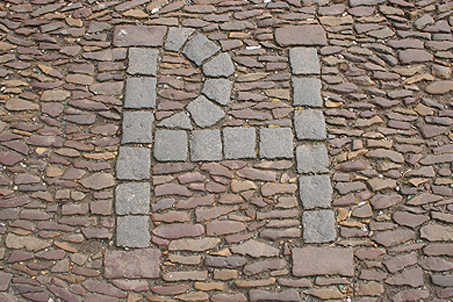
NOTE: We all have "second thoughts." For some of us, our "second thoughts" and regrets actually seem to precede our original thoughts and these are the things we carry around with us most often. However, if we all could express and deal with our second thoughts and revision exercises as well as Patrick Hamilton does here, I think the world would be a better, calmer, saner place. The "PH" stone monogram immediately above this note was a fortuitous discovery and, unlike the London "blue plaque" placed on Patrick Hamilton's former 2 Burlington Gardens, Chiswick W4 residence, isn't connected with the 20th century British author at all. Rather, it marks the place of execution by burning of the first Scottish martyr of the Reformation, Patrick Hamilton, in 1528, which took place at St. Salvator's Chapel, St. Andrews. This Patrick Hamilton was a protege of Martin Luther and wrote a book, 'Commonplaces' that sought to explain the doctrine of justification by faith, and was influential in the development of Scottish Protestant theology.