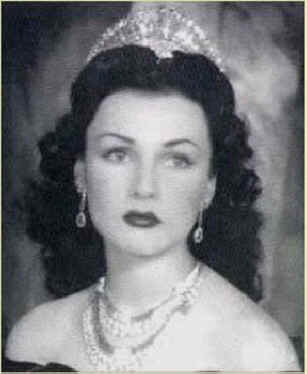
H.R.H. Princess Marina, Duchess of Kent, in 1940, "whose nobility was printed on features of the utmost refinement" -- Harold Acton (photograph by Dorothy Widing)
In view of the imminence of next week's royal wedding in Great Britain, I thought I would offer my acknowledgment of the grand event here by posting an excerpt or two from Sophia Watson's highly interesting, entertaining, and at times very moving 1994 biography of Great Britain's much-beloved Princess Marina, Duchess of Kent (1906-68), the great-great aunt of Prince William, to whom she is related through both Queen Elizabeth II and her husband, Prince Philip, the Duke of Edinburgh.

H.R.H. Prince George, Duke of Kent, 1920s by Paul Tanqueray
Born Princess Marina of Greece and Denmark, the glamorous wife (and then young and lifelong war widow) of the somewhat tragicomic Prince George (Duke of Kent and younger brother of Kings Edward VIII and George VI), Princess Marina's and Prince George's November 29, 1934 wedding ceremony at Westminster Abbey was the first royal wedding to be broadcast live over radio throughout Europe, which The Times' wireless correspondent described as an "unparalleled technical feat" on the part of the BBC.

The Duke and Duchess of Kent, October 1934 (photogravure after Dorothy Widing)
Sophia Watson describes Princess Marina's background as follows in her introductory chapter, "The World Into Which Marina Was Born":
"Marina of Greece was in fact anything and everything but Greek. Her mother, Grand Duchess Helen and paternal grandmother, Queen Olga, were Russian. Her paternal grandfather, George I of Greece was born Danish and her maternal grandmother was a German duchess of Mecklenburg-Schwerin. Yet her father, Prince Nicholas of Greece, had been brought up to regard himself as Greek and, as the historian C.M. Woodhouse declares, ‘the only practicable definition of a Greek is that he is somebody who thinks he is a Greek.’ To that extent Marina was a Greek until the day she died.

Royal Palace in Athens, 1920s
Prince Michael of Greece wrote:
‘The Greek royal family is the fruit of an unlikely union, a union between the descendants of Vikings with those of antiquity and Byzantium. Yet, as frequently occurs in such odd alliances, the result has been, and still remains, a happy one. Although we did not start in Greece we belong to Greece. Unless one speaks with a racial bias, Greekness does not imply membership in an ethnic group. On the contrary, it always used to mean (and, I like to think, it still does mean) partaking in a certain spiritual outlook, religion and language; sharing a common body of knowledge and appreciation of a way of life.’
Greece has had a troubled recent history, and to understand its ups and downs one must look further back than Marina’s immediate family. Throughout the centuries boundaries changed and different nationalities emigrated to Greece, adding their blood and cultures to the ancient Hellenic race. Despite, or because of, their mixed blood the Greeks are a fiercely patriotic breed."

Concert at the Royal Palace in Athens, 1907
During the course of her 62 year life, in addition to her many royal engagements and duties, and her service as the longtime president of the All England Tennis and Croquet Club in Wimbledon, Princess Marina was awarded the following official honors:
British Honours
CI: Companion of the Order of the Crown of India
GCVO: Dame Grand Cross of the Royal Victorian Order
GBE: Dame Grand Cross of the Order of the British Empire
GCStJ: Dame Grand Cross of the Order of St. John of Jerusalem
Royal Family Order of King George V
Royal Family Order of King George VI
Royal Family Order of Queen Elizabeth II
Foreign Honours
Greece: The Order of St. Olga and St. Sophia, 1st Class
Greece: Grand Cross of the Order of Beneficence
Mexico: Grand Cross of the Order of the Aztec Eagle
Peru: Grand Cross of the Order of the Sun of Peru
Chile: Grand Cross of the Order of Merit
Brazil: Grand Cross of the Order of the Southern Cross
Argentina: Grand Cross of the Order of Liberator San Martin
Honorary Military Appointments:
Colonel-in-Chief of The Kent Regiment
Colonel-in-Chief of The Queen's Own Royal West Kent Regiment
Colonel-in-Chief of The Dorset Regiment
Colonel-in-Chief of The Essex and Kent Scottish Regiment
Colonel-in-Chief of The Devonshire and Dorset Regiment
Colonel-in-Chief of the Corps of Royal Electrical and Mechanical Engineers
Colonel-in-Chief of The Queen's Regiment (Allied)
Honorary Colonel of the Buckinghamshire Battalion, The Oxfordshire and Buckinghamshire Light Infantry
Honorary Colonel of the 4th Battalion, The Oxfordshire and Buckinghamshire Light Infantry
Honorary Colonel of the 431 LAA Regiment RA
Honorary Colonel of the 299th (Royal Buckinghamshire Yeomanry, Queen's Own Oxfordshire Hussars, and Berkshire) Field Regiment, RA
Honorary Colonel of the Buckinghamshire Regiment, RA (Territorials)
Colonel of the Queen's Own Buffs
Honorary Commandant of the Women's Royal Australian Naval Service

Text excerpted from: Sophia Watson, Marina: The Story of a Princess. London, Weidenfield & Nicholson, 1994.