Showing posts with label Kim Philby. Show all posts

Tuesday, July 1, 2014

COVER PERSONALITY


‘The first duty of an underground worker is to perfect not only his cover story but also his cover personality.’ (Kim Philby, My silent war. London, Panther, 1969, p. 180).

Saturday, July 27, 2013

WE CONTINUE TO BE INTERESTED (GUY BURGESS)


Guy Burgess and Tom Driberg in Moscow, mid-1950s

 
    Unlike the compliant Philby and the conformist Maclean, Burgess never pretended to enjoy the drab anonymity life in his Russian exile.  Moreover, he loved the system and hated the people.  According to the late Tom Driberg, who wrote his apologia and incidentally introduced him to the “large underground urinal”  in the centre of Moscow, which was “open all night and frequented by hundreds of questing Slav homosexuals,” the nonconformist Burgess nonetheless did command some respect from his official superiors.  His political flair had not come amiss early in 1956, after the Suez fiasco, and Eden’s enforced retirement, when Burgess had advised, contrary to the prevailing wisdom, that Macmillan, not R.A. Butler, would be Britain’s next Prime Minister.

   “How on earth did you get it right?” Driberg asked him.

   “Oh,” he replied, “from a study of the life of the great Lord Salisbury . . .”

From:  Andrew Boyle, The Fourth Man, New York, Dial Press, 1980.

Note:  This week I read a review of a new Kim Philby biography that doesn't sound particularly good in terms of providing new information or insights, but I expect I'll get around to reading it.  The new Amanda Knox autobiography sounds much better on that score. That being said, continued study and inquiry into the Burgess/Maclean/Philby/Blunt spy story and its penumbrae will always be rewarding on many levels.


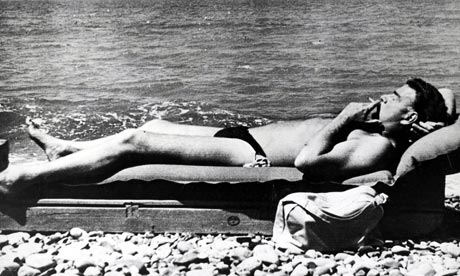
Guy Burgess vacationing on the Black Sea, mid-1950s


Monday, April 11, 2011

Disappointing. (Kim Philby In Moscow 1963-88)


          On his defection to Moscow in 1963, Philby had been dismayed to discover that he held only agent status in the KGB, did not hold officer rank and was not even allowed to set foot  inside the Lubyanka.  For the first five years of his Moscow exile, however, he was kept occupied by long debriefing sessions, helping to ghostwrite the memoirs of Konon Molody (published under his alias “Gordon Lonsdale”) and writing a sprightly, but tendentious memoir of his own career as a Soviet agent inside SIS, published in 1968 under the title of My Silent War.   Philby made no mention of the disappointments of his life in Moscow.  Instead, he claimed that , “As I look over Moscow from my study window, I can see the solid foundations of the future I glimpsed at Cambridge.”  Philby concluded his preface with words which were intended to inspire others:

"It is a sobering thought, that for the power of the Soviet Union and the Communist idea, the Old World, if not the whole world, would now be ruled by Hitler and Hirohito.  It is a matter of great pride to me that I was invited , at so early an age, to play my infinitesimal part in building up that power… When the proposition [to join Soviet intelligence] was made to me, I did not hesitate.  One does not look twice at an offer of enrollment in an elite force.”


Kim Philby photographed on the street in Moscow, 1970s


Lubyanka, KGB Headquarters (originally built as All Russian Insurance Company), before 1917. Click on photo to enlarge.


Kim Philby, USSR commemorative stamp, 1990


Excerpt: The Mitrokhin Archive and the Secret History of the KGB.
by Christopher Andrew and Vasili Mitrokhin, New York, Basic Books, 1999, page 415.