James Rosenquist. F-111 (detail from Section 3). 1964-65. Oil on canvas with aluminum, 23 sections. 10 x 86′ (304.8 x 2621.3 cm). The Museum of Modern Art, New York. Gift of Mr. and Mrs. Alex L. Hillman and Lillie P. Bliss Bequest (both by exchange).
NEW YORK, NY. (MOMA)-
James Rosenquist designed the eighty-six-foot-long F-111 to wrap around the four walls of the Leo Castelli Gallery, at 4 East Seventy-Seventh Street in Manhattan. He began the painting in 1964, in the middle of a turbulent decade marked by the escalating Vietnam War. Funded by citizens’ tax dollars, the F-111 fighter-bomber plane was being developed as the USA’s newest, most technologically advanced weapon. Rather than celebrate its military might, Rosenquist used the plane as a symbol of the economic implications of war. As it flies “through the flak of consumer society,” he later explained, the jet’s sharply pointed fuselage pierces superimposed images of commercial products and references to war, such as the bullet-shaped hair dryer floating above a young girl’s head and the atomic mushroom cloud frozen behind a beach umbrella. Through its expansive network of colliding visual motifs, unfolding across twenty-three panels, F-111 questions what the artist has described as “the collusion between the Vietnam death machine, consumerism, the media, and advertising.” Its jumps of scale, surprising juxtapositions of fragments of imagery, and vivid palette exemplify Rosenquist’s singular contribution to Pop art in the United States.

Section 1

Section 2

Section 3

F-111 is presented here as it was first exhibited at the Castelli Gallery in 1965, now also alongside a group of collages the artist made in preparation for this monumental composition. Rosenquist was well acquainted with painting on this immense scale: before becoming an artist he had earned a living as a billboard painter in New York City. Interested in the phenomenon of peripheral vision, Rosenquist wanted the painting to create an immersive environment that would heighten the viewer’s awareness of his or her own position in space. He cited artistic precedents for this ambition in works such as Claude Monet’s Water Lilies and the large horizontal paintings by Abstract Expressionist artists Jackson Pollock and Barnett Newman.

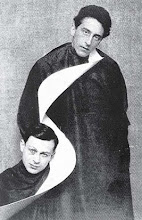
James Rosenquist photographed by Dennis Hopper, 1964
NOTE: This Museum of Modern Art press release announcing the exhibition of James Rosenquist's F-111 in proper wrap-around style along with some ancillary studies for the painting seemed like an appropriate item to re-circulate here, despite Blogger's scale, sizing and color limitations.
Among other things, Rosenquist's great painting stirs up many happy memories in me about my early days of discovering how great painting can be and how it can open your eyes to the world in different ways than literature and music. When I was in high school, my simultaneous exposure to and absorption of Pop art, Cubism, Dada and Surrealism propelled me into becoming the person I remain (at least what's left of him).
This morning I read a fairly recent interview with Rosenquist (who always gives trenchant interviews) denying (in a way that seems contrary to the MOMA quote included above) that he was expressing any specific dogmatic political views in this intense, dramatic work. The inquisitor was doubtful about this, but I'm not. For me, the power of Rosenquist's art is primarily visual, not literary or didactic, and comes from the way he forces pupils to open as wide as possible to take in and assimilate without barriers or impediments the power and scale of ocular experience. Overwhelming and jarring at first, structural significance, fine details and discernment come later.
Anyway, I haven't seen F-111 in person for quite some time and I'm looking forward to a visit. I expect I'll stop in at my onigiri place on W. 55th for lunch and fill the vacant spaces in my mind with other memories of hours spent at the Leo Castelli Gallery during its beautifully golden years.

James Rosenquist (aged 4) pictured with his parents, North Dakota, 1937

F-111 as originally exhibited at the Leo Castelli Gallery, New York City, 1965