Showing posts with label Heraclitus. Show all posts

Thursday, August 28, 2014

CATCHING


Late yesterday staring at Refdesk I noticed that it was Hegel’s birthday, which brought back volumes of unclear memories in sharp focus. 

Painfully I relived my lack of prowess and academic success as a philosophy minor, but also recalled how reading Hegel, on the one hand, and his ancient antecedents like Heraclitus, on the other, animated me and my thinking. 

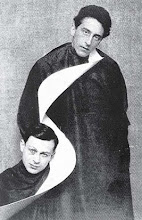
The brief Hegel reverie, vague as the crazy heat has rendered me, was a cool lucidity infusion.  I remembered (because I needed to) that insanity is catching, as in contagious.  I’ve always been able to draw a picture of this for the non-second sighted.  Now the picture draws itself.


Tuesday, November 20, 2012

Greek


Nothing will be said in this chapter about the development of the concept of the soul.  The Homeric idea of the psyche or breath-soul as an insubstantial image of the body, giving it life and surviving it in a wretched, bloodless existence in Hades, is too familiar to need description here.  Pythagoras was possibly the first Greek explicitly to treat the soul as something of moral importance, and Heraclitus first clearly indicated that some knowledge of the soul was relevant to knowledge of structure of the cosmos.


Yet the conception that the substance of the soul was related to aither, or to the substance of stars, seems from fifth-century B.C.  poetical contexts to have existed for some time already as part of the complex body of popular beliefs, alongside the distinct Homeric concept of a breath-soul.


G.S. Kirk and J.E. Raven, The Presocratic Philosophers, Cambridge, At The University Press, 1971

Wednesday, August 10, 2011

“Va t’en.” (Death Comes To Perigord 3)


     “Va t’en.”

         The command was hissed rather than spoken. But I had no intention of going before I had done my job, and as soothingly as possible told him so.  For now I felt sure that Le Marinel must have good reason for sending me the urgent message I had received, though to me it looked as if I might have been more usefully employed in examining into his mental rather than physical condition.  And examine him I did, in spite of all his expostulations.  His heart was certainly in a flutter; but that might be set down to his anger just as much to any cardiac weakness, for in other respects he was, for his age, in surprisingly sound condition.  He seemed, in fact, to be, with ordinary care, good enough for many years to come, and I could not see why I had been so urgently pressed by Le Marinel to go out that night.  The thought had puzzled me even before I left Perigord.


        Once I had done with the man I took up the candle from the bed side table with that little flurry of irritation a doctor is apt to experience in such cases.  Short of accident, many a much younger man would go before de Quettville.  The flutter at his heart was nothing.  He probably smoked too much.  All these Channel Islanders smoked too much:  tobacco was so cheap for them.  And my irritation over the needless call was certainly not lessened by contact with such an ill-mannered patient.  He had sunk back the moment I finished, and now reclined with closed eyes, his sharp nose and white night-cap silhouetted grotesquely in black against the bed curtain, the long beard showing like a waterfall.  But he was not asleep.  As I watched him with disfavor an eyelid fluttered and he waved a hand toward the door.

        “Va t’en,” he repeated crossly.