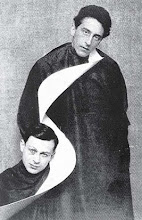
I am also that
shadow which follows me and which I flee.
Shadow of a
shadow, dancing on the ramshackle walls of chance, to the point of preceding me during those moments when
the heat on my back dissolves me in the sight of that frenzied caricature which
frightens me too much for me to laugh to my heart’s content.
Dream. In a telephone
booth in Les Halles. I’m waiting for a
call from who knows whom and who knows where.
A tinkling bell, comparable to those altar boys. I lift the receiver. At the end of the line, amidst the fizzling
sound of a Bickford fuse (at the same time, the idea of an enormous impending
danger), I catch the miniscule sound of a kiss imprinted on fingertips.
Dream. A woman of
about thirty, brunette, wearing a blood-red suit, is about to pass me on the
pavement of a violently sunlit street.
Deserted. I wish to turn back,
or at least to cross the street. But, as
it happens, I want to see what’s going to happen. Suddenly, at the moment she draws level with
me, she throws herself upon me, very nimbly, and kisses me on the right side of
my throat. A disagreeable sensation I
can’t describe. For the sake of saying
something, I say: “I could really do with a drink.”

Dream. A labyrinth of
dark corridors spiraling downwards.
Intestinal landscape. Impression
that I’m going to go on walking like this for eternity. How to get out? We carry on downwards (I say we because there’s an absolute crowd
thronging in these corridors, but in reality, all the time it’s me). Luxuriously comfortable cinemas as well as
immense urinal-cathedrals, feebly illuminated by neon open off these
sinuosities. The ground underfoot gives
the impression of walking on a raft of dropsical bellies. A whiff of sea breeze reaches me at the
precise moment I realize I am in a penal colony, condemned to forced labor for
life.
Lighting up the night only makes it more obvious.
Living is a kind of hide-and-seek. In seeking out ideas, men, and oneself, one
reckons to have a pretext for not getting lost or, at all events, in the masked
ball in which we are carried along, to find one’s clothes again in the
cloakroom.
It’s not the light that’s attracting me, but the darkness
that’s driving me on.
NOTE:
Julien Torma (April 6, 1902 – February 17, 1933) was a French writer, playwright and poet who was part of the Dadaist movement. He was born in Cambrai, France, and died in Tyrol.
A friend of Max Jacob and Robert Desnos, he was near the surrealist group without adhering to surrealism. He felt himself nearer to Alfred Jarry's 'pataphysics than André Breton's surrealism. Most of his writings were posthumously revealed by the French College of 'Pataphysique.
Julien Torma disappeared in the mounts of Tyrol at the age of 30. He possibly committed suicide.
Due to his elusive behaviour and the impossibility to check his life facts, it has been suggested many times that Julien Torma's existence may be entirely fictional. His purported birthday, April 6, is marked as "the birthday of pataphysics" in the "pataphysics calendar". Nevertheless, some believe that a real writer eager to create confusion authored the first four publications and Porte battantes.
Anyway, would the person be real, Torma has to be a pen name: according to the French institute for statistics INSEE, since 1891, only three Torma births have been recorded in France, all of them between 1941 and 1965 in the South-West.
Julien Torma texts excerpted from: Four Dada Suicides. London, Atlas Press, 1995.
Link: Torma 2 (Is This Real? Who Wrote This?)
Link: Torma 3 (Torma ! Torma!! Torma !!!)