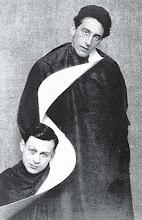
Rudy Burckhardt, Portrait of Edwin Denby
They say that You Can't Judge A Book By Its Cover (marvelous link here) and I suspect the same should be said about its Introduction (if it has
one).
It’s the actual text that you wanted, presumably, that you
sought out and purchased, and damn other people’s thoughts. You’d like to meet and spend time with the
author, not his or her cousin or dear friend.
I wanted to mention, however, that I recently read two
introductions to books, which are both simply superb.
T he first is Ron Padgett’s introduction to The Complete
Poems by Edwin Denby. The second is
Sean French’s essay that begins his biography, Patrick Hamilton, A Life.


Rudy Burckhardt, Pedestrians in Manhattan, 1938
Padgett’s and French’s pieces are both fairly long, but
utterly engrossing, reflecting each writers’ deep involvement with and knowledge
of their material and the passion that resulted in their shepherding
these works to press. Not
coincidentally, I think, both Denby and Hamilton, "city authors" who were hardly unknown in
their respective literary spheres, are writers who these guides feel have been injudiciously
overlooked and whose closer and more knowledgeable examination (in part by learning key facts about their lives) will profoundly reward readers.
Since I happen to own both books, I obviously agree, but I wanted you to know also.


Unknown photographer, Patrick Hamilton
As for “cover judgement,” the Edwin Denby portrait by his
close friend Rudy Burkhardt, which adorns the cover of The Complete Poems and appears at the top of this post, is a
remarkable image showing a handsome and distinguished man atop a city
which no longer exists except in the memories of a declining number of people. Teeming, densely populated Manhattan
actually looks dignified and hopeful, like a place where work can be accomplished,
pockets will not be picked, nor backs stabbed. The formal author portrait on
the cover of Patrick Hamilton, A Life (shown immediately above -- photographer, date and location all unknown) is almost heartbreaking in conveying a sense of
early accomplishment, future promise,
clear vision and, I think, the acute hearing that Claud Cockburn so memorably described in his introduction to The Slaves Of Solitude. Hamilton lived a fairly short, almost
ungovernable life. It may seem circular
reasoning, but one is left with the
feeling that his unique works couldn’t have emerged from any different set of
circumstances. Still, one is left with a sad, slightly queasy feeling
knowing that his autobiography (never completed) was to be called “Memoirs of a
Heavy Drinking Man.”
1. Edwin Denby, The Complete Poems, Edited and with an introduction by Ron Padgett and with essays by Frank O'Hara and Lincoln Kirstein. New York, Random House, 1986.
2. Sean French, Patrick Hamilton, A Life. London, Faber and Faber, 1993.
3. I was pleased to learn this morning that Faber & Faber will republish Patrick Hamilton's pioneering "graphic novel" Impromptu in Moribundia on November 17th, adding it to their previous release of Twopence Coloured in the Faber Finds series.
4. Sunday Morning -- Velvet Underground (link)

Piccadilly Circus, 1930 (c.f., Twenty Thousand Streets Under The Sky)

View from the top of the Parliament buildings, London 1958