Dover sole, "super-fish"
"On the day that Obama is to deliver his jobs speech to Congress, Bret Baier attends a secret White House meeting. Over Dover sole in the Red Room, the president tries to sell his $450 billion plan to a handful of anchors. The earnest, square-jawed Baier is animated upon returning, briefing two news executives in the hallway.
Obama
“painted a picture of a double-dip recession” and said if the bill “does
not get through, I will blame Republicans” for their “irresponsible
position,” Baier says, reading from his scribbled notes. Although the
two men clashed during an interview last year in which Baier repeatedly
interrupted the president, Obama made a point of praising the previous
Fox debate, telling Baier: “By the way, you guys did a great job in
Iowa.”

NOTE: It has been ages since I've enjoyed a dinner (never mind a lunch) of Dover sole. As Alan Davidson, the 20th century's leading writer on fish cookery, once observed, it is "the best fish," and ruinously expensive, always a "top of the menu" item, food literally fit for a king. (Please click on link above to be directed to the current Dover sole price guide for New York City restaurants.)
Davidson notes in North Atlantic Seafood [1]:
"The range of this super-fish is from the Mediterranean to the north of Scotland and the south of Norway. It is not present in the Baltic, except around the mouth of that sea. The best fishing grounds for it are in the North Sea and the Bay of Biscay. Dover is not its home in any exclusive sense, but was the best source of supply to the London market of freshly caught soles.


SMS Blucher in the process of capsizing during the Battle of Dogger Bank. This armoured German cruiser was sunk by the British Grand Fleet on April 24, 1915.

Embossed colored and illustrated 1917 postcard showing two young girls in Connaught Park, Dover, surrounded by a Dover sole "frame."
From "Roger's Reality Show," by Howard Kurtz
Newsweek, September 25, 2011

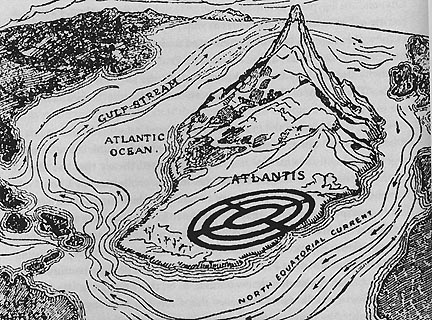
Dutch beam trawler dragging for Dover sole near Dogger Bank, North Sea. Dogger Bank has been suggested as the possible submerged location for the "lost continent" of Atlantis. In 1931, the largest earthquake ever recorded in the United
Kingdom took place below the bank, measuring 6.1 on the Richter scale.
NOTE: It has been ages since I've enjoyed a dinner (never mind a lunch) of Dover sole. As Alan Davidson, the 20th century's leading writer on fish cookery, once observed, it is "the best fish," and ruinously expensive, always a "top of the menu" item, food literally fit for a king. (Please click on link above to be directed to the current Dover sole price guide for New York City restaurants.)
Davidson notes in North Atlantic Seafood [1]:
"The range of this super-fish is from the Mediterranean to the north of Scotland and the south of Norway. It is not present in the Baltic, except around the mouth of that sea. The best fishing grounds for it are in the North Sea and the Bay of Biscay. Dover is not its home in any exclusive sense, but was the best source of supply to the London market of freshly caught soles.
Everyone knows how good the sole is, and it is never better than when plainly grilled and served with a simple garnish of lemon wedges. However, it is also very good when cooked a la meuniere; and the filets, which can be lifted off easily, may be used for a great variety of culinary feats. Most of these involve poaching them in a court-bouillon or wine and then dressing them with a sauce. Do so by all means, but do not complicate your fish unduly or risk masking the delicious flavour of the sole itself."
Dover sole on the sea floor
I wouldn't argue with a single word in Davidson's excellent description. I would like to suggest, however, that serving Dover sole at an event such as a deliberately ostentatious, "over the top", State Dinner would seem more appropriate, and less likely to provoke objection, than offering it to a group of journalists at a working lunch during severely straitened economic times in the U.S. on the cusp of delivering a speech about severely straitened economic times affecting most (but clearly not all) of the American people and then allowing publication of the menu in Newsweek.
Brill, megrim, scaldfish, topknot, plaice, flounder, dab, or lemon sole (to name some lesser flatfish) simply wouldn't do. Nor would the noble (and pricy) halibut or turbot -- it had to be solea solea, the true sole, whose name is derived from the Greek, "as the Greeks considered it would form a fit sandal for an ocean nymph." [2]
It forces one to ask, however, whether these people are crazy, stupid or both? It certainly tells you everything you need to know about their grasp on reality and what they think of you.
SMS Blucher in the process of capsizing during the Battle of Dogger Bank. This armoured German cruiser was sunk by the British Grand Fleet on April 24, 1915.
[1] Alan Davidson, North Atlantic Seafood, London, 1979.
[2] Francis Day, The Fishes of Great Britain and Ireland, Volumes I and II, London 1880-84.

Embossed colored and illustrated 1917 postcard showing two young girls in Connaught Park, Dover, surrounded by a Dover sole "frame."
9/27/11 Update: It was fascinating to me to (tediously) review Newsweek's "comment sewer" just now and observe not a single reader remark concerning the White House's regal menu for reporters. I guess providing $60-80 portions of Dover sole for luncheon guests is more common practice than I previously thought. I really should get out more. One wonders whether whole fish were deboned table-side or if the sole were filleted in advance? Also, which wine to serve? Personally, my favorite was always the M. Chapoutier "Chante Alouette" Hermitage Blanc, which I would dearly love to enjoy again. Shortly after completing this post today, I turned on the Morning "Limousine Liberal" Joe television program. They were discussing Howard Kurtz's article also and it wasn't a great surprise to find that the 3-star Michelin menu items went unnoticed at Domaine Lord Haw-Haw. Recessions and depressions go largely unnoticed among the fully-employed, I have found. "Bless you, Uncle Son. We won't forget you when the Revolution comes." (R. D. Davies)