Showing posts with label Arthur Edward Waite. Show all posts

Tuesday, November 22, 2011

Magic: My Fear Is For Those Who Fear Him (Eliphas Levi)


      For a great number of readers Magic is the science of the devil – even as the science of light is identified with that of darkness.  We confess boldly at the outset that we are not in terror of the devil.   “My fear is for those who fear him,” said St. Teresa.  But we testify also that he does not prompt our laughter and that the ridicule of which he is often the object seems to us exceedingly misplaced.  However this may be, it is our intention to bring him before the light of science.  But the devil and science – the apposition of two names so strangely incongruous – must seem to have disclosed the whole intent in view.  If the mystic personification of darkness be thus dragged into the light, is it not to annihilate the phantom of falsehood in the presence of truth? Is it not to dispel in the day all formless monsters of the night? Superficial persons will think so and will condemn without hearing.  Ill-instructed Christians will conclude that we are sapping the fundamental dogma of their ethics by decrying hell; and others will question the utility of combating error in which, as they imagine, no one believes longer.  It is, therefore, important to enunciate our object clearly and establish our principles solidly.


      We say, therefore, to Christians that the author of this book is a Christian like yourselves.  His faith is that of a catholic strongly and deeply convinced; for this reason he does not come forward to deny dogmas, but to combat impiety under its most pernicious forms, which are those of false belief and superstition.  He comes to drag from the darkness the black successor of Ahriman, in order to expose in broad day his colossal impotence and redoubtable misery.  He comes to make subject the  age-long problem of evil to the solutions of science, to uncrown the king of hell and bow down his head at the foot of the cross.  Is it not virginal and maternal science -- that science of which Mary is the sweet and luminous image – destined like her to crush the head of the old serpent?


NOTE:  I greatly enjoy reading Eliphas Levi's History of Magic in the kinetic A.E. Waite translation, but I would like to say that I object to the image of crushing "the head of the old serpent."  There are many serpents I like and admire.  Leave serpents alone.  There are enough human malefactors about.

Wednesday, April 6, 2011

Magic 3: The Magical Origin of Freemasonry (E. Levi; A.E. Waite)


Eliphas Levi (Alphonse Louis Constant) in 1878 


        That great Kabalistical association known in Europe under the name of Masonry appeared suddenly in the world when revolt against the Church had just succeeded in dismembering Christian unity.  The historians of the Order are one and all in a difficulty when seeking to explain its origin.  


Eliphas Levi (Alphonse Louis Constant) in 1848  


        According to one, it derived from a certain guild of Masons who were incorporated for the construction of the cathedral of Strasburg.   Others refer its foundation to Cromwell, without pausing to consider whether the Rites of English Masonry in the days of the Protector were not more probably developed as a counterblast to this leader of Puritanical anarchy.  In fine, some are so ignorant that they attribute to the Jesuits the maintenance and direction, if not indeed the invention, of a society long preserved in secret and always wrapped in mystery (1). 


Strasbourg Cathedral, constructed 1015-1439; from 1647-1874, the world's tallest building.


Pulpit at Strasbourg Cathedral attracting a ray of green light, 2009


        Setting aside this last view, which refutes itself, we can reconcile the others by admitting that the Masonic Brethren borrowed their name and some emblems of their art from the builders of Strasburg cathedral, and that their first public manifestation took place in England, owing to radical institutions and in spite of Cromwell’s despotism.   It may be added that the Templars were their models, the Rosicrucians their immediate progenitors (2), and the Johannite sectarians their more remote ancestors. 


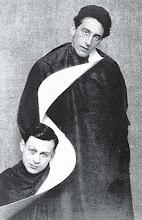
Arthur Edward Waite, co-creator of the Rider-Waite Tarot deck, author of its companion volume, the Key to the Tarot, and translator and annotator of Eliphas Levi's The History of Magic, in early adulthood (date and photographer unknown).


        Their doctrine is that of Zoroaster and of Hermes, their law is progressive initiation, their principle is equality – regulated by the hierarchy and universal fraternity.  They are successors of the school of Alexandria, as of all antique initiations, custodians of the secrets of the Apocalypse and the Zohar. Truth is the object of their worship and they represent truth as light;  they tolerate all forms of faith, profess one philosophy, seek truth only, teach reality, and their plan is to lead all human intelligence by gradual steps into the domain of reason.


Arthur Edward Waite in 1915.  Photographic portrait by E.O. Hoppe*.


NOTES BY ARTHUR EDWARD WAITE


(     (1) This remark, in which I concur unreservedly, may be noted by students of Masonic history as an offset against the pretentious nonsense which has been talked on the subject by French makers of fable and especially J.M. Ragon**, the dullest and most imbecile of all.
      
              (2) This opinion is showing signs of recrudescence at the present day, and it is well to say that there is no evidence to support it.   

       ACravan Notes:    

 *  For more examples of Emil Otto Hoppe (1878-1972) photographs, see here. 

** Waite is referring to Jean-Marie Ragon, author of Orthodoxe Maconnique (Suivie de la Maconnerie Oculte et de l'Initiation Hermetique).  Paris, E. Dentu, 1853. Should any reader wish to peruse this book, a copy is available here.

fR 

      Excerpt from: Eliphas Levi (Alphonse Louis Constant), The History of Magic.  New York, Samuel Weiser, 1971.   Translated, with a Preface and Notes, by Arthur Edward Waite.