Friday, March 11, 2011

The Passive Voice (Moonmad)


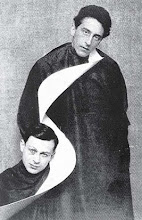
Max Ernst, The King Plays With A Queen, 1944 (bronze cast 1954)


        Last night in bed, while I was wrestling with an upsetting late-in- the-day development, one of Tom Clark’s short “parts of speech” poems came into my head.  Called “Verbs”, it  goes: “Verbs/ do/ the heavy/ lifting.”

        I think about this one often because it hits the mark as a description of good writing (at least in terms of one of its indispensible ingredients).  It also says something important about life.

        As I recall, it was during Watergate that political discourse seemed suddenly to shift from the active to the passive voice.  People no longer acted.  Instead, things simply "occurred" without anyone "doing" them. "Mistakes were made" became a kind of news mantra. When prior descriptions and explanations required revision, they weren't specifically withdrawn and then replaced or supplemented. They became "no longer operative”.  

        Eventually, we all washed up on the wretched shores of “plausible deniability”, the logical result of people refusing (without saying so) to take affirmative responsibility for actions and consequences.  

        The "occurrence" I mentioned was of this nature.  The passive voice usage in question was “fell through the cracks”. Its context was a teacher’s insufficiently embarrassed explanation of her apparent total inattention to an important aspect of my daughter’s life and education. 

        Although the situation isn’t hopeless or even life-threatening, it is maddening.  

        Given the choice, I would like to drop the polite act and give this teacher a vivid piece of my mind.

        It’s 5 am and I just encountered Caroline in the kitchen, something that hasn't happened since the long-ago days when we might be arriving home at this hour.  She’s equally restive and enervated.

        We’re at a Crossroads.


Max Ernst, Moonmad, 1944 (bronze cast 1956)

Thursday, March 10, 2011

Presence Of The Lord -- Eric Clapton's Guitars and Amps Make $2.15 Million at Charity Auction in New York


From ArtDaily.org, 3-10-11


        "Collectors, fans and musicians alike gathered yesterday (9.3.11) at Bonhams New York to celebrate the rock icon, Eric Clapton, whose personal collection of 75 guitars and 55 amps were auctioned off to benefit The Crossroads Centre in Antigua. 

        With 100% of the lots sold, the final auction total more than tripled pre-sale expectations, with proceeds going to the drug and alcohol rehabilitation centre founded by Clapton in 1998. Bidders from all four corners of the globe battled throughout the 4 ½ hour auction and included clients from the U.S., Asia, Australasia, UK, Europe, and the Caribbean. Notably, a private Russian Eric Clapton fan and collector showed keen interest in the room and Asian participants included those from Japan, Korea and Hong Kong."


        Jon Baddeley, Worldwide Head of Collectables at Bonhams, "It has been a privilege and an honour working on this exceptional sale and being associated with one of the most iconic living musicians, Eric Clapton. Arguably the greatest guitarist of all time, Eric Clapton inspires an ever-expanding fan base many of whom made the journey to Bonhams in New York over the past few days and joined us for this remarkable auction. We were delighted to play our part in raising funds for The Crossroads Centre, a charity with a noble mission and a cause that remains very close to Eric's heart." 

        Guitar highlights included a 1948 Gibson L-5P, estimated at $20,000-30,000 that sold for a staggering $82,960; and a 2005 Zemaitis S22BP 3S, estimated at $12,000-18,000, which sold for $75,640. The top amp of the sale was a pair of 1997 Fender Twin Amps, estimated at $9,000-12,000, sold for $42,700."


Reader NoteI love ArtDaily.org and auctions are part of their beat, but minor news indeed. $42,700 for a pair of 1997 Fender amps?  I just don't know "collectables", I guess, or how anyone can use the phrase "most iconic".  Still, when we visited Antigua a number of years ago, I did hear that Eric Clapton's drug treatment facility did outstanding work (Antigua, we found, a propos of basically nothing, like this article, has the best yogurt in the world; you can see the contented Antigua cows all over its scrubby, grassy pasture land), so I suppose this is for a good cause.  It also goes to prove something I've always been told about successful rock musicians -- their favorite instruments tend to be the ones they've most recently acquired.  

Please see below a nice early shot of Eric with Cream.  Please see also a rather ridiculous 2005 shot of the Great Man either sharing a genuinely enjoyable moment (a troubling thought) or a slightly uncomfortable one with HRH Prince Charles, musician/television presenter Jools Holland and comedian/actor/author Stephen Fry.


Star Quality -- Steller's Sea Eagles (Orlan and Caspian)


        I first met Orlan and Caspian, the handsome pair of Steller's Sea Eagles in the Edinburgh Zoo who are pictured above and below, on Jane's 8th birthday, August 29, 2006.  It was unforgettable.

        An eagle, once sighted either at a distance or (especially) up close, commands your visual and mental field for quite a while and persists in memory long after you've left his company.  Orlan and Caspian have never left mine.

        The Steller's Sea Eagle (named for naturalist Georg Wilhelm Steller) is enormous -- the biggest bird in the genus Haliaeetus and one of the largest raptors overall.

        Their typical size range is 85 to 110 centimetres (33 to 43 in) long and the wingspan is 195 to 300 centimetres (77 to 120 in). Females typically weigh from 6.8 to 9 kilograms (15 to 20 lb), while males are considerably lighter with a weight range from 4.9 to 6 kilograms (11 to 13 lb).  An unverified record exists of a huge female who, apparently gorged on salmon, weighed 12.7 kilograms (28 lb).

        Steller's Sea Eagles' massive nests are build on cliffs, often near seabird colonies. Inland, they will utilize large pine trees near rivers or lakes.  The birds' diet varies by location, but largely features fish and seabirds.
    
        The eagles' large size suggests that they are a glacial relict, a remnant of a formerly widespread species that persists in an isolated area, who evolved in a narrow subarctic zone of the northeasternmost Asian coasts.  The Steller's bird is unique among all sea eagles in having a yellow bill, even in juvenile birds, and possessing 14, not 12, rectrices, or tail flight feathers. The skull and bill are the largest of any eagle and are comparable to the largest Old World vultures, the biggest of the accipitrids.

        Steller's Sea Eagle is classified as "Vulnerable" by the International Union for Conservation of Nature and Natural Resources (IUCN), meaning that they face a high rate of extinction in the wild.  They are protected by law throughhout their range. In Japan they are officially designated as a "National Monument".  The current population of Steller's Sea Eagles is 5,000 (and decreasing).  They are threatened by habitat loss due to hydro-electric, logging and coastal development, over-fishing, pollution and human disturbance, especially in their nesting areas.

        Steller's Sea Eagles have been found in North America but these are considered to be individual eagles that have strayed from Asia. They are not known to nest anywhere in North America.

    Reader Note:        

Our visit to Edinburgh, its zoo (the penguins are truly remarkable there; see penguin cam) and Martin Wishart's marvelous restaurant in the Port of Leith, where we celebrated Jane's birthday dinner, were all memorable and we hope to return there soon in order to visit Orlan, Caspian and the Vane Farm Bumble Bee Sanctuary in Kinross,  the first bee reserve of its kind in the world.   From there we will travel north again to Loch Ness, where it would be nice to stay a while.  I would also like to drink another Caledonian 80/- (pronounced "80 shilling").  You can't get in the the U.S. and it is truly great.


Wednesday, March 9, 2011

I Shall Be Released


          They say everything can be replaced.


        They say every distance is not near.


        So I remember every face,


        Of every man who put me here.


Tuesday, March 8, 2011

My Delicate Childhood (Blue Trout and Black Truffles)


Joseph Wechsberg in Ostrava at 2 years old


        "The food in our home was distinguished only for its monotony.   The menu for the noon meal was planned for weeks ahead.  Every Monday, Tuesday, Wednesday, and Thursday we had consommĂ© and boiled beef with vegetables (Monday: carrots; Tuesday: spinach; Wednesday: cabbage; Thursday: peas), followed by a dessert.  Friday we had fish and on Saturday a roast.


Hoop-Cheese Dumplings


Bohemian Dalken


        Today I know that the cooked Mehlspeisen of my delicate childhood are gastronomic delights.  I can think of nothing better than povidla-tascherln, hoop-cheese dumplings, Bohemian Dalken, Palatschinken (pancakes), Kaiserschmarren, Apfel im Schalfrock (“apples in dressing gown,” fried apple slices), Schusterbuben (“shoemaker’s boys”, a sort of potato noodles).  But at home I hated them.  I would have hated Sevluga caviar and Chateau Margaux 1899 if I’d had them five times a week.


Apfel im Schalfrock


Kaiserschmarren
 

        On Fridays we had fish and I was afraid of fish.  I’d almost choked to death on a carp bone, an episode known in our house as the-day-he-got-blue-in-his-face.  On Sundays the main dish was Wiener Schnitzel.  The religious split in town ran straight through the populace’s Sunday menu:  the Jews had Wiener Schnitzel, the Gentiles had roast pork with sauerkraut and dumplings. 

        It was customary to have five meals a day.   Breakfast was at half-past seven in the morning.  At ten-o’clock, children had their dejeuner a la fourchette, sandwiches, sausages, hard-boiled eggs, fruit.  Many men would go for half an hour to the beerhouse for a goulash or a dish of calf’s lungs and a glass of beer.  Between ten and ten-thirty little work was done in offices and shops; everyone was out eating. Two hours later, people were having lunch – at home, since eating lunch in a restaurant was unknown – and afterward they had a nap. Then to the coffeehouse for a demitasse and a game of whist or bridge, and back to the saltmines for an hour’s work.


Jause


        It was a strenuous life and around four-thirty in the afternoon most people were hungry again and had to have their Jause.  A genuine central-European Jause consists of several large cups of coffee, topped up with whipped cream, of bread and butter, Torte or Guglhupf (the bizarre Viennese variation of a pound cake shaped like a derby on which several people have been sitting), and assorted patisserie.  It is a feminine institution and my mother didn’t mind skipping lunch and dinner but she had to have her Jause.  She would often complain that she gained weight “practically from nothing”, but it couldn’t be the Jause, she said; you didn’t gain weight from the Jause.


Gugelhupf


Karlsbad Spa, 1910 postcard 


        What with appetizers and hors d’oeuvres and a sumptuous dinner, many people had to go to Karlsbad once a year to take the cure, lose fifteen pounds, and get in shape again for another year of arduous eating."


Text excerpted from Joseph Wechsberg, Blue Trout and Black Truffles. New York, Alfred A. Knopf, 1954

 
        Reader Note:  I have been aware of Joseph Wechsberg's memoir, Blue Trout and Black Truffles, and the affection that many people have for it, since I was very young.  The book was in my parents' library and my mother discussed it with me, but I had never read any part of it until recently.  It really is marvelous.

        The excerpt above, taken from the chapter My Delicate Childhood, appealed to me because it reminded me of things my friend Ulrich Pendl (who would have been one of the Gentiles living in the same area of German-speaking Czechoslovakia as Wechsberg, who was Jewish) has told me over the years about  aspects of his own childhood, particularly the happy times before the Second World War, which brought ruin, misery and permanent dislocation to so many.  The fond and detailed food memories -- the abundance, the richness, the elegance and the fantastic-sounding names of the various dishes -- inform the mind, delight the inward eye and lift the spirits.  (Readers' outward eyes will need to rely on enticing photographs like those illustrating this article, including the food and the "exotic" travel photos below, for their uplifting and delight.)

        Wechsberg's biography is fascinating and instructive also.  Schooled and qualified as a lawyer in Czechoslovakia, with solid and serious musical training (and eventually owning a Stradivarius violin and a Peccate bow),  Wechsberg came to the United States ahead of World War II  following extensive travels in Asia during the 1930s.   After fulfilling his ambition of securing a journalist's berth at the New Yorker magazine, where he wrote on a variety of subjects, he served with distinction in the United States Army and later on the U.S. War Crimes Commission and in OSS intelligence. In some ways, Wechsberg's life brings to (my) mind Casablanca (Paul Henried, Claude Rains, Humphrey Bogart and all), The Third Man and foggy and sunny Central Europe.

        Wechsberg also wrote The Murderers Among Us: The Simon Wiesenthal Memoirs, considered important for the early details it provided about how much of the Nazi political machine was preserved in Germany, and also through asylum overseas in Argentina, Chile, and Paraguay.

         Joseph Wechsberg's work and his life story fills corporate mouse lawyers like myself with admiration, a little jealousy and a lot of appreciation.  I suggest that you visit the excellent Joseph Wechsberg tribute website to gain a fuller picture of the man.


Masarykplatz, Ostrava, 1910 


Djibouti marketplace, 1930 


Washing an elephant, Colombo, Ceylon, May 1930 (click on photo to enlarge)


Der Bund, Shanghai, June 6, 1930


Oran, Easter Sunday, 1939 


"Theodore Kaghan (l.) and J.Wechsberg meet furtively in a dark corner of Arlberg-Orient Express before Wechsberg’s departure for Budapest and Bucharest where he was invited by Red Rumanian government. Content of conversation was not overheard. Presumably further strategy was being discussed. Kaghan has admitted to living for nine months with known Communist (male), in early thirties. Wechsberg admits to like Malosol caviar and boeuf Stroganoff, in early fifties. Picture was snapped by State Department’s “mystery” photographer. "


With Clark Gable


With Henri SoulĂ© (middle) and Mr.O’Connor, manager of the Ritz Carlton, prior to a party given for the publication of Dining at the Pavillon in 1962


Monday, March 7, 2011

There Is A Charm In Solitude That Cheers (John Clare)


There is a charm in Solitude that cheers
A feeling that the world knows nothing of
A green delight the wounded mind endears
After the hustling world is broken off
Whose whole delight was crime at good to scoff
Green solitude his prison pleasure yields
The bitch fox heeds him not -- birds seem to laugh
He lives the Crusoe of his lonely fields
Which dark green oaks his noontide leisure shields


John Clare poem composed before 1856; First published 1949
From John Clare -- Selected Poetry and Prose. Methuen, London, 1986 (ed. Merryn and Raymond Williams).

More on this here.
And here. 
Finally here. 

Sunday, March 6, 2011

On Sunday, March 6th, We Sighted Our First Spring Flowers


        Today, Sunday March 6, brought us our first spring flowers.         

        In addition to snowdrops (or snowsprites -- see above), winterberries (see below) and crocuses, our Easter hyacinth, which we gave to Jane three years ago as a remembrance of our dear cat Pansy, is beginning to poke up.


               Things are a bit scrubby now, of course, but this is a lovely development -- the best, really -- and makes us very happy.