Tuesday, December 7, 2010

Letter of Transit


     There are times when you ride the train in the early morning and it's all grotesques.


Vincent Van Gogh, Prisoners Exercising (After Dore), 1888 


     Residual, slight self-awareness quietly tells you that this is an unfair, possibly inaccurate, judgement.  On these days, to the extent you retain (and wish to retain) any small sense of self-containment, the disconnected endings that seem to protrude from every point tear, abraid, and “put paid” to that.  You become entrapped in a collective, unhappy and bothering, unconscious. 


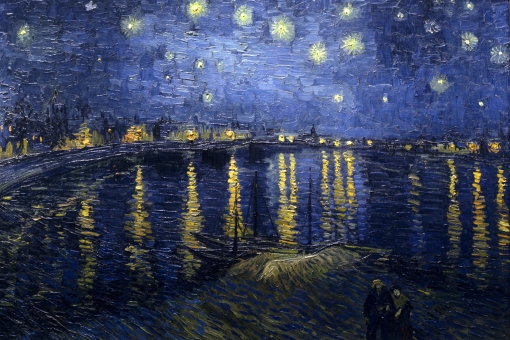
Vincent Van Gogh, Starry Night Over The Rhone, 1888


     Steps that take you from home to terminus (not yours) are like climbing a defense wall studded with glass shards or penetrating razor wire. Remembering that you actually pay (a great deal) for this experience lends, as a poet once wrote, comedy to shame.

     Every single building and still unlighted window seen across the river from the train reminds of an unacknowledged telephone call or unanswered letter.  Long Shot Kick De Bucket by The Pioneers comes to mind.   All your pens stop working at exactly the moment you finish finally drafting the grim letter you've been carrying around in your head.  


      Cold, no coat; mislaid and misremembered address, purpose for the day and conviction.  At the next terminus (not yours), terrible food made of oddly assorted ingredients is on sale in ugly stores at prices that recall childhood “Your Weight On Jupiter” exhibits.  I feel like a fish swimming in the wrong kind of water.


Vincent Van Gogh, Wheatfield With Crows, 1890


     Many hours later the phone rings and Jane has a question. (The only good part of cell phones is hearing from your daughter or wife.  Everything else can be handled in due course.)  Let Your Yeah Be Yeah (Pioneers) comes to mind along with a memorable passage I cannot quite remember from Henry Green about dangers inherent in leaving the house, recommending  the “oblique approach in middle age” and ending “the unusual at this period is to get anywhere at all—God damn!”   There was also something about loving your family and your cats.


Only an approximation of the wonder that follows


     This is the basic version of a Christmas cookie recipe we make every year, which may have  a couple of secret chef variations (I believe the French call these trucs) that I’m not aware of because I’m not the baker.  We served these the other night and our guests ate with greater pleasure than I can recall seeing on view anywhere during the entire year 2010:

Almond Spritz Cookies 

1. Preheat oven to 350 degrees.

2. Combine 4 1/2 cups flour with 1/2 teaspoon salt.

3.  Cream together (using standing or hand mixer) with 1 1/2 cups sugar and 2 cups butter.

4.  Add 4 egg yolks, 2 teaspoons almond extract, green food coloring and stir into flour mixture.

5.  Put dough through cookie press (we use a Christmas tree shape) onto ungreased cookie sheet.  Paint carefully with reserved egg whites and decorate as desired. (Take care not to drip egg white onto sides of cookies or cookie sheet as it will make cookies stick and break.)

6. Bake about 10 minutes.


Van Gogh at 13, 1866


Arles Arena

Monday, December 6, 2010

The Wind in the Portico 2


I scrambled along the sedgy margin, not daring to lift my eyes till I was on the temple steps.


     The place was brighter than day with a roaring blast of fire.  The very air seemed to be incandescent and to have become a flaming ether.  And yet there were no flames -- only a burning brightness.  I could not enter, for the waft from it struck my face like a scorching hand and I felt my hair singe....


      I am short-sighted, as you know, and I may have been mistaken, but this is what I think I saw.  From the altar a great tongue of flame seemed to shoot upwards and lick the roof, and from its pediment ran flaming streams.  In front of it lay a body -- Dubellay's -- a naked body, already charred and black.  There was nothing else, except that the Gorgon's head in the wall seemed to glow like a sun in hell.


Sunday, December 5, 2010

Salted Almonds (Elizabeth David) & Flavored Vodkas (Christmas Is Approaching)


  Christmas Day in Cairo
 
     What follows below is Elizabeth David's recipe for Salted Almonds, which appears in the Savouries section of her book Spices, Salt and Aromatics in the English Kitchen (London, Penguin, 1970).

     For me, it is the finest piece of food writing ever and my favorite example of her work.

     On a practical level, it is a simple, complete and superb recipe for a Christmas season staple in our house  (although salted almonds, obviously, can be eaten year-round).  Caroline and I associate salted almonds with memories of her mother, who made them according to a traditional family recipe.  She would give them to us every year as a Christmas gift.  Eventually, we started doing the same for our friends after we discovered this recipe, which works equally well with macadamia nuts. (Roasted salted macadamia nuts, offered as gifts, secure friendships for life.)

     Another nice small and easily prepared home-made Christmas gift are flavored vodkas.  We buy pint-size bottles of Stolichnaya vodka, whose naturally vanillin flavor works particularly well for this, and in them macerate variously raspberries, blueberries, sections of clementine or whole vanilla beans.  The idea is to allow the fruit or spice to flavor the vodka for a week or so before wrapping them and giving them away.  The flavor is excellent and much better than the now-ubiquitous commercial varieties of these liquors.


    The raspberry variety is especially nice.  When the bottle is slightly shaken by the recipient upon opening or use, the vodka takes on the most beautiful and attractive pink tint.  The flavor is pure and not overly sweet because no additional sweetening, other than the fruit itself,  is used.  You can also prepare a spicy vodka using dried cayenne peppers, but that takes a little bit of trial and error in order to be semi-certain you've created a palatable concoction.

     Your friends will tend to think you're a genius and and compliment you excessively, but preparing these is  really easy to do.  You need to pour off vodka from each pint bottle to allow room for the flavoring, which means you must collect the extra vodka in another vessel and have it available for topping up bottles as needed.  For the sake of economy, in addition to the pint bottles (which you may need to order in advance from your liquor store), you should also buy a very large-format Stolichnaya bottle for this purpose.  You will also probably want to prepare  a fifth or liter bottle of each flavor for yourself, both to enjoy during the season and to monitor the progress of the current year's products.  Needless to say, there's a tipsy-making element to preparing flavored vodkas that you don't encounter in the salted almond manufacturing process.  (Friends don't let friends man the flavored vodka production line alone.)


Elizabeth David: Salted Almonds

With drinks, the cashews and peanuts of commerce make wretched substitutes for salted almonds; and salted almonds, whatever words held out by the words vacuum-sealed or oven-fresh on tins and jars are not to be bought.  They must be prepared at home, and on the day they are to be eaten.  Five or six hours after the almonds come out of the oven they are at their best.  Within twenty-four hours they have already lost their pristine freshness.  It is, goodness knows, easy to prepare almonds for salting.  They cost half the price of salted almonds in jars or tins and taste twice as good.

     If blanched whole almonds are not to be found, the skinning process is a matter of minutes.  Plunge the almonds into boiling water.  When the water has again boiled, turn the almonds out into a colander.  When they are still warm, slip off the skins.  This part of the operation can be done in advance.

     All that is needed apart from the blanched almonds is an oven, a baking tin, kitchen salt and kitchen paper, and if possible, a tiny phial of sweet almond oil bought from the chemist, and cayenne pepper in a sprinkler.  Butter, very highly refined olive oil or deodorized ground-nut oil will pass instead of almond oil.  Corn oil, with its detestable taste and greasy cling, will not pass for this, nor so far as I am concerned, for any other purpose whatsoever.


     It was a Sudanese cook called Suliman who cooked for me in Egypt, who discovered how the best salted almonds are made.  Suliman used not more than a teaspoon of almond oil or butter per half pound of blanched almonds, and it does not matter whether Valencia or Jordan almonds are used.  What you do is to put the prepared almonds in a baking tin rubbed with the oil or butter.  The tin then goes into the centre of a very slow oven (the oven in my Cairo kitchen was a tin box perched over a primus stove.  The magic of this primitive device can be very well reproduced with any gas, solid fuel, or electric oven at a temperature of approximately gas No. 2 or 210 degrees F.) and there leave it for about 45 minutes until the almonds are pale toast color.  Have ready on the table a sheet of greaseproof paper and some perfectly ordinary kitchen block salt (about three tablespoons to the half pound) or if you prefer, gros sel.  Free-running table salt is to be avoided for this purpose.  Empty the toasted almonds on to the paper.  Swish them round in the salt. Gather up the corners of the paper and twist them so that you have a tightly fastened little parcel which you put away in a drawer, or in the kitchen cupboard.  This part of the ritual is not so much a matter of witchcraft as of plain common sense. In my experience, it is necessary to conceal salted almonds from all eyes until the appropriate time comes for them to be produced.  Nothing yet invented sets the gastric juices to work as the sight of a plateful of freshly toasted and salted almonds.  Even to say the words or see them written does the trick.  (Whoever thought of calling the cocktail bar at the old Trocadero the Salted Almond knew a thing or two.)  Left where anybody can see them, a pound of salted almonds will be devoured within fifteen minutes.

     When therefore the moment to set out the almonds arrives, unwrap the parcel, shake the almonds free of excess salt and over them shake an infinitesimal sprinkling of cayenne pepper.  


     There is very little question of salted almonds left over from one evening being produced again the next.  There never are any left over.  Should there be, re-toast them in a slow oven -- but they will not be the same.  Suliman used to put any left over into a rice dish.  And he could not be persuaded to make salted almonds in a hurry.   He held it essential to give them their few hours in the salt.  He was right.  The important points about salted almonds are that they must be so dry from the slow toasting in the oven that they squeak as you bite into them; at the same time they must be salty in taste but not to the extent that their own flavour is killed. 


Nilometer, Egyptian Museum, Cairo


A cat named Cairo

The Wind in the The Portico

  
"Rome only sleeps",  he said;  "she never dies".

     Nightingale nodded.  "Sometimes she dreams in her sleep and talks.  Once she scared me out of my senses". 


Saturday, December 4, 2010

A Decline In The Cultural Level -- Ancient Radio Play vs. Harry Potter and the Deathly Hallows


Sydney Greenstreet as Nero Wolfe

     A chance encounter with a 60-year old radio play while driving early yesterday morning turned the rest of my day into a fevered search for a half-remembered literary citation.

     The radio play, entitled The Final Page, was a semi-silly, but highly enjoyable detective mystery featuring Rex Stout’s famous Nero Wolfe character.  It was originally broadcast on the NBC radio network on March 23, 1951 and told the story of Wolfe solving the murder of a writer friend who had “finally met a deadline”.
 
     The famous English actor with the unforgettable voice and elegant (and equally unforgettable) physical presence, Sydney Greenstreet, played Nero Wolfe, described in the show’s spoken introduction as “a chair-borne mass of unpredictable intellect”.


Sydney Greenstreet in his most famous role, Kasper Gutman, in The Maltese Falcon (1941) 

     
     What made The Final Page so terrific was its coherence, its quality of execution and its respect for the audience’s time and intelligence.  The writing was economical, sharp and amusing (which is not to say that it was a literary masterpiece), the acting (lead and character) was uniformly excellent and conveyed the mystery story with vigor and pace through the players’ clear diction and the musicality of their voices, and the show’s creators focused on giving the audience just enough in order to leave them wanting more.   The total harmonious effect was achieved using only dialogue, a simple musical score and very basic sound effects.


Nero Wolfe was an orchid fancier


 Nero Wolfe loved beer.


     I couldn’t help but contrasting the quality of the ancient production, which seems fairly typical of radio plays of all genres I’ve been listening to for the past year on satellite radio, with the great mass of contemporary tv and movie junk I encounter during my personal forays into those media, as well as the shows and films I see with my 13-year old daughter.

     The literary citation I was looking for and eventually found was a line of poetry written by the 20th century American Ezra Pound, taken from his Canto LXXXI.  It reads simply “What counts is the cultural level”.


     I first saw a reference to it in Tom Clark’s Beyond The Pale blog of last August 21st called Wild Life: WPA Posters, 1936-40, which provided a memorable look at tourism posters created by artists working for the United States government’s WPA program during the Great Depression.

     In a responsive comment to a reader, discussing factors he thought made it unlikely that we would ever see  this poster program’s record of artistic high achievement repeated in our lifetimes, Clark referred to “the decline in what Pound once called ‘the cultural level’”. The comment struck me as true and stuck with me.


Ezra Pound (1885-1972)

     First,  I would like to say that you should definitely check out Wild Life by clicking on the link provided above.  The poster artwork selected and displayed is a surprise and a delight.  I had no idea that such powerful, yet essentially lighthearted images formed part of the WPA art heritage.  (Like most people, I think, I tend to associate the program with more portentous, serious fare.)

     What makes Wild Life relevant to me as a point of reference is that when evaluating “the cultural level”, I think you need to look at the middle spectrum of art and entertainment (i.e., the bread and butter fare people seek for their daily amusement and diversion), such as tourism posters of marginal commercial value,  as a barometer, rather than at the supposed “high quality”, more rarefied end of things, such as avant-garde art that is by its nature controversial and whose merits are likely to be debated for a long time after the works in question are created. (A recent example that is important to me are the two Chris Burden pieces, Trans-Fixion and Shoot, from the early 1970s, which I included in this space last week to illustrate a painful personal experience. I had been thinking about Burden’s work since the 1970s without resolving my thoughts and feelings about it.  Only last week did these pieces come into focus for me as communicating a sort of intense “cry of pain/ primitive blues” feeling that I found resonant and thought was applicable to what I was trying to say.  I fully recognize that there will always be people who think these extreme works are repellent and worthless.)

     Accordingly, it seems legitimate to compare the Nero Wolfe show (acting as a stand-in for all classic radio, which I recognize is not entirely legitimate) with the current immensely popular movie, Harry Potter And The Deathly Hallows, Part 1.


     Our family has seen all of the earlier movies in this series and found them fairly enjoyable, if a little corny, cheesy and ersatz.  (Which is to say that they don’t measure up to Peter Jackson’s work on Lord Of The Rings, but they’re a great deal better than the somnolent, less-than-skin-deep Twilight pictures.)

    However, in terms of the three positive qualities cited above in support of the Nero Wolfe show --  coherence, quality of execution and respect for the audience’s time and intelligence – the Harry Potter film is a piece of junk that signifies a decline in the cultural level.

     I haven’t read any of J.K. Rowling’s original Harry Potter novels, so I cannot say whether the movie is more or less coherent than the source material, but that doesn’t really matter.  It’s an incoherent film from the moment it begins its non-exposition until it reaches its non-conclusion.  Like some other "Better Living Through Chemistry" inventions, it is more like getting on a modern fairground ride (shiny, fast, smooth and ultimately unmemorable) than embarking on a journey you long for, one which calls to you that you hope will take you  to an unknown, unpredictable destination, which is what I usually desire in any work of art.


The slogan "Better Living Through Chemistry" originated at DuPont and was modified and adopted by other companies.
 

     The Deathly Hallows’ quality of execution is fairly poor on all levels.  Variety, the entertainment industry trade paper, awarded it the usual “tech credits excellent” line of praise, a judgement that is fairly meaningless in the contemporary movie world.  The men and women creating the special effects are obviously gifted, but their work is meant to serve the story, rather than serve as the story.   In any event, on the “SFX” score the film is no Matrix or Independence Day and it minimizes the impact of the impressive effects it does use through excessive repetition.


     The script and the quality of acting are mostly execrable, meaning that in addition to the illogical plotting and sequencing  (leading to audience confusion and boredom; the formula is now to insert a chase scene and/or employ a magic wand to blow something up while figuring out where to go next in the story), the lines are uniformly flat and pointless when spoken by any of the three sadly untalented lead actors (whose performances have each sunk to new lows in this film) or, even more unfortunately, by the extremely talented group of British lead and character actors who make up the rest of the cast and are woefully underused. (I believe the always great Alan Rickman appears in two scenes only.)

     A clear and despicable sign of awful film making or fiction writing is when a creator kills off a character the audience has grown to know and like arbitrarily.  Such acts of disposal acknowledge that that the character isn’t real, but only a prop, merely a way of getting from Point A to Point B. This essentially describes the entire trajectory and purpose of this movie, which functions primarily as a transition device to the series’ conclusion in the forthcoming Part 2.


Real world special effect, July 2007, Glasgow, Montana (Sean Heavey)  

     In Harry Potter and the Deathly Hallows, the expendable victim is Harry's owl Hedwig.  In prior films, this mysterious and self-possessed creature seemed (as owls generally do) to have authority, her own story and some important role to play in the future.  In The Deathly Hallows, Hedwig is killed off, virtually unnoticed, unremarked on and unlamented during the initial 5-10 minutes in the first of the picture’s many pointless, unexciting chase scenes.

     This event, treating the death of an important character as mere “collateral damage” (at best), is the clearest indication to me of the film’s lack of respect for its audience’s time, intelligence and, finally, its pocketbooks.  It is contemptible and I hope the owls of the world take notice and retaliate. That would be a movie worth seeing.


Real world special effect, July 2007, Glasgow, Montana (Sean Heavey)

     Over the past year I’ve recommended to Jane, who is handy with home recording equipment and an artistic person as well, that she and her friends develop radio plays for school projects and simply for fun.   The Harry Potter films prove again that having a large budget is no substitute for imagination and discipline. Listening to the radio, I can close my eyes and, aided by the writers, actors, musicians and directors, summon up a real world that in turn suggests other real worlds.  If I am ever again forced  to watch a movie actor tap-tapping on a computer keyboard or goonishly staring into a monitor, signifying that fundamental actuating events of  life are occurring, I think I will give up going to the cinema forever. (At today’s ticket and snack prices, that’s probably a very good idea and a might be a blessing in disguise.


Sydney Greenstreet as Nero Wolfe, NBC Radio publicity photo


     You can’t cheat emotion and real audience engagement in this way on radio, of course.  It forces creators to use the virtual colors available to them in different, interesting and unexpected ways.  In some respects, as with beautiful black & white film, the medium's potential is inherent in and proceeds from its limitations.


Stranger than fiction


     I know Armageddon (even worse than a decline in the cultural level) seems to be upon us when we’re subjected daily and repeatedly to those television commercials featuring G. Gordon Liddy selling gold for Rosland Capital.  (What hath God wrought?)

     But I’m hanging on to hope, nonetheless.


Ezra Pound, Vortograph by Alvin Langdon Coburn (1916-17)

Thursday, December 2, 2010

Rose (Bat-Girl) -- Meglio Solo, Part 2


Rose Roberts
 

     It's quite early in the morning and I've just met, as I do every day at this hour, my cat Rose in my office. Apart from our broader, deeper relationship, we are partners at Outlier Entertainment, my small independent entertainment firm, and we work the same long shift every day sitting facing each other across the room. 

     The Outlier Entertainment logo shown below might also be called "Portrait of Rose" because the concepts it illustrates -- an "object situated away from other main bodies" and "a person whose residence and place of business are at a distance" -- pretty well describes Rose's status and position in space vis-a-vis the other members of our household.  As the needlepoint pillow inscription clearly states, Rose prefers to be alone than in bad company.


Outlier Entertainment Group logo    


     Rose is a kind, serious and, obviously, beautiful creature.  She is 13 now, our oldest cat.  She and her sister Pansy were the first cats we adopted after finally losing our dear U and Santa.  It is always difficult and confusing beginning a new family after a hard loss, but we were luckier than we ever imagined or could have hoped for, meeting and joining up with these two beautiful and spirited sisters from Nashville who were very close, but utterly different in personality. 


Rose and Pansy as kittens climbing up my leg at 510 East 86th Street, New York, New York
     

     Rose has never been wholly supportive of our large-scale cat adoption program, although she has tolerated it.  She has old-fashioned good manners and a dramatic sense of decorum (the kind you only see in 1930s black & white "high society" movies or theater revivals these days) and she chooses her friends carefully.   She is by no means a snob. Although she loves Claude, our family's aristocrat cream-colored Persian with the "Burke's Peerage" set of  bloodlines, she has equal affection for our large tabby Eddie, who lived outside for several years in dire conditions, exposed to harsh weather, everyday danger and disease.  Her feelings about the others range from (sometimes amused) indifference for the "kids" (Bunny, Junior, and Princess Daisy) and the several ferals who stay in the basement, to quiet hostility for Felix, our bruiser, mostly Maine Coon male, who I like quite a bit, but admit is deficient in the "going along to get along" department.


Spicy Detective Stories, July 1942, "Blood for the 'Bat-Girl'"


     Caroline felt that my post about Rose last weekend, which I intended to be a pure portrait-plus-title moment, provided readers kind enough to visit this page insufficient detail regarding this remarkable girl and I agree.  You would all definitely love mysterious Rose.  Apart from her unique Bat-Girl mask, deep green eyes and even deeper purr, her speaking voice, which has a unique "tearing paper set to music" quality, both guides you around the house like a flashlight in the dark and provides constant and ample food for thought.  Rose really holds up her end of the conversation.  


Outside of Nashville, Tennessee (Leiper's Fork), where Rose and Pansy were born


     Not only is Rose the first thing I see in the morning and the last thing I see at night, but she was also the first element of our new family life that Jane experienced when we returned from China in the fall of 1998.  We were very slightly worried that our infant daughter might either be allergic to or not care for cats, but when we opened the apartment door that night on East 86th Street after weeks in Asia, and Rose and Pansy, also babies still, greeted us, the look of surprise and cry of delight from Jane and the chorus of their three voices are things we will never forget and will always be grateful for.     


You are dismissed.

Wednesday, December 1, 2010

Eve Of Destruction (No Matter Who You Vote For, The Government Always Gets In)


Lord John Emerich Edward Dalberg-Acton, 1st Baron Acton (1834-1902)
     
     I have tried to keep this blog as non-political as possible because my thoughts regarding politics are fairly settled and static. Essentially, they boil down a belief in Lord Acton's dictum that "power tends to corrupt, and absolute power corrupts absolutely", supplemented by Pete Townshend's pronouncement: "meet the new boss, same as the old boss".

     I would rather try to use my imagination more flexibly on subjects that seem to invite and welcome flexion and reflection, however successful or unsuccessful I might be in my efforts on any given day.

     But the recent (unrelated) matters of Rep.Charles Rangel's disgrace and the current Wikileaks fiasco are so dispiriting.


Charles Rangel fingerpointing

     Rangel is, of course, a poster figure phony at best, who exploited his youthful good achievements and talents (if you live a long life, as the congressman has, resting on the 50-year old laurels of a distinguished service record in Korean war no longer cuts it on a per se basis) for purposes of amassing personal wealth disproportionate to the his official public official's salary level and securing for himself until now unassailable and virtually impregnable stature and status as part of the "permanent government." 


Charles Rangel resting from his fingerpointing labors
     
     Until this year, when his larceny was brought to light and proven, attacking Rangel for any reason would have incited false charges of racism. This, despite the sorry figure he has cut for decades serving as the personally ambitious congressman for the economically depressed Manhattan ghetto (New York Times Metro section and real estate Gazeteer stories to the contrary, notwithstanding) so powerfully depicted in the tragic film New Jack City.  As a former New York prosecutor during the early days of the crack epidemic, as well as a longtime New York resident, I am amazed that Rangel's professional inadequacies (in terms of their sheer obviousness) are never spoken of by the claque of journalists so anxious to amplify the congressman's "I am such a nice guy" (although there is ample evidence in the record that he really isn't) statements and comment instead on his natty attire. I mean, apart from taking routine Caribbean corporate junkets to visit his offshore investments, feathering his own nest by acquiring additional rent controlled New York City real estate, parking his disused, engine-out  Mercedes sedan free for more than a decade on the public dime in the congressional garage, evading and violating the provisions of the tax code he has, in part, written and overseen, and planning his eponymous CUNY mausoleum (it's hard to think of it as a think tank), what were exactly Rangel's constituent-oriented priorities over the course of his career?  When the roll call of brave and great 20th and 21st century civil rights leaders is collated and recited, does anybody imagine that it will actually include Rep. Charles Rangel (D-NY, 15th District)? 

     Like Richard  Nixon, spared prison and, in fact, pardoned, when so many underlings in his administration were incarcerated, the difference between you, I and Charlie Rangel is that if we had done what he did, we would be rotting in jail, despised and quickly forgotten.  As sarcastic, rueful jokes so often end, "is this a great country or what?"  And as the Scottish novelist, Muriel Spark wrote perfectly: "All politicians simply want to manipulate people; that mixed with a marked tendency to kleptomania".


Pvt. First Class Bradley E. Manning, U.S. Army

     As for Wikileaks, one needs to contrast the amorality and apparent psychopathy and delusions of grandeur of Julian Assange and Private First Class Bradley E. Manning (about both of whom it has usefully been asked, why don't you guys first train your efforts on non-democratic, despotic regimes and then attack imperfect, but clearly preferable nations containing large populations of actual flesh and blood, non-fat cat, non-government stooge, people who are not cardboard cutouts, stick figures or digital images populating your fantasy mental shooter games?) with the fecklessness of the United States government, including its State, Defense and Justice departments, in this matter.


Julian Assange, Wikileaks

     I could cite revealing passages from Sergey Nechaev and John Most, among others, contained in Part II (The Origins of Modern Terrorism) of Walter Lacquer's very fine Terrorism Reader to illustrate where Assange's and Manning's heads are at (although Assange and Manning both seem to lack the literary powers of these 19th century terrorists).  Still, from Assange's weird, affectless but enervated manner and the dumb, endlessly recycled news image of Pvt. Manning, supplemented by yesterday's CNN reports about his background and possible motivations, which are sure to stir up a hornet's nest of rancor and confusion, one can imagine both men endorsing the chilling, taunting  Khmer Rouge slogan and warning:  "Losing you is no loss; keeping you is no particular gain."

     Regarding our own culpable and incompetent public officials, who oversee the ridiculous scrivening of  "Dear Diary"-style self-aggrandizing and indiscreet memos, which are then published in insecure and seemingly unedited cable traffic, it seems as though, despite all the enormous (both on a percentage and actual dollar level amounts) public sector pay raises our government has enacted, they haven't yet produced, or even procured at an inflated price, better diplomatic mousetraps.

    Incompetence isn't a sin; neither is it a virtue.  And this isn't volunteer work. Results count.

    Barry McGuire had it right in Eve Of Destruction:  You might leave here for four days in space, but when you return it's the same old place.  As we all say in French, diplomacy's former language (since replaced by gibberish),  plus ca change, plus c'est la meme chose.


Bonzo Dog Band, London, 1968 


     And as the great, great Bonzo Dog Band said in their 1988 reunion single (Neil Innes, Vivian Stanshall and most original hands on board):

No Matter Who You Vote For, The Government Always Gets In 


Khmer Rouge handiwork


Eve of Destruction logotype


That's it, I promise. I'm returning to happier pastures.