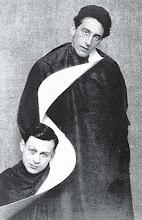
I fight in red for the same reasons That Garibaldi chose the red shirt
-- Because a
few men in a field wearing red
Look like many men -- if there are
ten you will think There are a hundred; if a hundred You will believe them a thousand. And the colour of red dances in the
enemy's rifle sights And his aim will be bad – But, best
reason of all, A man in a red shirt can neither hide nor
retreat.
Street
demonstration, Nevskii Prospect, Petrograd, July 4, 1917, just after troops of the Provisional
Government opened fire with machine guns.
The Bolshevik party had been marching
toward the seizure of power, with its astonishing steadfastness, lucidity and
skill, ever since the fall of the autocracy.
To be convinced of this it is necessary simply to read Letters From Afar, written by Lenin before
his departure from Zurich in March 1917.
But perhaps, like any historical definition that tries to be precise,
that is too narrow a statement. The
party had been marching towards power ever since the day when its obscure
Central Committee of émigrés (like Lenin and Zinoviev) declared, in 1914, that‘imperialist
war must be translated into civil war,’ or since the even earlier day when it
was born as a party of civil war at the London Congress of 1903.
Petrograd
Military Committee of the Bolsheviks, 1917. Standing: Galkin, Kedrov,
Paniushkin. Seated: Orlov, Mekhenoshin, Nevskii, Podvoiskii, Dashkevich,
Raskolnikov
When Lenin arrived in Petrograd on 3
April, 1917, he proceeded to amend the political line of the party’s central
newspaper ; this done, he set about
defining the objectives of the working class.
Tirelessly he urged the Bolshevik militants to use persuasion to win the
working masses. In the first days of
July when an infuriated popular upsurge broke for the first time against the
Kerensky administration, the Bolsheviks refused to follow this movement. These are leaders, in the real sense of the
word, who are refusing to be led.
Vladimir Tatlin, Proposed Monument to the Third International in Petrograd, 1920
Excerpt fromVictor Serge, Year One Of The Russian Revolution, translated and edited by Peter Sedgwick, Chicago, Holt Rinehart & Winston, 1972
I'm not sure what caused me to think about Vladimir Tatlin this morning,
but once I did I began to retrace paths I hadn't taken for years. It was
nice being reminded of many things I had forgotten about this highly appealing
and inspiring artist and also a little bit sad to find that I was unable to
unearth my favorite Tatlin quote concerning his Daedelus-like flying machine,
the Letatlin. (The quote was an exhortation, sort of along the lines of Edgard
Varese's "the present-day composer refuses to die", but more broadly
pitched, positive and utopian.) In any event, posting these Tatlin images
on the cusp of Labor Day seems appropriate.
Vladimir Tatlin -- Letatlin flying machine (1932)
I first became enthusiastic about Tatlin and some of the other Russian
Constructivists in college and I wrote a seminar paper about the movement that
actually seemed pretty good when I reread it about 10 years ago. It's my
loss, not the world's, that I misplaced the paper, but I would really like to
see the illustrations (and to retrieve that quote) again. I once
worked in an office building in Manhattan that boasted a wall sculpture by Naum
Gabo and an enormous wall mosaic by Joseph Albers. A friend, who had
become enthusiastic about Constructivism, and who now works for a law firm in
the same building, asked me what had happened to the Gabo and Albers?
(Apparently, during the building's interior transformation from the very
1960s-like Celanese Building to its current 21st century incarnation as the
News Corp. Building -- the owners, ironically, of 20th Century Fox -- both
pieces had been removed). I told him that I didn't know. He also
asked whether the Gabo was a really good one. I told him that it
wasn't and that the piece had aged badly (meaning that the physical materials
were looking worn and dirty when they were meant to look eternally shiny and
modern), but that working in a building with a mediocre Gabo was much better
than working in one with no Gabo at all.
Vladimir Tatlin -- Monument to the Third International (1920) ("The
first Russian monument without a beard" -- Vladimir Mayakovsky)
"Lynton
concludes that Tatlin, commissioned in the aftermath of the first world war,
must have known from the outset that the monument in these photographs could
never be built. The real fulfillment - itself by turns brash and complex,
polemical and poetic - of his architectural ambition is to be found instead in
the written responses to the scheme. Official reactions were guarded; Trotsky
applauded the artist's rejection of traditional forms, but (rather stating the
obvious) wondered if the tower didn't look like so much "unremoved
scaffolding". The novelist and journalist Ilya Ehrenburg approved of the
design, but wrote that most Bolsheviks still preferred the old plaster heads.
Tatlin, however, had his champions, notably the critic Nikolai Punin, who
hymned the tower as "a synthesis of the different types of art" and
welcomed the aesthetic cleansing of old forms: 'the charred ruins of Europe are
now being cleared.'
The tower was
an iron stanza scrawled across the frozen cityscape. In other words, it was a complexly readable object in a way that
advanced writers of the era hoped their works might become. It referred back to
numerous precursors, and forward to several possible futures. It conjured
architectural wonders both ancient and modern, real and imagined. It resembled
the Tower of Babel, the Colossus of Rhodes, the Pharos lighthouse at
Alexandria, the emblematic landmarks of Pisa and Paris. It could even be viewed
as a diagram of the thrusting gesture of the Statue of Liberty. At the same
time, as the architectural critic Owen Hatherley has pointed out recently in
his book Militant Modernism, the Russian avant garde was transfixed by the
mythology of the red planet - the tower is also a Martian invention, bestriding
St Petersburg like a tripod from The War of the Worlds" -- Brian
Dillon, The Guardian -- 7-25-09