Showing posts with label Max Ernst. Show all posts
Sunday, June 9, 2013
IFFY
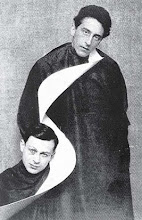
Given the renewed hue and cry erupting, flowing, sneaking and surveilling in the direction of "Tea Party types," one wonders what today’s "powers that be" would make of a really iffy personality like Max Ernst?
Iam glad not to know. I would hate for Mr. Ernst to let me down (as most of our creative artists eventually do) by being co-opted, brought to heel, in pages of People or Vanity Fair celebrity coverage.
And as a Quaker and, I hope, a good American, I would dislike seeing the full force of Ernst’s art and power make the surveillers heads explode like Scanners.
Labels:
La Femme 100 Tetes (1930),
Max Ernst,
People,
Scanners,
Vanity Fair
Saturday, June 9, 2012
Moon-Sane
24.
Awed by her splendor
Stars near the lovely
moon cover their own
bright faces
when she
is roundest and lights
earth with her silver
Best Days in June 2012
Below are the best days for activities, based on the Moon's sign
and phase in June.
For Cutting Hay:
- 12, 13
For Setting Eggs:
- 8, 9
For Fishing:
- 1–4, 19–30
Poem:
Sappho.
Activity suggestions: Farmers
Almanac.
Illustrations:
Upper: Vincent Van
Gogh, Starry Night Over The Rhône.
Second: Georges Rouault,
Christ On The Outskirts.
Third: Leonardo da
Vinci, Drawing Of The Moon.
Below: Caspar David Friedrich, Man and Woman Contemplating The Moon.
NOTE: I once
posted a piece called Moonmad, which
took its night-title from a mysterious, chthonic Max Ernst cast
bronze sculpture to which I appended a crazed, but justified,
ranting series of complaints. This
Sappho fragment finds (or renders) me Moon-Sane
instead.
I wish I had posted this earlier and I apologize to anyone possibly interested in fishing
and egg-setting moments passed. I’m happy to learn there are future June dates to pursue these activities.
This poem and these pictures right my skiff tonight.
Friday, November 18, 2011
Animated Doll
I never knew how little I knew
But it’s getting though to me now.
Nothing I do of the little I do
Seems to ring true to me now.
Commitment evades me
I don’t feel involved at all.
I’m just going through the motions
Like an animated doll.
I never knew. I never
knew.
I never knew how lucky I was
Maybe nobody does when they’re young.
A couple mistakes, that’s all it takes
You can never erase what you’ve done.
Now I can fake a range of feelings
I can weep like a waterfall.
You’d never guess that you were dealing
With an animated doll.
I never knew. I never
knew.
The mind in my skull exerts a powerful pull
Like the pull of the moon on the tides.
Like my heart in its cage
And though neither can gauge
Clearly enough to be guides.
Where they’ll lead I’ll follow
I will follow till I fall.
Head and heart as hollow
As an animated doll.
Saturday, October 1, 2011
First Exhibition In Switzerland Devoted To Surrealism Opens At Fondation Beyeler In Basel
A
visitor looks at an artwork, titled The Artist's Atelier (1929), by
Spanish artist Pablo Picasso (1881-1973) during the press preview of the
exhibition 'Surrealism in Paris' at the Fondation Beyeler in Riehen
near Basel, Switzerland, 30 September 2011. The exhibition opens to the
public from 02 October 2011 to 29 January 2012. EPA/WALTER BIERI.
BASEL.-
"The Fondation Beyeler
is devoting the first-ever comprehensive exhibition in Switzerland to
Surrealism in Paris. On view will be major works by artists such as
Salvador DalÃ, Joan Miró, Max Ernst, and many more who either belonged
to the movement or were associated with it. The show will focus on the
innovative forms of expression developed and employed by the Surrealists
– especially object art, collage, photography and film.
Surrealism was one of the most crucial artistic and literary
movements of the twentieth century. After emerging in Paris in 1924, it
unfolded a worldwide effect that continues to this day. Major modern
artists belonged to the movement, were associated with it, or inspired
by it. Its aim was radical change and expansion of the expressive means
of art and poetry and their impact on society. Aspects of the psyche and
creativity that had previously lay fallow were to be made fertile for
artistic activity and human life as a whole.
Profoundly shaken by the experience of the First World War and under
the leadership of its chief theoretician, André Breton, the Surrealists
developed innovative approaches and lent form to an art that tapped
poetic imagination, the world of dreams, and the unconscious mind. Their
idols included Sigmund Freud and many writers, such as the scandalous Marquis de Sade, the poets Charles Baudelaire, Comte de Lautréamont, and Arthur Rimbaud, Edgar Allan Poe, and the German Romantics.
"DalÃ, Magritte, Miró – Surrealism in Paris" comprises about 290
masterworks and manuscripts by about 40 artists and authors. These
include approximately 110 paintings, 30 objects and sculptures, 50 works
on paper, 50 photographs, 30 manuscripts and original editions, 15
pieces of jewelry and four films. The exhibits are arranged in the
exhibition spaces partly by artist, partly by theme. The introduction is
provided by Giorgio de Chirico, a pioneering predecessor of Surrealism
whose cityscapes and interiors of the 1910s can be considered decisive
forerunners of the movement. On view as well are valuable manuscripts
and editions of Surrealist texts, including manuscript versions of
Breton's manifestos.
A further emphasis is placed on two major artists of the movement,
Joan Miró and Max Ernst. Miró, who opened out entirely new spaces for
modern art with his hovering dreamlike colored configurations, is
represented by works such as Painting (The Circus Horse), 1927, from the
Metropolitan Museum of Art,
New York, and Ernst by superb works such as the renowned Wavering Woman
(The Slanting Woman), 1923, from the Kunstsammlung NordrheinWestfalen,
Düsseldorf. Then follows a room devoted to Yves Tanguy, whose imaginary
spaces populated by mysterious objects – as in the monumental The Last
Days, 1944, from a private collection – represent one of the most poetic
evocations in all Surrealism. The next space is devoted to a key
Surrealist medium – the object. The works on view include Meret
Oppenheim's famous Ma gouvernante - My Nurse - Mein Kindermädchen,
1936/1967, from the Moderna Museet Stockholm, and Hans Bellmer's major
object The Doll, 1935-36, from the Centre Georges Pompidou, Paris. Also
brought together here are major drawings and paintings by Victor
Brauner.
A special feature of the exhibition is the inclusion of two superb
private collections of Surrealism. The presentation of that of André
Breton and his first wife, Simone Collinet, represents a premiere. The
couple amassed the collection in the 1920s, and after they separated
Collinet expanded her share. Among the works in the collection are
Francis Picabia's large-scale painting Judith, 1929, and de Chirico's
The Evil Genius of a King, 1914-15, now in the Museum of Modern Art, New
York. On view in a second room are outstanding works from the Peggy
Guggenheim Collection, including Max Ernst's The Antipope, 1941-42,
which the Peggy Guggenheim Collection in Venice seldom permits to travel.
These works constitute an ensemble within the exhibition in which the
period of the Surrealists' New York exile during World War II is
virtually distilled. In addition, the presentation of the two
collections permits us to highlight key aspects of private stagings of Surrealist art.
The artists prominently represented in further rooms include Hans
Arp, and not least Pablo Picasso, who for a time was closely associated
with Surrealism. On view is his highly Surrealist painting The Artist's
Studio (The Open Window), 1929. This is followed by an outstanding group
of works by the visual magician René Magritte. In an inimitable way,
Magritte's art captures visual reality only to subvert it again. Fine
examples are the early The Interpretation of Dreams, 1930, and later
major works such as The Dominion of Light, 1962, both from private
collections.
A concise selection of outstanding Surrealist photographs, including
works by Man Ray, Raoul Ubac, Dora Maar, and Eli Lotar rounds off the
picture. A screening room presents key works of Surrealist cinematic
art, including ones by Luis Buñuel and Man Ray.
The exhibition concludes with the artist who is likely the most
famous Surrealist of all, Salvador DalÃ. A spectacular group of his
masterpieces on view here includes The Enigma of Desire, 1929, from the
Pinakothek der Moderne, Munich, the outstanding Metamorphosis of
Narcissus, 1937, from the Tate London, and Dream Caused by the Flight of a Bee around a Pomegranate, one Second before Awakening, 1944, from the Museo Thyssen Bornemisza in Madrid.
The exhibition links up with previous Galerie Beyeler and Fondation
Beyeler projects. Ernst Beyeler early on devoted various exhibitions to
Surrealism in his Basel gallery, including the 1947 "Surréalisme et
peinture" and the 1995-96 "Surrealismus: Traum des Jahrhunderts," as
well as to individual representatives of the movement, bringing his
unique eye for this art into play. Accordingly, the Beyeler Collection
now boasts key works by such artists as Arp, Ernst, Miró and Picasso.
The Fondation Beyeler can likewise look back on shows of Surrealist art,
including "Calder, Miró", 2004, "Picasso surreal," 2005, "René
Magritte: The Key to Dreams", 2005, and, with some Surrealist works,
"Giacometti", 2009. These were supplemented by thematic exhibitions in
which Surrealist art prominently figured. The current extensive
Surrealism exhibition provides a panoramic view of the movement as a
whole.
The exhibition is curated by Philippe Büttner, Fondation Beyeler Curator."
A visitor stands in front of an artwork,
titled Vogeldenkmal (1927), by German artist Max Ernst (1891-1946)
during the press preview of the exhibition 'Surrealism in Paris' at the
Fondation Beyeler in Riehen near Basel, Switzerland, 30 September 2011.
The exhibition opens to the public from 02 October 2011 to 29 January
2012. EPA/WALTER BIERI.
NOTE: This is definitely a "lazy" re-post (first day of Q4; feeling fatigued), but I wanted to pass it along because it looks like an extremely worthwhile, enjoyable presentation of important 20th century art. Given the contributions of the famous Swiss Surrealists Arp, Oppenheim and Bellmer, I am extremely surprised that Switzerland waited so long to accord Surrealism its "inaugural retrospective," but I'm glad they finally addressed this, better late than never. And although I myself won't be attending the show, I'd like to think that by spreading the word, someone who might not otherwise be aware of it will. The opportunity to see the integral Breton-Collinet collection alone would justify the excursion to Basel. Here is a Link to the Fondation Beyeler website giving more details.
Personally, if I were able to attend, I would plan my trip around Jane Birkin's live appearance at the museum on November 6th or, possibly, just plan to spend Christmas and New Year in the home of cuckoo clocks and Swiss chocolate.
Mental travel is all very nice, and I can picture the exhibition in my head, but I would dearly love to fly to Basel and see the show in person. I haven't been on a plane for a while, but last night watched "Inception" again and took that long, surreal, intensely moving plane and head journey.
Following below to round out this communique are an atmospheric television interview with Max Ernst from 1959 and a link to "Bee Dream" by Peter Blegvad, a song and performance that definitely fit the Surrealist mood, style and method.
Monday, August 1, 2011
TORMA ! TORMA !! TORMA !!! ("efface the trace of a dreadful past")
I. My opinon of nature:
The feet try in vain to tempt the ground; it is a sated belly, refusing all superfluity. Who would dare brag of doing as much?
II. Whiteness is filthy.
III. Nothing astounds me more than the taste of the commonality for dogs, cats, parrots, etc. For my part, a creature interests me only when its reactions become totally alien to me. The leech isn't too bad, the starfish is quite an improvement. But the slug! Speak to me of slugs!
IV. Society is a concert (with its bum-notes, of course.) But people are disconcerting. To reassure oneself, one pretends to confound them. People talk of the "beau-monde," or of "mixing in high society." Cosmic -- and comic -- demi-monde.
V. Demon is the anagram of monde.
VI. The unexpected is not all that so. Fortunately, it would otherwise go unrecognised and pass unnoticed. Tediously, it is for this very reason that it quickly becomes tedious.
VII. We are mistaken in not being on guard against certain ill-effects of thought. I take it as understood that a pleasant event will take place only at the moment when I am giving it the least thought, and because I am giving it the least thought. The thought kills the event, and from the still-born event there arise mortal emanations. Action, that is to say, creation, constitutes the exact inverse of conscious thought. In that second, I kill in myself something a thousand times better than my thought. Let's think no more, dis-pense with thinking.
VIII. Forgetting is the most living thing there is in life. The secret of magical renewal and of virtu, valor, strength. Reconciliation too is the only solution, the solution of continuity.
In illness, it is the memory that usurps and invades the living being: the body is marked and cannot, at least for a while, efface the trace of a dreadful past. Death is the subversive subversion of all forgetting. Since cohesion is maintained only by the onward impulse, total fixation is at the same time decomposition. And the corpse, when it becomes past, returns to its own past, that is to say, to the beginning of the cycle, to the original elements. In the consciousness of the dying man this finds expression in the well-known hypermnesia under which it falls apart.
Forgetting is thus still the panacaea, the remedy in the absence of a remedy: the veritable potable gold of alchymical science. And I lived a golden star by the light of nature. Forgetting is yellow, as Van Gogh SAW it. Hence the melancholy of memory and the moralistic-pallbearer mannerism that takes hold of all who live in the past.
IX. Not life, but a fit-up between life and death.
X. Every day they recite their "I-lesson"
XI. IT'S ALL THE SAME TO ME (I measure myself against it, and reckon myself its equal).
XII. Nobody has ever given me orders. If some have reckoned to do so (in the army), I never noticed it. I have no need to have a world that's in order.
I have never given myself an order.
Links:
1. TORMA!
2. TORMA!!
Saturday, May 28, 2011
Beauty Will Be Convulsive: Leonora Carrington: (4.6.17 -- 5.25.05)
Leonora Carrington, Self-Portrait, 1937-38, Oil on canvas, Metropolitan Museum of Art
Leonora Carrington, Self-Portrait, 1938, Photograph
"I didn't have time to be anyone's muse... I was too busy rebelling against my family and learning to be an artist." --Leonora Carrington, 1983
"Beauty will be convulsive or will not be at all" -- Andre Breton, 1928
Reader Note: Those interested in Leonora Carrington may enjoy This.
Also This.
And This.
Images ENLARGE.
Labels:
Andre Breton,
Leonora Carrington,
Max Ernst,
Mexico City,
Surrealism
Friday, March 11, 2011
The Passive Voice (Moonmad)
Max Ernst, The King Plays With A Queen, 1944 (bronze cast 1954)
Last night in bed, while I was wrestling with an upsetting late-in- the-day development, one of Tom Clark’s short “parts of speech” poems came into my head. Called “Verbs”, it goes: “Verbs/ do/ the heavy/ lifting.”
I think about this one often because it hits the mark as a description of good writing (at least in terms of one of its indispensible ingredients). It also says something important about life.
As I recall, it was during Watergate that political discourse seemed suddenly to shift from the active to the passive voice. People no longer acted. Instead, things simply "occurred" without anyone "doing" them. "Mistakes were made" became a kind of news mantra. When prior descriptions and explanations required revision, they weren't specifically withdrawn and then replaced or supplemented. They became "no longer operative”.
Eventually, we all washed up on the wretched shores of “plausible deniability”, the logical result of people refusing (without saying so) to take affirmative responsibility for actions and consequences.
The "occurrence" I mentioned was of this nature. The passive voice usage in question was “fell through the cracks”. Its context was a teacher’s insufficiently embarrassed explanation of her apparent total inattention to an important aspect of my daughter’s life and education.
Although the situation isn’t hopeless or even life-threatening, it is maddening.
Given the choice, I would like to drop the polite act and give this teacher a vivid piece of my mind.
It’s 5 am and I just encountered Caroline in the kitchen, something that hasn't happened since the long-ago days when we might be arriving home at this hour. She’s equally restive and enervated.
We’re at a Crossroads.
Max Ernst, Moonmad, 1944 (bronze cast 1956)
Labels:
Max Ernst,
Moonmad,
Passive Voice,
The King Plays With A Queen,
Tom Clark,
Verbs
Subscribe to:
Posts (Atom)