Showing posts with label Tristan Tzara. Show all posts

Monday, July 1, 2013

MONOCLE


Winona Ryder as Veronica Sawyer in Heathers (1989)


    A monocle is a type of corrective lens used to correct the visual perception in only one eye.  It consists of a circular lens, generally with a wire ring around the circumference, that can be attached to a string.  The other end of the string is then connected to the wearer's clothing to avoid losing the monocle.  


   It was Baron Philipp von Stosch (1691-1757), the important, but controversial Prussian antiquarium, collector and (apparently) spy, who first put the monocle on the fashion map when he wore the device in Rome in the 1720s in order to more closely examine engravings and antique engraved gems.  Stosch's tome, Gemmae Antiquae Caelatae, containing Bernard Picart's engravings reproduced the images of seventy antique carved hardstones, including onyx, jasper and carnelian.  It is still considered an invaluable scholarly resource.


 Edme Bouchardon (1698-1762), Neo-Classical Bust of Baron Philipp von Stosch,  1727, marble, Staatliche Museen, Berlin


    Stosch's collection eventually comprised over 10,000 cameos, intaglios and antique glass pastes.  (Most of these are currently housed in various Berlin museums.)  Like some other "intrepid" collectors throughout history, some of Stosch's acquisitions were obtained through shady methods, as the following story illustrates:


"It was in looking over the royal cabinet of medals that the keeper perceived the loss of one; his place, his pension and his reputation were at stake; and he insisted that Baron Stosch be most minutely examined.  In this dilemma, forced to confession, the erudite collector assured the keeper of the royal cabinet that the strictest search would not avail.  'Alas, sir, I have it here within', he said, pointing to his breast.  An emetic was suggested by the learned practitioner himself, probably from some former experiment."  (From Isaac D'Israeli, Curiosities of Literature, 1791.) 


Giovanni Battista Pozzo,  Cast bronze medal portrait of Baron Phillpp von Stosch at age 26 (1717)


   It was not until the 1790s, however, that the monocle, introduced as a high fashion "dandy's 'quizzing glass'", became a more standard item of gentlemen's apparel.  This set the stage for its greater popularity throughout the nineteenth century.


19th century gold "quizzing glass" monocle


   Like many people, I'm certain, I was intrigued by the monocle immediately upon first viewing. Although that specific event is forever lost in the sands of time, I think it might have been when I saw an encyclopedia  photograph of the famous actor and anti-vivisectionist George Arliss,  the first Brit to win an Academy Award (which he did in the Best Actor category for his portrayal of Disraeli in 1929).  Arliss was a great star and a fine man.  With his monocle in place, he  projected fully the image of the English gentleman. (In a  funny coincidence, Isaac D'Israeli, the source for the Philipp von Stosch anecdote recounted above, was the father of Benjamin Disraeli, the British prime minister so memorably portrayed by George Arliss.) 


 George Arliss (1868-1946)


   Until yesterday I had completely forgotten that Winona Ryder had worn a monocle in some key scenes from Heathers, one of her best movies.  And today, I rediscovered the picture found below of the always impressive and somewhat frightening William Hartnell, appearing as the very first Doctor Who, as well as the strange internet photo of a Japanese girl who posted a plaintive request for someone, anyone to please send her a drawing showing her posing in her monocle.


William Hartnell (1908-75), the first Doctor Who


Female Japanese monocle wearer, 2008 


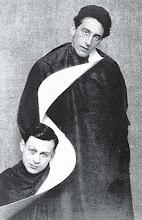
   My own personal monocle avatar has always been the Romanian-French poet, Tristan Tzara (1896-1963), a principal Dadaist, key early Surrealist, and always a charismatic, inspirational figure.  For me, one look at Tzara (I have provided three below) tells the whole story.   


Tristan Tzara (top two photos); Tristan Tzara, Hans Arp, Max Ernst (bottom photo)


   I used to have a monocle too.  I spent the summer of 1971 on a student summer trip to Paris and when my school, the Paris-American Academy, scheduled a four-day excursion to London, I made it my main purpose to purchase a monocle there.  (I was already under Tzara's spell.)  Someone told me that I would probably be able to find one at the Portobello Road flea market and I was not disappointed, except for the fact that I found the monocle difficult to wear and it made me look ridiculous.  (How did Tristan Tzara manage to look so cool when I looked so uncool?)  I soon placed the monocle in a dresser drawer or a jewelry box and haven't laid eyes on it since the mid-1970s.  


    When we moved into our current house three years ago, I  was finally able to retrieve everything I had placed in storage over the years.  Once again, I seem to physically possess absolutely everything I have ever owned.  I suspect the monocle may be in the attic, no more than 200 feet from where I sit.  I wonder if I will ever see it again?


19th century gold monocle fitted with "gallery" piece for greater comfort.


Mr. Peanut, Antonio Gentile and Unknown Artist, 1916

Sunday, August 19, 2012

Arp Abstract (From The Dada Almanac)


Constellation, 1932


"It was the special achievement of Hans Arp to view the métier itself as the problem.  In this way he gave renewed  emphasis to it and the possibility of nourishing it with a renewed imagination.   


Hans Arp's Studio Window, Basel


For him it was no longer a question of improving and specifying an aesthetic system and making it more precise.  He wanted a direct form of production, one that exactly conformed to the way a stone breaks off from a mountain, a flower blossoms, or an animal perpetuates itself. He wanted imaginative qualities that are not to be found in any museum.   


Mirr, 1949-50


A type of animal-like formation with all its wild intensity and diversities.  The creation of a new body outside of us that lives as long as we do, perches on the corners of tables, resides in gardens, looks down from walls.   


He wanted abstraction."


Alexander Partens, “Dada Art,” published in The Dada Almanac, edited by Richard Huelsenbeck (Berlin 1920), English Edition presented by Malcolm Green (London, 1993), London, Atlas Press, 1993.  (Note:  Alexander Partens was the pseudonym of Tristan Tzara, Walter Serner and Hans Arp, the so-called Limited Company for the Exploitation of Dadaist Vocabulary.)


Hans Arp with Sophie Tauber-Arp


Hans Arp, 1926


Head With Green Nose, 1923

Monday, July 30, 2012

Symbols Are Containers (Arp)


Symbols are containers of the various levels of knowledge.  They represent metaphysical insight into the organizing principle of life itself.   


At their most condensed and when logically understood for what they are, symbols possess enormous power as sources of psychic energy.  They recapitulate the ontology of natural growth, and more specifically, the evolution of the human race and the intellectual and emotional development of every child.  In effect, the code of human universals resides in two contrasting forms:  the first is in each human brain, the second is in all artifacts comprising the man-made world.  


In terms of practical function and iconicity, every manufactured object and spatial enclosure represents a deductible imprint of specific universals.  Consequently, this code is carried from generation to generation by two separate means: organically through the brain of every living individual and inorganically through the trans-lingual relationships embodied in every artifact, writing, or spatial relationship.  


This invites a great paradox.   


All profound art and writing lies in conflict between being as the essence of spiritual revelation and the illusional permanence of the written word, the icon or the sacred space.


Jack Burnham, “Objects and Ritual: Toward a Working Ontology of Art”, in Great Western Salt Works, Essays on the Meaning of Post-Formalist Art, New York, George Braziller, 1974.


  Illustrations by Jean Arp:

          1. Head-Flag, 1926.
          2. The Navel-Bottle, 1923.
          3. Automatic Drawing, 1916.
          4. Tristan Tzara’s 25 Poems, 1918.
          5. Untitled, 1951.
    6. Lion, 1916.
ll

Tuesday, October 12, 2010

Monocle


Winona Ryder as Veronica Sawyer in Heathers (1989)


A monocle is a type of corrective lens used to correct the visual perception in only one eye.  It consists of a circular lens, generally with a wire ring around the circumference, that can be attached to a string.  The other end of the string is then connected to the wearer's clothing to avoid losing the monocle.  

It was Baron Philipp von Stosch (1691-1757), the important, but controversial Prussian antiquarium, collector and (apparently) spy, who first put the monocle on the fashion map when he wore the device in Rome in the 1720s in order to more closely examine engravings and antique engraved gems.  Stosch's tome, Gemmae Antiquae Caelatae, containing Bernard Picart's engravings reproduced the images of seventy antique carved hardstones, including onyx, jasper and carnelian.  It is still considered an invaluable scholarly resource.


Edme Bouchardon (1698-1762), Neo-Classical Bust of Baron Philipp von Stosch,  1727, marble, Staatliche Museen, Berlin


Stosch's collection eventually comprised over 10,000 cameos, intaglios and antique glass pastes.  (Most of these are currently housed in various Berlin museums.)  Like some other "intrepid" collectors throughout history, some of Stosch's acquisitions were obtained through shady methods, as the following story illustrates:

"It was in looking over the royal cabinet of medals that the keeper perceived the loss of one; his place, his pension and his reputation were at stake; and he insisted that Baron Stosch be most minutely examined.  In this dilemma, forced to confession, the erudite collector assured the keeper of the royal cabinet that the strictest search would not avail.  'Alas, sir, I have it here within', he said, pointing to his breast.  An emetic was suggested by the learned practitioner himself, probably from some former experiment."  (From Isaac D'Israeli, Curiosities of Literature, 1791.) 


Giovanni Battista Pozzo,  Cast bronze medal portrait of Baron Phillpp von Stosch at age 26 (1717)


It was not until the 1790s, however, that the monocle, introduced as a high fashion "dandy's 'quizzing glass'", became a more standard item of gentlemen's apparel.  This set the stage for its greater popularity throughout the nineteenth century.


19th century gold "quizzing glass" monocle


Like many people, I'm certain, I was intrigued by the monocle immediately upon first viewing. Although that specific event is forever lost in the sands of time, I think it might have been when I saw an encyclopedia  photograph of the famous actor and anti-vivisectionist George Arliss,  the first Brit to win an Academy Award (which he did in the Best Actor category for his portrayal of Disraeli in 1929).  Arliss was a great star and a fine man.  With his monocle in place, he  projected fully the image of the English gentleman. (In a  funny coincidence, Isaac D'Israeli, the source for the Philipp von Stosch anecdote recounted above, was the father of Benjamin Disraeli, the British prime minister so memorably portrayed by George Arliss.) 


George Arliss (1868-1946)


Until yesterday I had completely forgotten that Winona Ryder had worn a monocle in some key scenes from Heathers, one of her best movies.  And today, I rediscovered the picture found below of the always impressive and somewhat frightening William Hartnell, appearing as the very first Doctor Who, as well as the strange internet photo of a Japanese girl who posted a plaintive request for someone, anyone to please send her a drawing showing her posing in her monocle.


William Hartnell (1908-75), the first Doctor Who


Female Japanese monocle wearer, 2008 


My own personal monocle avatar has always been the Romanian-French poet, Tristan Tzara (1896-1963), a principal Dadaist, key early Surrealist, and always a charismatic, inspirational figure.  For me, one look at Tzara (I have provided three below) tells the whole story.   


Tristan Tzara (top two photos); Tristan Tzara, Hans Arp, Max Ernst (bottom photo)


I used to have a monocle too.  I spent the summer of 1971 on a student summer trip to Paris and when my school, the Paris-American Academy, scheduled a four-day excursion to London, I made it my main purpose to purchase a monocle there.  (I was already under Tzara's spell.)  Someone told me that I would probably be able to find one at the Portobello Road flea market and I was not disappointed, except for the fact that I found the monocle difficult to wear and it made me look ridiculous.  (How did Tristan Tzara manage to look so cool when I looked so uncool?)  I soon placed the monocle in a dresser drawer or a jewelry box and haven't laid eyes on it since the mid-1970s.  

When we moved into our current house three years ago, I  was finally able to retrieve everything I had placed in storage over the years.  Once again, I seem to physically possess absolutely everything I have ever owned.  I suspect the monocle may be in the attic, no more than 200 feet from where I sit.  I wonder if I will ever see it again?


19th century gold monocle fitted with "gallery" piece for greater comfort.


Mr. Peanut, Antonio Gentile and Unknown Artist, 1916