Showing posts with label Elizabeth David. Show all posts

Tuesday, July 23, 2013

EVERLASTING SYLLABUB -- ROYAL BABY BLOG


The recipe comes from Elizabeth David’s pamphlet Syllabubs and Fruit Fools (which also includes some delicious Scottish specialities).   She traces the history of syllabubs back to the seventeenth century.  The simplest of all was a pastoral affair, a picturesque treat for town visitors to the country; a milkmaid would direct a stream of new warm milk into a bowl of spiced cider or ale.  After a while a light curd formed on top, with a delicious whey underneath. 

The more solid syllabub, the kind we eat today – the Everlasting Syllabub as opposed to the milkmaid’s simple affair of milk and cider – also goes back to the seventeenth century.  In grander kitchens, cream and wine were used, though Sir Kenelm Digby, in The Closet . . . Opened, his notebook of recipes which was published after his death, in 1699, does remark that concentrated fruit syrups could be substituted for the wine.  They should be on the tart side, ‘very weak of sugar.’


For 4-6
8 tablespoons (4 fl oz) white wine or sherry
2 tablespoons brandy
Pared rind and juice of 1 lemon
60 g (2 oz) sugar
300 ml (1/2 pt) double cream
Nutmeg

PUT the first three ingredients into a bowl and leave overnight.  Next day strain the liquid into a bowl and stir in the sugar until it has dissolved.  Still stirring, pour in the cream slowly.  Add finally a grating of nutmeg, beat the syllabub with a wire whisk until it holds its shape – do not go on too long, or too vigorously, or the cream will curdle and separate into a buttery mass.
Spoon the syllabub into small glasses or custard cups – there is enough for four to six people – and keep in a cool place (if possible, not the refrigerator) for two days or more.  Of course they can be served straightaway, but it is usually more convenient to make puddings in advance and this one keeps well.  ‘A nice sprig of rosemary or a little twist of lemon peel,’ can, as suggested by Sir Kenelm Digby, ‘be stuck into each little filled glass.’ Serve with almond or sponge biscuits.


Elizabeth David

From Jane Grigson, English Food, London, Ebury Press, 1974.

Tuesday, July 19, 2011

Sardines On Toast (Jeremiah Tower)


Don't laugh.

        I cannot think of a tinned product that has more of a cult following than sardines.  Arguments rage about how long sardines should be aged in the can (yes, there are vintage sardines) and whether they should be Portuguese, French, Spanish, Chinese or Southeast Asian.  In the Phillipines, I had the famous delicacy of the freshwater sardines from Lake Bombon, but after I saw the polluted lake I was unfairly prejudiced against the fish.


        Let's not get into the whole debate about brislings versus sardines, but do read "Oules of Sardines", an article that Elizabeth David wrote for the Spectator in 1962.  You can find it in her superb An Omelette and a Glass of Wine (1984).  Or read Alan Davidson's essay "What Is A Sardine?", published in the Petits Propos Culinaires, No. 2 (August 1979), published by Prospect Books in London.


        A plate of good quality, canned sardines is a fully satisfying dish that takes only 10 minutes to prepare.  Eat them with horseradish, hot sauce, Meyer or salt-preserved lemons, or mayonnaise, but always with freshly grated onion.


SERVES 4 TO 6

2 cans sardines in olive oil or water

1 sweet onion (Walla-Walla, Vidalia, Maui or a fresh red one), peeled

4 leaves fresh mint

2 tablespoons extra-virgin olive oil

1/2 teaspoon sea salt

1 teaspoon coarsely ground fresh pepper

Hot toasted bread, English muffins or brioche


        Finely grate the onion and chop the mint., and mix in a bowl with a pinch of salt and pepper.  In another bowl, mix the olive oil, salt and pepper.  Pour the oil or water off the sardines and put them on a plate.  Pour the seasoned olive oil over them, turn them over in it several times, and serve on hot toast with the mint relish on top.

VARIATION:   A bit over the top but amazing is toasted brioche slathered with ham mousse and then topped with sardines prepared as above.


Note:  Easy, fun and highly informal recipe from Jeremiah Tower Cooks.  Tower is a fascinating figure in many ways and this snippet imparts, I think, something essential about his taste and style, something people mentally caught up in the fancier trappings of the early Chez Panisse menus and the chic of Stars, might overlook.  My favorite Tower contributions, actually, are the how-to/technique photo-essays in the Time-Life Good Cook series (where Tower assisted Richard Olney), which teach so much so well.  Anyway, I love sardines and am told I should eat more of them by my doctor.  No argument.  I can't wait to try this recipe.

For More Sardines:  See Here


Wednesday, June 15, 2011

The Yeast Dies (Elizabeth David)


Granulated yeast


          "A last word on the working of yeast in bread dough:  at a temperature of 130 degrees F., 54 degrees C., or thereabout, yeast cells die.  They are killed when that degree of the heat of the oven penetrates to the centre of the loaf.  Until then there should still be sufficient spring or aeration potential left in the dough for it to go on rising in the oven.  The small amount of alcohol produced by the yeast is driven off during baking."  

                      ---- From English Bread And Yeast Cookery


        From the time I first read (immersed myself really; it's that kind of monumental book) in Elizabeth David's English Bread And Yeast Cookery, I was singularly struck by this passage and its title, The Yeast Dies, as being emblematic of David's profound way of dealing with her two vast text and subtext subjects -- food and life.  


Yeast life cycle

 
        One tends to think of bread baking as the most benign of activities (bread, it is often said and I think it is also deeply felt, is the "staff of life") and most people, I think, mentally discard the potential violence that might be seen as inherent in the cultivation and sowing of wheat for milling in the same general way many people think that it is more humane to be a vegetarian than a non-vegetarian.  

        I fully understand this, but also came to realize a long time ago (when I chose to abandon full-time vegetarianism) that life, sadly, seems to be an irreducible competition among species for survival.  (Toward what end, I don't know, especially lately.)   


Yeast fermenting in beer


        I don't know of a writer other than Elizabeth David, however, who has focused on attention on the fact that in bread baking we bring dormant yeast to life for leavening purposes in order to kill it at the exact momemt when it has done its work.  

        This all came to mind yesterday when I removed David's book from the shelf in order to embark on a new project.  Years ago, long before Jane was born, I was a very active bread baker and became fairly accomplished at it, although my repertoire was, by personal choice, fairly limited.  The bread I liked to make best was David's basic wheaten loaf (about 1/3 whole wheat flour and 2/3 strong unbleached white flour), which I preferred to prepare in a round shape with a scored surface under a La Cloche baking bell, rather than in a Pullman or other form of loaf pan.  I developed a very good personal recipe for this combining David's directions with others taken from Judith and Evan Jones' excellent The Book of Bread.  Many people enjoyed the bread I made, which was gratifying, but the process of preparing the bread, which, as every bread baker knows, is simultaneously energetic and soothing (mentally and physically), is where the real reward lies.


La Cloche   


         This all occurred in pre-word processing, pre-internet days.  I always wrote down my recipes, but I misplaced this one years ago, and because I became busy with other things, I eventually stopped baking bread.  But I still have my books, my La Cloche, my memory and an oven, and now I have a daughter who I think will enjoy learning bread baking with me.  (She's already quite accomplished at some other forms of baking and cooking, which she pursues with her mother.)  


        So, that's the plan.


Monday, February 21, 2011

"Wyvern" -- Peach Fritters and Pickled Steak (From Culinary Jottings From Madras)


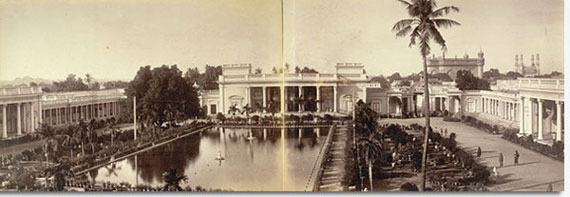
Hyderabad, 1893, Lord and Lady Wenlock; Lord Compton


        I began the year (referring to January 2nd's post) with a short excerpt from "Wyvern"'s extraordinary 1878 volume, Culinary Jottings From Madras, and his comments on hors d'oeuvres.   

        "Wyvern", you may recall,  was the nom-de-plume of Colonel Arthur Robert Kenney-Herbert (b. 1840 - d. 1916), a British Indian Army officer who served in Bangalore in the south, Secunderabad (or Sikandarabad, British cantonment and neighbor to the royal city to Hyderabad) in the north, and other postings beginning in the 1860s, who wrote memorably and penetratingly about cooking and household management in a number of books, as well as in articles published in the Madras Athenaeum and the Daily News (India). 


Cubbon Hotel, Bangalore, late 19th century 


        Like most people interested in his Wyvern, I imagine, I first discovered him via Elizabeth David's books.  Rescuing and reviving interest in Colonel Kenney-Herbert and his Culinary Jottings From Madras is yet another reason we need to be grateful to Mrs. David and her pioneering, highly original work.


Willoughby Wallace Cooper, Stick Carriers, 1870


      The other day Caroline found the following recipe for Peach Fritters, which looks delicious and is also surprising because of its complimentary words about the tinned American peaches in syrup (a staple of both our childhoods), which were then available and highly esteemed in India.  Following, in a sleepy state, I was energized reading the recipe for Pickled Steak.  These two were not paired as part of the the same menu (Wyvern's menus for various occasions make excellent, stimulating reading), but I think they would go well together and we intend to try them out shortly.   They sound both traditional and contemporary, without seeming at all "retro", a term that would, I think, have repelled Wyvern, who was practical,  unpretentious and an enemy of the precious and frou-frou.


 Frederick Fiebag, Mosque in Madras, 1870


        As Caroline and I did two days ago, I'll begin with dessert, moving backwards to the entree:


Peach Fritters


 I. Beignets de Peche
(Peach Fritters)

        Wyvern's peach fritters sound sensational.  So do all his fritters -- sweet and savoury.  First, I think it would be wise to pass along his basic fritter advice: 

        "Failure in the accomplishment of the many excellent dishes which come under the head of 'fritters' may be fairly attributed to three things: the first, ignorance in making the batter; the second, a wrongly shaped utensil;  and the third, an insufficient use of the frying medium.  If you once master these cardinal points and can drum them into the head of your Ramasamy, you will have at your hand a tasty and, indeed, artistic method of cookery upon which you can always rely with confidence.  The charm of fritter cooking is its simplicity.  The mixing of a good batter merely depends upon the accurate following of the recipe before you, whilst the culinary operation itself presents no difficulty whatever, provided a liberal supply of fat be given out, and the vessel used a proper one.  The beginner, as a rule, overcomes this part of his education after a few trials, and thenceforward has no apprehension concerning success."

Now, on to:


         1. The Batter

        "I have adopted as a standard batter in my own kitchen one recommended by the 'G.C.', whose advice I have so often quoted in these pages.  Friends who have tried it at my recommendation have generally commended it.  You must proceed in this way:

        Beat up the yolks of three eggs with two table-spoonsful of brandy, one table-spoonful of the best salad oil, and four or five table-spoonsful of cold water.  Incorporate with this mixture three table-spoonsful of flour and a salt-spoonful of salt.  The flour should be dry, and the best imported.  Work this now, with care to a smooth paste, and continue to beat it for at least ten minutes.  If the batter appear too thick, add a little water until its consistency be satisfactory, i.e., it should cover the spoon when lifted out of it with the coating about an eighth of an inch thick.  This stage having been reached, take the whites of the three eggs, and whip them to a stiff froth; stir this into your batter at the time of using.

        Another good batter is made thus: -- Beat up equal parts of salad oil, and brandy, -- say a table-spoonful of each; and the yolk of an egg and incorporate with this, sufficient flour to make a thick paste which you thin to the required consistency by the addition of water, reserving the whipped white of the egg to finish with."

2. The Fritters

        "Cut the peaches (American ones in tin are excellent) into neat pieces; dust them with powdered sugar, and let them lie in a little maraschino, or any nice liqueur till wanted, then dip them in your batter, and fry them in abundance of boiling fat; drain them on blotting paper, and serve them dusted over with pounded loaf sugar finely sifted.  In the case of raw fruit, the peaches cut in halves, peeled and stoned, should be carefully stewed in syrup with a dash of liqueur and a little lime juice first, then set to get cold, and after being drained, dipped in batter, &c., as above explained.  All fritters should be served without delay."


Bangalore, late 19th century


II. Pickled Steak or Chops


        "Place a steak in a deep dish with a couple of onions sliced, a clove of garlic, pepper corns, salt, some leaves of thyme and marjoram, a bunch of parsley, and some lime peel.  Add oil and vinegar (two table-spoonsful full of former to one of the latter) sufficient to soak the meat well without actually covering it.  Let it soak all day; lift it, when wanted, from the marinade, and fry lightly in butter : then (when coloured on both sides nicely) pour in the marinade, with a breakfast cup of made gravy, and stew the steak gently till thoroughly done.-- Strain the liquor, free it from fat, reduce it a little over the fire, pour over the steak and serve.  This is just as good with a nice mutton steak, or a few juicy chops."


Upper:  Nizam of Hyderabad and Suite, 1870 
Lower: Nizam's Chowmahela Palace, Hyderabad


Wyvern excerpts taken from Culinary Jottings From Madras (5th edition, 1885; republished London, Prospect Books, 2007, ed. Leslie Forbes)

Sunday, December 5, 2010

Salted Almonds (Elizabeth David) & Flavored Vodkas (Christmas Is Approaching)


  Christmas Day in Cairo
 
     What follows below is Elizabeth David's recipe for Salted Almonds, which appears in the Savouries section of her book Spices, Salt and Aromatics in the English Kitchen (London, Penguin, 1970).

     For me, it is the finest piece of food writing ever and my favorite example of her work.

     On a practical level, it is a simple, complete and superb recipe for a Christmas season staple in our house  (although salted almonds, obviously, can be eaten year-round).  Caroline and I associate salted almonds with memories of her mother, who made them according to a traditional family recipe.  She would give them to us every year as a Christmas gift.  Eventually, we started doing the same for our friends after we discovered this recipe, which works equally well with macadamia nuts. (Roasted salted macadamia nuts, offered as gifts, secure friendships for life.)

     Another nice small and easily prepared home-made Christmas gift are flavored vodkas.  We buy pint-size bottles of Stolichnaya vodka, whose naturally vanillin flavor works particularly well for this, and in them macerate variously raspberries, blueberries, sections of clementine or whole vanilla beans.  The idea is to allow the fruit or spice to flavor the vodka for a week or so before wrapping them and giving them away.  The flavor is excellent and much better than the now-ubiquitous commercial varieties of these liquors.


    The raspberry variety is especially nice.  When the bottle is slightly shaken by the recipient upon opening or use, the vodka takes on the most beautiful and attractive pink tint.  The flavor is pure and not overly sweet because no additional sweetening, other than the fruit itself,  is used.  You can also prepare a spicy vodka using dried cayenne peppers, but that takes a little bit of trial and error in order to be semi-certain you've created a palatable concoction.

     Your friends will tend to think you're a genius and and compliment you excessively, but preparing these is  really easy to do.  You need to pour off vodka from each pint bottle to allow room for the flavoring, which means you must collect the extra vodka in another vessel and have it available for topping up bottles as needed.  For the sake of economy, in addition to the pint bottles (which you may need to order in advance from your liquor store), you should also buy a very large-format Stolichnaya bottle for this purpose.  You will also probably want to prepare  a fifth or liter bottle of each flavor for yourself, both to enjoy during the season and to monitor the progress of the current year's products.  Needless to say, there's a tipsy-making element to preparing flavored vodkas that you don't encounter in the salted almond manufacturing process.  (Friends don't let friends man the flavored vodka production line alone.)


Elizabeth David: Salted Almonds

With drinks, the cashews and peanuts of commerce make wretched substitutes for salted almonds; and salted almonds, whatever words held out by the words vacuum-sealed or oven-fresh on tins and jars are not to be bought.  They must be prepared at home, and on the day they are to be eaten.  Five or six hours after the almonds come out of the oven they are at their best.  Within twenty-four hours they have already lost their pristine freshness.  It is, goodness knows, easy to prepare almonds for salting.  They cost half the price of salted almonds in jars or tins and taste twice as good.

     If blanched whole almonds are not to be found, the skinning process is a matter of minutes.  Plunge the almonds into boiling water.  When the water has again boiled, turn the almonds out into a colander.  When they are still warm, slip off the skins.  This part of the operation can be done in advance.

     All that is needed apart from the blanched almonds is an oven, a baking tin, kitchen salt and kitchen paper, and if possible, a tiny phial of sweet almond oil bought from the chemist, and cayenne pepper in a sprinkler.  Butter, very highly refined olive oil or deodorized ground-nut oil will pass instead of almond oil.  Corn oil, with its detestable taste and greasy cling, will not pass for this, nor so far as I am concerned, for any other purpose whatsoever.


     It was a Sudanese cook called Suliman who cooked for me in Egypt, who discovered how the best salted almonds are made.  Suliman used not more than a teaspoon of almond oil or butter per half pound of blanched almonds, and it does not matter whether Valencia or Jordan almonds are used.  What you do is to put the prepared almonds in a baking tin rubbed with the oil or butter.  The tin then goes into the centre of a very slow oven (the oven in my Cairo kitchen was a tin box perched over a primus stove.  The magic of this primitive device can be very well reproduced with any gas, solid fuel, or electric oven at a temperature of approximately gas No. 2 or 210 degrees F.) and there leave it for about 45 minutes until the almonds are pale toast color.  Have ready on the table a sheet of greaseproof paper and some perfectly ordinary kitchen block salt (about three tablespoons to the half pound) or if you prefer, gros sel.  Free-running table salt is to be avoided for this purpose.  Empty the toasted almonds on to the paper.  Swish them round in the salt. Gather up the corners of the paper and twist them so that you have a tightly fastened little parcel which you put away in a drawer, or in the kitchen cupboard.  This part of the ritual is not so much a matter of witchcraft as of plain common sense. In my experience, it is necessary to conceal salted almonds from all eyes until the appropriate time comes for them to be produced.  Nothing yet invented sets the gastric juices to work as the sight of a plateful of freshly toasted and salted almonds.  Even to say the words or see them written does the trick.  (Whoever thought of calling the cocktail bar at the old Trocadero the Salted Almond knew a thing or two.)  Left where anybody can see them, a pound of salted almonds will be devoured within fifteen minutes.

     When therefore the moment to set out the almonds arrives, unwrap the parcel, shake the almonds free of excess salt and over them shake an infinitesimal sprinkling of cayenne pepper.  


     There is very little question of salted almonds left over from one evening being produced again the next.  There never are any left over.  Should there be, re-toast them in a slow oven -- but they will not be the same.  Suliman used to put any left over into a rice dish.  And he could not be persuaded to make salted almonds in a hurry.   He held it essential to give them their few hours in the salt.  He was right.  The important points about salted almonds are that they must be so dry from the slow toasting in the oven that they squeak as you bite into them; at the same time they must be salty in taste but not to the extent that their own flavour is killed. 


Nilometer, Egyptian Museum, Cairo


A cat named Cairo

Wednesday, October 20, 2010

End of the season: Zucchine Fritte (Elizabeth David)


From Italian Food (1954) by Elizabeth David

"Zucchine are usually cooked unpeeled, cut into thin rounds, fried in butter or oil.  They can be stuffed, stewed, used in a sauce for pasta, fried in batter, added to vegetable soups, and cooked with tomatoes and cheese in the same way as aubergines.  Very thin strips of zucchine fried crisp in hot oil, piled up on the dish like potato straws, are sold in every Roman rosticceria in the summer."


Zucchine Fritte (Fried Small Marrows)
Cut 1/2 lb. of small unpeeled marrows into little strips, like very small chips.  Salt them and leave them to drain for an hour.  

Shake them in a cloth with flour and fry them in deep oil.  They will only take about 3 minutes to cook.  Lift them out of the pan with a perforated spoon and drain them on kitchen paper.


Rosticceria in Rome


September 26, 1949 -- End of the season, Tower Beach, London


Tower Beach, the Foreshore, 1905


Savile Row, London


Elizabeth David


Now you are gone, end of the season
Winter will come any day
Back in the scrum on a wet afternoon
Down in the mud, dreaming of flowers in June