Showing posts with label Diana Dors. Show all posts

Sunday, July 29, 2012

SERMON -- JUDGEMENT (LETTERS FROM ENGLAND)


    "Madame Tussaud’s is a museum of famous people, or rather of their wax-effigies.  The Royal Family is there (also King Alphonso, somewhat moth-eaten).  Mr. MacDonald’s Ministry, French Presidents, Dickens and Kipling, marshals, Mademoiselle Lenglen, famous murderers of the last century and the souvenirs of Napoleon, such as his socks, belt and hat ; then in a place of dishonor Kaiser Wilhelm and Franz Josef, still looking spruce for his age.   


      Before one particularly effective effigy of a gentlemen in a top-hat I stopped and looked into the catalogue to see who it was ; suddenly the gentlemen with the top-hat moved and walked away ; it was awful.   


     After a while two young ladies looked into the catalogue to see whom I represented.


          At Madame Tussaud’s I made a somewhat unpleasant discovery ; either I am quite incapable of reading human faces, or else physiognomies are deceptive.  So for example I was at first sight attracted by a seated gentleman with a goatee beard, No. 12.  In the catalogue I found : “12.  Thomas Nell Cream, hanged in 1892.  Poisoned Matilda Glover with strychnine.  He was also found guilty of murdering three other women.”  Really, his face is very suspicious.  No. 13, Franz Müller, murdered Mr. Briggs in the train.  H’m.  No. 20, a clean-shaven gentlemen, of almost worthy appearance :  Arthur Devereux, hanged 1905, known as the “trunk murderer,” because he hid the corpses of his victims in trunks.  Horrid.  No. 21 – no, this worthy priest cannot be “Mrs. Dyer, the Reading baby murderess.”


     I now perceive that I have confused the pages of the catalogue, and I am compelled to correct my impressions : the seated gentleman, No. 12, is merely Bernard Shaw ; No. 13 is Louis Blériot, and No. 20 is simply Gugliemo Marconi.


     Never again will I judge people by their faces."


From:  Karel Ĉapek,  "Animals and Famous People" in  "Letters from England," translated by Paul Selver, London, Geoffrey Bles, 1925.

Illustrations:

1. HRH Prince Charles and Camilla, Duchess of Cornwall, exhibited at Madame Tussauds, London.

2.   Mademoiselle Suzanne Lenglen (1899-1938), La Divine.

3.  Thomas Neill Cream (1850-92), the Lambeth Poisoner.

4.  Madame Tussauds' waxwork of Hawley Harvey Crippen (1862-1910).  Known as the first murderer caught with the aid of Gugliemo Marconi's wireless as a tool.

5.  Waxwork showing  Louis Blériot (1872-1936), the first aviator to cross the English Channel in a heavier than air aircraft.

6. Applying the finishing touches to waxwork of Diana Dors, Madame Tussauds, London.

7.  Robert Evans, producer of The Godfather, Rosemary's Baby, Love Story and Chinatown.  Is it real or is it Memorex?


Monday, July 11, 2011

One Train Later (Andy Summers)


Zoot Money and the Big Roll Band at the entrance of the Flamingo, 33-37 Wardour Street, Soho, London.  (George "Zoot" Money, left; Andy Summers, second from left; ca. 1965)


        London, with its speed, noise, dirt, concrete, and multiracial society, is shocking.  I wander around Soho through streets filled with prostitutes, betting shops, bars, private drinking clubs, and exotic food smells, trying to get used to the idea that this fast, cynical place is now my home. Security comes from being in the band, coming from the same town, and having moved here together.   But gradually we settle into it and after a while I can't imagine being anywhere else.

        As we gain popularity from our steady gig at the Flamingo we play six or seven nights a week and are able to add a couple of saxophones to the band.   This regular work eventually provides enough money for Zoot to move upstairs to the ground-floor flat with his new girlfriend, Ronni, a tough and outspoken little Scot who acts as the voice of sanity, the shaper of events, and the mother hen in the madness of the next few years.

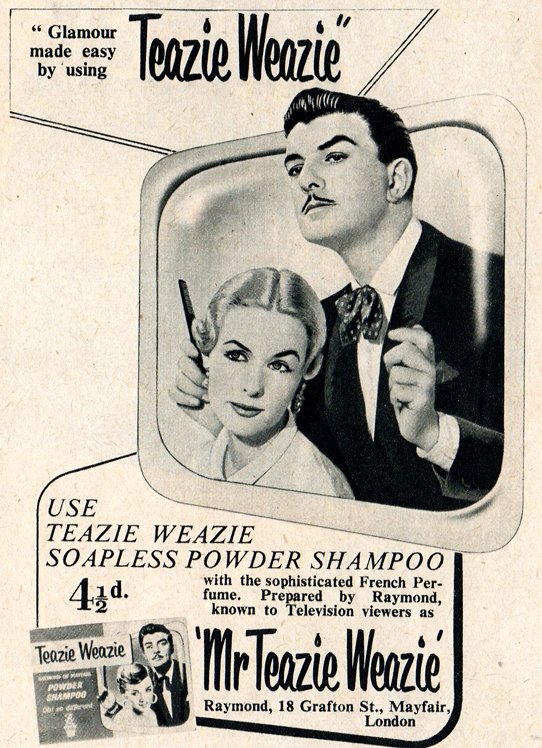
        Our show, Zoot Money and the Big Roll Band, is a fast-paced rabble-rousing set of R&B featuring the songs of Ray Charles, the Isley Brothers, Rufus Thomas and James Brown.  Zoot is a great blues shouter/R&B singer with a natural flair for comedy and showmanship.  From the stage he heckles the audience with insults and jibes about playing in the graveyard, etc., until he goads them into a full and heated response.  At this point being in a band is about having a good time rather than being moody, artistic and introspective.  We are supposed to be entertainers, and the idea of calling ourselves artists is not on the dial yet.  Artists are referred to as "arteeeests" with a French accent, and with a smirk you think of Mr. Teezy Weezy -- hairdresser to the stars.


Raymond Bessone, an Englishman better known as Mr. Teasy Weasy, was one of the most famous stylists of the 50's and 60's. Also known as Raymond of Mayfair, for his salon in the elegant London neighborhood, he created the popular "bouffant" hairstyle, which was worn by many movie actresses, like Diana Dors. At that time he had a TV show and was dedicated to the racehorses. His horses wore permed hair. 

    As our reputation grows we begin playing around the country and start an endless round of gigs that have us locked up in a Commer van, criss-crossing England on a daily basis.  But we always return to the Flamingo and the sessions known as all-nighters.  These run from eleven P.M. till seven A.M. on the weekends and are almost Shakespearean in the way that tragedy and comedy play out in front of the stage and the dark recesses of the club.  They become the fixed point, the true north of our universe.


The Beatles inside their Commer van, 1963


Notes:   

[1]       I have wanted to post an excerpt from Andy Summers' memoir One Train Later, which is now several years old (its publication preceded the extremely successful 2007-8 Police reunion tour by about 18 months) for some time now because it is one of the very few books about rock and roll that is actually worth reading. (Having read an inordinately large number, I can attest to this and provide tedious detail why I think this is.)  

              It is odd and surprising that such a colorful and exciting art form, which has inspired so many, has produced so few high-quality biographies, autobiographies or good, business-oriented books (Fred Goodman's Mansion on the Hill and Fortune's Fool being particularly notable exceptions in the last category) detailing its inner workings and, it seems to me, absolutely no decent full-length works of critical commentary.  

              Of the first-person life accounts, Summers' book, Dave Davies' Kink and Stewart "Dinky" Dawson's Life On The Road stand out because each is written in a consistent, recognizable authorial (not ghost-authorial) voice and all are marked with sincerity and a clear desire to communicate with the reader.  None of these writers is a great prose stylist, but their reach is commensurate with their grasp, something that failed Ray Davies in his noble, but ultimately unsuccessful "unauthorized autobiography" X-Ray.  Bob Dylan's marvelous Chronicle remains a chimera - a Dylanesque artifact that future generations may ultimately unravel.


Jenny Fabian, author of the famous rock novel, Groupie, photographed by Michael Ward in 1969. Fabian was Andy Summers' inconstant girlfriend after the Big Roll Band transmogrified into the psychedelic group Dantalian's Chariot.  Summer's is "Dave" in the book; Dantalian's Chariot is renamed "Transfer Project".


          Although One Train Later provides enough anecdotal, behind-the-scenes detail to satisfy Summers' Police fan-base and reward them sufficiently for purchasing the book, it is mainly a story of a serious young musician growing up in post-World War II Britain trying to discern and develop his individual artistic voice and then doggedly insisting that this was the voice he would speak with and be known by.   For those who followed Summers' development and pre-Police career, it's an inspiring and revelatory supplement to his guitar playing, where he is much more articulate and eloquent than in his occasionally overlabored, but always honest and informative, prose.


[2]  Zoot Money and the Big Roll Band -- The Cat (Columbia Records, 1966)


[5]  The Police - Roxanne (live at PinkPop Festival, Holland, 1979)