Saturday, May 1, 2010

Cabbage Thoran


This delicious vegetable dish is a centerpiece of Kerala cuisine and identified with Ona Sadya, the main feast during Onam, the major harvest festival celebrating the homecoming of the legendary King Mahabali, falling between August and September each year.  

The festival lasts for ten days and is linked to many elements of Kerala's culture and tradition.  Intricate wreaths of flowers, food, Snake Boat Races and the Kaikottkali dance all play a part in the festival.  For this festival, people wear new clothes: men a shirt and mundu, a skirt-like bottom; women a mundu and a gold top, a Nariathu.   Girls wear a skirt called a Pavada and a blouse.  The festival is also important because of its popularity with all communities within Kerala.  Although the festival of Onam originated with, and is connected to, the Hindu religion, it is celebrated today with equal fervor by the Hindus, Muslims and Christians of Kerala.

Many lamps are lit in Hindu temples of Kerala during this celebration.  A palmyra tree is erected in front of temples and surrounded with a wooden balustrade and covered with dry palmyra leaves.  It is lit with a torch and burned to ashes to signify that Mahabali went to hell as a sacrifice.

Cabbage Thoran (Adapted from Madhur Jaffrey)

6 tablespoons mustard oil

1 tablespoon whole black mustard seeds

2 bay leaves OR leaves from 3 or 4 sprigs of fresh curry leaf.  (Note: Curry leaves are preferred.  We chop them coarsely and they can be eaten in the finished dish.   We buy them at a local Indian grocery.)

3 - 3 1/2 lbs. cabbage, cored and finely shredded (1 medium-sized cabbage)

3/4 - 1 teaspoon salt

1/2 teaspoon sugar

1 fresh hot green chili cut into long, fine strips.  (Note:  We use a little more than this and use the fresh green chilis found at our local Indian grocery, which are fairly small in size.)

1/2 cup grated coconut.  (Note:  We use fresh coconut powder, which we purchase in airtight bags at our local Indian grocery.  It melts into the dish and works well, imparting exactly the right flavor.)

Heat the oil in a heavy, wide casserole-type pot over a medium-high flame.  When hot, put in the mustard seeds and bay or curry leaves.  As soon as the bay or curry leaves begin to darken a bit and the mustard seeds begin to pop (this happens very quickly), add the shredded cabbage.  Turn the heat to medium.  Stir and cook for about 5 minutes.  Add the sugar, salt and green chili strips.  Stir and cook for another 3-5 minutes.  Cabbage should be bright green and slightly wilted, but still crunchy.  Turn off the heat.  Sprinkle with the coconut, mix well and serve.

Wednesday, April 28, 2010

Jane B. Cravan: Update To The Society, April 28, 2010


Police Tried to Protect 'Nessie' From Hunters
Lee Spiegel, ContributorAOL News
(April 28)(AP) -- A Scottish police chief in the 1930s believed the Loch Ness monster existed and tried to protect the unknown animal from hunters who targeted "Nessie" with harpoons.

Documents released this week by the National Archive of Scotland reveal that, in the 1930s, local authorities tried to get the Scottish government to protect and defend the famous monster of the deep, dark waters of Loch Ness.

A 1938 letter written by Chief Constable William Fraser stated, "That there is some strange creature in Loch Ness now seems beyond doubt, but that the police have any power to protect it is very doubtful."

The news comes as no surprise to those who are still trying to confirm the legendary monster's existence.

"I think that there are gigantic, unknown seals that have yet to be discovered from all of the Northern Hemisphere lakes, and Loch Ness is a prime example," said Loren Coleman, who runs the International Cryptozoology Museum in Portland, Maine.

As a result of the many reports in the 1930s of strange creatures in the lake, several hunting parties came to the area looking for them, including a couple who showed up in 1938 and wanted to use a harpoon to capture one of the animals so they could prove that a Loch Ness monster was obtainable.

Coleman, 62, thinks the release of Fraser's letter is overwhelmingly important because it validates that the Scottish government -- despite public pronouncements to the contrary -- at the time was secretly concerned that there were real creatures there and wanted to protect the "monsters," or unknown animals that lived in the lake.

"It's a breeding population -- there have been multiple sightings of more than one creature," said Coleman, who in 1999 gave the keynote address to the first International Cryptozoology Symposium ever held at Loch Ness.

"The other big thing that nobody talks about," he told AOL News, "is that it's only six miles to the ocean, and there have been about 27 sightings of these creatures on land, crossing the road, and described as a walrus-type animal or a big slug."

Given the strangeness of whatever it is that inhabits the famous Scottish loch comes under the purview of cryptozoology, which is the study of hidden or as-yet-undiscovered animals.

Whatever lurks in Loch Ness has a long history, dating back to A.D. 565, when the first monster sighting was recorded. Over the centuries, many sightings and photos of a creature (or creatures) have fueled speculation that there might be a surviving dinosaur species in the lake. But it's important to protect these animals, says Coleman, who's considered the world's leading living cryptozoologist.

"I think that any species like this that hasn't easily been found are certainly low in numbers. And the last thing we want to encourage is to think that people, looking for a pot of gold, can go out there and hunt these creatures to near extinction. We really have to undermine the greed motivation that is behind a lot of these hunters." And, Coleman says, what the Loch Ness monster eventually turns out to be will most likely shake science up.


Sunday, April 25, 2010

My Time After Awhile (1): Jean Helion


     I would like to present a couple of excellent pictures by Jean Helion, a 20th century French painter who interests me, and crib a few lines from an article by Merlin James, published in The Burlington Magazine in April 2005, about Helion. 


     One very good thing about having led an intellectually interrupted life is that it makes it very easy not to pontificate because of over-education or having acquired too much information along the way.  (One period of clarity mixed with confusion gets replaced by another and then another.) 
     Although one desires and seeks accurate and more complete knowledge (about everything), perhaps the residue of early training and instinct, combined with a more relaxed mind and eye, have helped me by now discern the forest for the trees a little, patterns in the landscape, and I feel a little less stuck than I used to on details that just catch, impede, and suddenly and painfully tear like nail-ends protruding from a wall. In art, as in everything else, “lying equals many tears”.  That’s a line in a poem that I like a lot. 
     Also, I’d like to say (to someone, possibly on a series of roadside billboards or a Times Square sign), “you lost me at 'post-modern'”.  Neologisms and silly nomenclature are mainly obfuscation.  As Lou Reed once observed about slang (speaking about why he tried not to include it in his lyrics), nothing “dates” you faster.
     All of this is a way of saying that some people love Jean Helion’s art and others dislike it greatly and regard him as mediocre and retrograde.


Merlin James:
“But in fact it is mistake to concentrate on Hélion’s strategic manoeuvring – on where he stands, what he stands for – at the expense of responding to his works themselves. Celebrating his contrariness, his provocative diversity and unpredictable stylistic manners, is paradoxically to risk doing him a similar disservice as did those who once criticised him for stepping out of line with the avant-garde. What counts is not, as such, that he repudiated abstraction (and then skirted around other movements such as surrealism, post-war realism or Pop). He did so only as a consequence of making the works he felt compelled to make. Parading painting’s affective and semantic potential, his pictures cry out to be critically appreciated and interpreted, not just endorsed as some ‘alternative’ to a discredited – or still tacitly accepted – mainstream canon.”
 “Seurat and Poussin were among Hélion’s acknowledged masters at the time, and while he wrote of them (in the progressive Axis magazine and elsewhere) in formalist terms, his own pictures announce their affinity with past art in subtle ways hardly done justice to by truisms about shared visual rhythm and structure. An abstract canvas by Hélion is recognisably the same category of object as a David, a Louis Le Nain or a Ucello, not least in making the viewer hyperaware of the a skin of paint on a surface, actively and, as it were, continually (re-)generating and sustaining the image.”


“With “Cyclist," (1939) inaugurates the window-and-door dramas, the passing cyclists, the gents with umbrellas, the smokers, the opposition of ‘in’ and ‘out’ – all common in Hélion. "Défence D’," (1943) announces his creed of semantic continuum, from written word through visual representation to ambiguous or abstract colour and form. The hat brim covering the eyes in this, as in so many paintings, flags notions of inner and outer sight, identity and anonymity. "The Stairs" (1944) introduces blindness, (an increasing concern up to the loss of Hélion’s own sight late in life) and enshrines the key principles of ascent, descent, rotation, pairing. "Wrong Way Up" (1947) with its gallery frontage displaying an abstract picture, begins the symbolic juxtaposition of art and reality and the play between shop window and street life. The ubiquitous newspaper readers are definitively assembled on a park bench in "The Big Daily Read" (1950).”


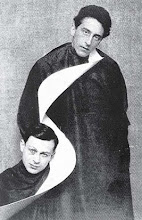
     The final image is a nice, atmospheric photo of Helion and some friends, including Alexander Calder, taken in the 1930s.


Wednesday, April 21, 2010

MASTER OF THE BURIN: THE BOOK ILLUSTRATIONS OF JOHN BUCKLAND WRIGHT, 1897-1954 (PART 3)


"In the 1930's, 1940's and early 1950's, three artists did a great deal to launch British engraving into the exciting waters of contemporary European art:  the New Zealander John Buckland Wright and two Englishmen, William Hayter and Stanley Gross.  They all had French attachments and were quite independent of the influences of earlier and highly successful schools of British engraving.  Buckland Wright helped Hayter to found his famous Atelier 17 in Paris.  At this workshop in which artists experimented at novel methods of printmaking, JBW (as he became known by his initials) worked with artists such as Matisse, Chagall, Picasso, Miro and Dali.  Later when teaching at the Camberwell and Slade Schools of Art, he was able to communicate to his pupils his experiences of how these artists worked."

"If William Hayter described himself as a 'third-class passenger with the Surrealists', JBW was one to hop on and off the train, experimenting with abstract and surreal styles, while not adopting wholeheartedly the method a la Breton.  During 1934 and 1935, he produced a large number of prints, nearly all abstract or surreal, in a style that he claimed was a mix of the 'blood' of realism and the 'brains' of the abstract rhythm.  The subject matter -- images of women entitled Composition or Artist or Model -- were sometimes in copper engraving but more often in wood.  They were characterised by strong lines and clear and precise delineation.  This recent publication, compiled by Christopher Buckland Wright, reveals some of his 'surreal' outputs:  Surreal Times:  The Abstract Engravings and Wartime Letters of John Buckland Wright.  Denby Dale [England]:  The Fleece Press, 2000.

 Note:  Buckland's range, versatility and subtle humor is impressive.  The series of aquatints he created to accompany the Folio Society edition of Boccaccio's The Decameron, translated by Richard Aldington, is highly enjoyable.  A large amount of Buckland's work can be seen and appreciated at the website: http://www.library.otago.ac.nz/exhibitions/jbw/index.html


Sunday, April 18, 2010

New Lizard On The Block; Baby Fruit Bats (Benjamin and Zephirina)


ACravan, Outlier Entertainment Partners, Tenerife, Mombassa, Mexico City, New York.