Showing posts with label The Bride Stripped Bare By Her Bachelors Even. Show all posts

Monday, September 15, 2014

GREETINGS FROM HERNE BAY


Dreamer

The blue sea
lies at white cliffs and a brown
skinned child dressed in virgin white
sung songs there, bringing tears
to sad sweet hearts.

All the songs were called I bow the dawn.


Note:  Amid all the weekend's headaches, I was fascinated to learn that Herne Bay, Kent native Kevin Ayers had published a small book of poetry, Leo The Lilo, with collaborator David Gray in 1965, and grateful that I was able to read it online.  Kevin's song lyrics are far better realized than the poems, but it is always good to gain another view into the mind and work of a developing great artist.  

Kevin always ran down Herne Bay when he spoke about it, but I know he returned there regularly throughout his life.  One thing he never mentioned (because I'm sure he wasn't aware of it) was the fact that Marcel Duchamp visited Herne Bay in 1913, chaperoning his niece Yvonne during her summer holiday.


1913 was the Nude Descending A Staircase/Armory Show year, two years ahead the artist's semi-permanent departure to Manhattan where he created The Bride Stripped Bare By Her Bachelors, Even (1915-23), also known as The Large Glass, and one year prior to the beginning of World War I.  

This 2013 Telegraph (UK) article (Link) describes Duchamp's surprising and pleasant Kent sojourn (anyone for tennis?) and the possible visual influence of the seaside resort on the artist's eternally enigmatic masterpiece. 

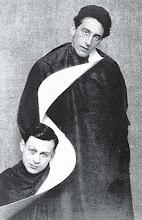
In first position above is a postcard Duchamp sent to a friend from Herne Bay recording pertinent details of the trip. The other images are tantalizing fragments from The Green Box, Duchamp's poetic-hermetic notes informing, undergirding and supplementing The Large Glass. 
Adding to the word/picture assemblage is Kevin's chanson Puis-Je? (Link).

Well, May I?


Cream: Anyone For Tennis (Link)


Tuesday, September 13, 2011

Undry Eyes -- Richard Hamilton Passes Away


Richard Hamilton, "Just What Is It that Makes Today's Homes So Different, So Appealing?"


By Reid Singer (ArtInfo)

Published: September 13, 2011

          Richard Hamilton, the painter and collagist whose work became a fulcrum of the British Pop art canon, passed away at the age of 89 this morning. The artist's death was announced by the Gagosian Gallery, which represents his work. No cause was released. 

         Hamilton began studying painting in night courses at St. Martin's School of Art while holding down work as a draftsman and industrial designer. He soon entered the Royal Academy schools and taught at St. Martin's following the Second World War. As a member of the British Independent Group, Hamilton was a leader in the early Pop movement, pioneering the re-appropriation of images from magazines and other forms of print advertising in painting and sculpture.

          Known for his powerful and inventive work that commented on the state of British postwar consumer culture, Hamilton was probably most famous for "Just What Is It That Makes Today's Homes So Different, So Appealing?", a 1956 collage installation of a bodybuilder and model planted in a middle-class living room. Predating Andy Warhol's experiments with Pop themes by nearly a decade, the work was featured in the "This is Tomorrow" show at the Whitechapel Gallery and made Hamilton an international star. A teaching post at the Royal College of Art followed, where his mentees included David Hockney and Peter Blake.

         Hamilton was outspoken politically, and frequently incorporated social activism into his artistic practice. In 1964, he painted a portrait that satirized then Labour Party leader Hugh Gaitskell for rejecting a policy of nuclear disarmament, and between 1981 and 1983 he created a trilogy of paintings based on the treatment of political prisoners by the Irish Republican Army.

     Before his death on Tuesday, Hamilton was actively working on a retrospective that was expected to travel to Los Angeles, Philadelphia, London, and Madrid from 2013 to 2014. In its statement, Gagosian Gallery highlighted Hamilton's "sense of humor, energy, sparkle and modesty that was his innate character." Larry Gagosian is quoted saying, "This is a very sad day for all of us and our thoughts are with Richard's family, particularly his wife Rita and his son Rod." 


Richard Hamilton's remarkable, painstaking reconstruction of Marcel Duchamp's The Bride Stripped Bare By Her Bachelors, Even (1915-23), 1965-66, Tate Gallery, London

NOTE:  FOR THE CURIOUS AND/OR ENTHUSIASTIC, EACH IMAGE HERE ENLARGES BEAUTIFULLY WHEN CLICKED. I THINK THE RICHARD HAMILTON PORTRAIT IS VERY BEAUTIFUL.

Tuesday, August 16, 2011

The Bride Stripped Bare By The Bachelors (V. Stanshall/N. Innes)


(So The Boys Got Together And Formed A Band;
Fate Played The Straight Man, And Since Then They've Never Looked Back.)


We arrived at the gig looking rough.
Not happy, We'd all had enough
Of Eight Hours On The Road.


Legs Larry said: "Ee, It's the Boozer for me, dear boy."
(Yip, Yip! Yes, Indeed!...)


And the Hotel Reception was empty and cold,
With horrid red wallpaper, forty years old.
It stank like a Rhino House.


Mr. Slater said: "Pooh -- I can smell vindaloo."
"Oh, really?"
"No, Sir. O'Reilly!"


As We Wave To The People Who Frown
At Our Hair As We Ride Into Town. . .


And Chalky and Noz set up the gear
At the club where the Do-Pal Show would appear
In Person As Themselves


And Neil, Fred and I played darts for a while
Before we switched on our theatrical smiles


LINK:


Has there ever been?  I ask You.


Monday, January 31, 2011

Twice Foretold: The Bride Stripped Bare and The End Of The Affair


I. 

Given: 

        1. The Waterfall, 

        2. The Illuminating Gas

(Étant donnés: 

        1. La chute d’eau, 

        2. Le gaz d’éclairage)

        -- Marcel Duchamp, from The Bride Stripped Bare By Her Bachelors, Even (La Mariee Mise A Nu Par Ses Celibataires, Meme), 1915-23


II.

A story has no beginning or end:  arbitrarily one chooses that moment of experience from which to look back or from which to look ahead.  I say 'one chooses' with the inaccurate pride of a professional writer  who -- when he has been seriously noted at all -- has been praised for his technical ability, but do I in fact of my own free will choose that wet black January night on the Common, in 1946, the sight of Henry Miles slanting across the wide river of rain, or did these images choose me?  It is convenient, it is correct according to the rules of my craft to begin just there, but if I had believed then in a God, I could also have believed in a hand, plucking at my elbow, a suggestion, 'Speak to him:  he hasn't seen you yet.'

        For why should I have spoken to him?  If hate is not too large a term to use in relation to any human being, I hated Henry -- I hated his wife Sarah too.  And he, I suppose, came soon after the events of that evening to hate me: as he had surely must have hated his wife and that other, in whom in those days we were lucky enough not to believe.  So this is a record of hate far more than of love, and if I come to say anything in favour of Henry and Sarah, I can be trusted:  I am writing against the bias because it is my professional pride to prefer the near-truth, even to the expression of my near-hate.

        -- Graham Greene, The End Of The Affair, 1951