Showing posts with label Siberia. Show all posts

Thursday, May 16, 2013

COLD SPRING (RESPECTING IT)


Next morning there was a magnificent halo; the monarch of day appeared surrounded by a luminous circle, radiant with all the prismatic colours. This phenomenon never lost its charm, for the Doctor, however frequently it occurred, and he always noted carefully down all particulars respecting it.


From :  Jules Verne, Voyages et aventures du capitaine Hatteras (1864)

Saturday, September 1, 2012

WHEN WILLIAM CAME


The meal was begun in an appreciative silence; a picnic in which three kinds of red pepper were available for the caviare demanded a certain amount of respectful attention.


“My heart ought to be like a singing-bird to-day, I suppose,” said Cicely presently.


“Because your good man is coming home?” asked Ronnie.


Cicely nodded.


“He’s expected some time this afternoon, though I’m rather vague as to which train he arrives by.  Rather a stifling day for railway travelling.”


“And is your heart doing the singing-bird business?” asked Ronnie. 


“That depends,” said Cicely, “if I may choose the bird.  A missel-thrush would do, perhaps; it sings loudest in stormy weather, I believe.”


Ronnie disposed of two or three stems of asparagus before making any comment on this remark.


“Is there going to be stormy weather?” he asked. 


“The domestic barometer is set rather that way,” said Cicely.  “You see, Murrey has been away for ever so long, and, of course, there will be lots of things he won’t be used to, and I’m afraid matters may be rather strained and uncomfortable for a time.”


“Do you mean that he will object to me?” asked Ronnie.


“Not in the least,” said Cicely, “he’s quite broad-minded on most subjects, and he realises that this is an age in which sensible people know thoroughly well what they want, and are determined to get what they want.  It pleases me to see a lot of you, and to spoil you and pay you extravagant compliments about your good looks and your music, and to imagine at times that I’m in danger of getting fond of you; I don’t see any harm in it, and I don’t suppose Murrey will either—in fact, I shouldn’t be surprised if he takes rather a liking to you.  No, it’s the general situation that will trouble and exasperate him; he’s not had time to get accustomed to the fait accompli like we have.  It will break on him with horrible suddenness.”


“He was somewhere in Russia when the war broke out, wasn’t he?” said Ronnie.


“No,” said Cicely, “but he’ll come back naturally feeling sore and savage with everything he sees around him, and he won’t realise just at once that we’ve been through all that ourselves, and have reached the stage of sullen acquiescence in what can’t be helped.  He won’t understand, for instance, how we can be enthusiastic and excited over Gorla Mustelford’s début, and things of that sort; he’ll think we are a set of callous revellers, fiddling while Rome is burning.”


“In this case,” said Ronnie, “Rome isn’t burning, it’s burnt.  All that remains to be done is to rebuild it—when possible.” 


From:  Saki, When William Came: A Story Of London Under The Hohenzollerns,  London, John Lane, 1913.

Saturday, December 24, 2011

A Winter's Tale -- Trouble In Tomsk


Tomsk, Lenin Square


     State prosecutors in the Siberian city of Tomsk are trying to ban the Russian translation of the Bhagavad Gita, an important Hindu scripture, because they believe the text too "extremist."

     The trial, which started in June, has attracted a lot of negative attention, and sparked protests, which even closed down the Indian parliament Monday, according to the Guardian.

     The court's decision concerning the proposed ban was expected on Dec. 19, but officials pushed back the date until Dec. 28.

     Prosecutors reportedly took issue with the Russian translation of the sacred text called "Bhagavad Gita As It Is", with commentary by A.C. Bhaktivedanta Swami Prabhupada, founder of the International Society for Krishna Consciousness (ISKCON), because it promoted "social discord" and hatred toward non believers, according to The Hindu 


Pre-1917 photograph of Trinity Cathedral, Tomsk (demolished 1934) 


     However, ISKCON followers and about 15,000 Indians living in Moscow say the proposed ban was brought about by a "majority religious group's" intolerance toward the Hindu religion, the Asia Times reports.

     Protesters have even called on diplomats to intervene in the case. 

     But in an exclusive interview with CNN-IBN, Ambassador of Russia to India Alexander Kadakin explained the government cannot influence the courts. He did, however, acknowledge the "madness" must come to an end. He said: 

"...It is not the Russian government that started the case; these are the some petty people in far away though very beautiful city of Tomsk who did it. The government has nothing to [apologize] for, the government can only testify and reiterate the love and affection and highest esteem our nation has for Bhagavad Gita."


Tomsk State University


Last year, courts banned Adolf Hitler's "Mein Kampf," but a spokesperson for ISKCON India said comparing the Bhagavad Gita to the dictator's autobiography was outrageous.

     "To compare Hitler to Lord Krishna is an insult to Indians across the globe," Vrajendra Nandandas told the Wall Street Journal. "Our cultural identity and ancient beliefs have been mocked at today."

     If the book is banned, ISKCON says the government should expect "intensified" protests, the Hindustan Times reports.


Tomsk, 1898


NOTE:   Although I usually try to read the mediocre-at-best Huffington Post as little as possible, this story about the events in Tomsk caught my eye.  

So did this inconclusive and unsatisfying Shroud of Turin story.

I've included all the interesting links in the Tomsk article.  

They're marked in REDAnd remember:


Tuesday, November 8, 2011

People Get Ready (The Iceman Cometh): Siberians Share DNA With Extinct Human Species!!


Man's ancestors mated with Neanderthals and other related hominids during human evolution, according to a new study.


      Researchers have found that people in East Asia share genetic material with Denisovans, who got the name from the cave in Siberia where they were first found.  Man's ancestors mated with Neanderthals and other related hominids during human evolution, according to a new study.

      The new study covers a larger part of the world than earlier research, and it is clear that it is not as simple as previously thought.


Denisova Cave 


      Professor Mattias Jakobsson, of Uppsala University in Sweden who conducted the study together with graduate student Pontus Skoglund, said hybridisation took place at several points in evolution and the genetic traces of this can be found in several places in the world.

      He said: "We'll probably be uncovering more events like these.


      "Previous studies have found two separate hybridisation events between so-called archaic humans - different from modern humans in both genetics and morphology - and the ancestors of modern humans after their emergence from Africa.

      "There was hybridisation between Neanderthals and the ancestors of modern humans outside of Africa and hybridisation between Denisovans and the ancestors of indigenous Oceanians.


Valley of the Denisova Cave


       "The genetic difference between Neanderthals and Denisovans is roughly as great as the maximal level of variation among us modern humans."

      The Uppsala scientists' study demonstrates that hybridisation also occurred on the East Asian mainland.


      The connection was discovered by using genotype data in order to obtain a larger data set.
 
      Complete genomes of modern humans are only available from some dozen individuals today, whereas genotype data is available from thousands of individuals.

      These genetic data can be compared with genome sequences from Neanderthals and a Denisovan which have been determined from archeological material.

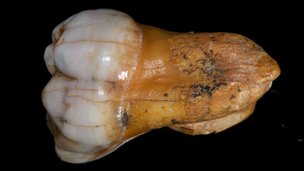
     Only a pinky finger and a tooth have been described from the latter.


 The Denisova tooth

  
      Genotype data stems from genetic research where hundreds of thousands of genetic variants from test panels are gathered on a chip.

      However, this process leads to unusual variants not being included, which can lead to biases if the material is treated as if it consisted of complete genomes.

      Prof Jakobsson and Skoglund used advanced computer simulations to determine what this source of error means for comparisons with archaic genes and have thereby been able to use genetic data from more than 1,500 modern humans from all over the world.

      Prof Jakobsson said: "We found that individuals from mainly Southeast Asia have a higher proportion of Denisova-related genetic variants than people from other parts of the world, such as Europe, America, West and Central Asia, and Africa.


     "The findings show that gene flow from archaic human groups also occurred on the Asian mainland."


       Skoglund added: "While we can see that genetic material of archaic humans lives on to a greater extent than what was previously thought, we still know very little about the history of these groups and when their contacts with modern humans occurred."

     Because they find Denisova-related gene variants in south east Asia and Oceania, but not in Europe and America, the researchers suggest that hybridisation with Denisova man took place about 20 million years ago, but could also have occurred earlier.


      This is long after the branch that became modern humans split off from the branch that led to Neanderthals and Denisovans some 300,000 to 500,000 years ago.

    Prof Jakobsson said: "With more complete genomes from modern humans and more analyses of fossil material, it will be possible to describe our prehistory with considerably greater accuracy and richer detail." 
      The findings were published in the online edition of the journal PNAS.


__________________
_________________ 


On the cusp of the Tunguska Event


NOTE:  This story interests me for several reasons:

I.   Jane's been studying this subject in school this term, reading William Goldman's The Inheritors, as well as other relevant scientific and anthropological material.  It's on her mind, in our conversations and review sessions, and you know: These grades go to Colleges!!.


Artist's renderng of Tunguska Event (pre-impact)


II.  Could anything be more fascinating than the study of Early Man?   My Physical Anthropology course at Swarthmore College, taught by Professor Steven Piker, was utterly engrossing -- every week a serious adventure in learning and discovery.  I will always remember Professor Piker's deep love and knowledge of his subject, his passionate, infectious enthusiasm and his unfailing courtesy and personal kindnessI also recall the very weird "National Character" school of physical anthropology which developed in the 1940s and how it seemed to elevate bigotry and gross generalization to the level of being a unified theory of natureUber-simplistic explanations of complex phenomena may prove false, but they can have mad memorability and panache.


Tunguska Event aftermath


III.  When I was very young, my father told me on several occasions that his own college anthropology professor once advised him that he was "a perfect example of Transalpine Man."  My conversations with my father tended to be fragmentary (like much of ancient history) and I have no idea what he meant by this.  I wanted to research this because I thought that if my own father was a perfect example of Transalpine Man,  I must at least be a pretty good specimen and this might be a good resume item.

(Speaking of Siberia, as we were a short minute ago, I absolutely believe that the other side of my family tree came through Ellis Island shortly after landing on this planet as a result of the 1908 Tunguska Event. All the facts fit. I don't believe this can be disproven.)

Unfortunately,  my research was pretty fruitlessThe only references I could find to "transalpine men" concerned a Swiss Catholic order called the Transalpine Redemptorists and these were clearly irrelevant.  

For the record,Webster's defines "transalpine" as follows: 


"Adjective
1.  situated beyond the Alps, especially toward the north as viewed from Italy.
2.  passing or extending across or through the Alps: a transalpine railway.
3. of, pertaining to, or characteristic of peoples or lands beyond the Alps.

Noun
4. native or inhabitant of a country beyond the Alps.


Tunguska Event aftermath 2


My father's "people," such as they are (if you're nice to me, I'll never introduce them to you and you won't need to count the silverware so often and so carefully), have no obvious connection to the Alps My father himself preferred flatter, more urban sections of France, Italy and Switzerland.   

If anyone can shed any light on this very odd and obscure anthropological description, however, I'm all (Transalpine) Ears, like my maternal ancestor Mr. Spock, my only celebrity relative except for Major General Smedley Darlington Butler (but that's through marriage).


Tunguska CraterI can see my house from here.


Musical Entertainment (for hominids and others):  


Query of the Week:  What can possibly surpass the unsurpassable People Get Ready by The Impressions?  

One of my most vivid and stirring memories is picking up the telephone at the ABC Records offices at 1414 Avenue of the Americas early one morning in 1977 and finding on the other end of the line a person introducing himself as Jerry Butler, who was calling to speak to our office head, Barbara Harris.  

Hearing the beautiful, sonorous voice, I found myself saying without thinking: 

"The Ice Man?"  

Mr. Butler said YesIt was quite a thrill. 

(N.b.  The Ice Man does not appear on People Get Ready.)