Showing posts with label John Lennon. Show all posts

Monday, November 25, 2013

REMAKE/REMODEL


The last several days I've been mentally composing, discarding and recomposing my thoughts on the pertinent subject, "Defining Incompentency Downward," which comes to mind whenever I see or hear fresh news reporting about the Obamacare roll-out.

It seems that my entire life, especially following college, has been spent trying to become competent at one thing or another, and once I attained it, putting that competence to work.


It hasn’t been at all easy, but a long time ago in high school (where whatever natural aptitude and talents I had were still sufficient to get me through what I now realize was "the audition") I first read Plato's admonition: “Hard is the good.” 

I believe that, and although it isn't a total surprise to me that I was once able to achieve competence in the academic study of art history at a fine graduate school (I was, after all, interested enough in the subject to choose risking long-term penury by pursuing it deep down the rabbit hole), the fact that I was ultimately able to become a competent lawyer staggers me because mystery, abstraction, and indifference reigned supreme for me in law school.


When I first heard President Obama say that key next steps in the Obamacare roll-out included a “re-roll-out,” “rebranding” and “remarketing,” my initial thoughts were: a) how superficial; b)how expensive; and c)  who's going to pay for this?

Throughout my career I’ve worked with skilled marketing and sales executives extending all the way from junior trainees to CEOs.   

None of these individuals were ever easy on themselves. Most were financially astute and hewed to the maxim “spend the company’s money as if it were your own.”   

I have witnessed and weathered my share of corporate difficulties, even disasters, but until the Obamacare capers and fiascoes, I have never seen such bottom-to-top incompetence and complacency  daily on display.  Serious drug abusers I have known (ironically, all in IT jobs) did far better work with more pride and attention to detail.

N.b.:  I am not forgetting the cur-like serial dishonesty (by-product of contempt, malevolence and perhaps sociopathy) attending the Obamacare incompetence, but that is a subject for another blog. 


Roxy Music: Remake/Remodel (Link)

John Lennon: Gimme Some Truth (Link)


Addendum:  An executive who formerly worked as a senior marketer for Pizza Hut told me this story one night.  At Pizza Hut, the biggest reluctantly pondered imponderable and existential internal corporate question was discerning why Pizza Hut made such lousy pizza.  Long study and massive expenditure ultimately revealed the answer: they had an oven problem. 

Pizza Hut ovens, which franchisees were required to purchase, simply could not produce good pizza.  The company devised a retrofitting plan, altering design, and solving the problem. 

However, on a parallel track, the company also ran a cost/benefit analysis comparing total re-engineering costs with the price of remarketing/rebranding; i.e., turning out the same vile product but simply promoting it (presumably) more effectively.

Pizza Hut's Remakers/Remodelers came out on top.   

And that is why Pizza Hut pizza is still beneath contempt.  


My wife always says: "These are the Dark Ages, but even in the Dark Ages people lived enjoyable lives."
 

Dave Edmunds: Get It (Link) 


VIVA ROXY MUSIC!


Wednesday, August 1, 2012

FILE UNDER POPULAR (TOMORROW NEVER KNOWS)


I.


   Contemporary with both the waning Yardbirds and the waxing Beatles, another innovating group were starting to win a following in London: The Who.  Aside from their Pop Art image, so in tune with “Swinging London’s” image of itself, and apart from their violence and ground-breaking lyrics, The Who, like The Yardbirds,  but to a far greater degree, had begun to extend the possibilities of pure noise and emotional expression.  With the amplifier turned up loud, The Who discovered that to be violent with the instrument sounded like that violence. Townshend would smash his guitar into his speakers, or saw the neck and strings against a microphone stand or throw the guitar at a wall or onto the floor.  Feedback, which had been feared and avoided as unpleasant (because unwanted) became another sound available to music and accessible to control.  Can I explain how important this was?  It sounds negative, decadent.  It was exhilarating, releasing.  It seemed to be beyond aesthetics and commodity.  The moment of rage and damage to the “expensive” instrument, the moment of not caring about that damage, of sacrifice, seemed real.  Like the thrill we got when Harpo Marx threw all that stupid bureaucratic paperwork all over the floor at the customs house.


II. 


    Phil Ochs hanged himself in April, 1976.  Elvis Presley was found dead one year later, in August 1977.  Both were entertainers, singers, but beyond this it is hard to imagine two men with less in common.  Ochs was a political radical, Presley an arch conservative.  Ochs wrote his own songs and belonged to the “counter-culture,” Presley was a creature of Colonel Tom Parker and the Record Industry.  Ochs produced, Presley was consumed.  Yet there is a thread winding around these men, and one that is well worth unraveling.


NOTE: 


   Over the past few days, I’ve been re-reading File Under Popular, Chris Cutler’s “Theoretical and Critical Writings On Music.”  First published in 1985 and revised in 1993, I think it remains the most enjoyable, eye-opening (in terms of being accurately and usefully descriptive) book on various forms of post-World War II popular music I know.  If you find the excerpts included above interesting or intriguing, you might want to seek out a copy.


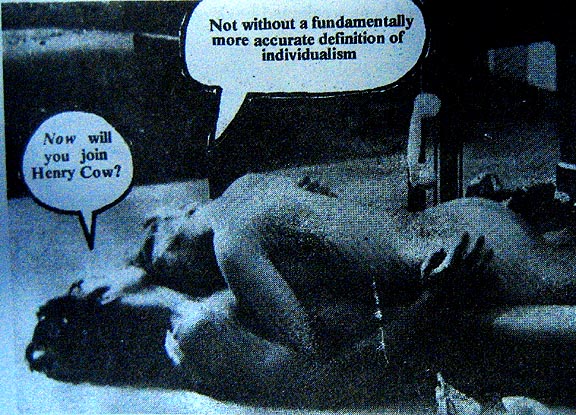
   The author is the great Henry Cow drummer, who is also the proprietor of the superb and valuable ReR record label and distribution company out of England (and the author of ReR’s always compulsively readable catalogue).  Tendentious and rooted, as might be expected, in Marxism, Cutler is a disciplined critic and writer, so unusual in this genre.  And I think his musical gifts make this book “play” in a style that is exciting, dramatic and rhythmic.


   One can’t help but feel that Cutler’s and Henry Cow’s “outsider” status (to a degree self-conscious and self-imposed) to the main gearworks of what used to be recognizable as the "Record Industry" is what confers him his critical perspective, both in the objective observer sense and as the occasionally overly pejorative scold.  (I mean, his putdown of “A Whiter Shade Of Pale” is ludicrous, over-the-top.)  


   And one can’t help occasionally but imagine what kind of world it would be if Henry Cow, rather than The Beatles, had been “Top Of The Pops,” and a sharp writer like John Lennon and Chris Cutler exchanged places?  Tomorrow never knows.   


Excerpts from Chris Cutler, File Under Popular, Brooklyn, Autonomedia, 1993.


Henry Cow: Nirvana For Mice (Link)

Henry Cow: Industry (Link)

Peter Blegvad: Daughter (feat. Chris Cutler and John Greaves)(Link) 


Monday, November 8, 2010

(Hideous) Silver Commemorative John Lennon Coin Issued by United Kingdom Royal Mint; Two Cleopatras


"Imagine" John Lennon's face pictured on an English Five Pound Silver Coin.........

Previously, I would have said that I would have found that extremely difficult to do, but last week the United Kingdom Royal Mint removed  the agency of imagination from the equation by actually awarding Lennon a graven berth on official silver and gold UK currency, joining previous "special coin" honorees William Shakespeare, Winston Churchill, Charles Darwin and Florence Nightingale.

Sadly, the Mint has created a totally pedestrian image of the great man.

I think everyone probably has their favorite mental picture of the leader Beatle.  Lennon was a flamboyant man in a flamboyant business and provided during his career a variety of hair, clothing and accessory styles and attitudes suitable for memorialization, to choose from. 


Personally,  I would have preferred a coin pose based on Lennon's "Rolling Stones Rock and Roll Circus" television performance of  "Yer Blues", showing John clad in proto-Working Class Hero denim, still looking youthful, totally engaged and incredibly cool.

Possibly something from the long hair and beard "Bed Peace" period would have conveyed the essential, transgressive Lennon, hiding in plain sight amid bedclothes and an aureole of hair and glasses, but always projecting a deliberate, aggressive image. An engraving of the iconic photograph showing an exuberant John giving the "V" sign in front of the Statue of Liberty in New York City after resolving his Nixon-era immigration problems would have been incredibly cool and "disruptive" (as they like to say these days), although this obviously would have been an unlikely choice for the Mint.  (Money connoting stability probably hews closer to their party line.)


Regarding the question of John Lennon appearing on money at all, I'm ok with that.  Lennon's version of  Barrett Strong's  "Money" (written by Berry Gordy and Janie Bradford) on the Plastic Ono Band's Live Peace In Toronto lp is killer (Yoko Ono's idiotic writhing around in the large bag notwithstanding).  And in "Revolution", John wrote an exceptionally fine, somewhat enigmatic song, that still has me saluting his brave and thoughtful qualities as a writer and reveling in his talents for melody and rhythm.  Because John apparently could live with many contradictions and provided such pleasure and, to a degree, guidance in my life, I feel that I can endeavor to struggle through the odd sight of his visage on a piece of medium-denomination metal money.

Unfortunately, the Mint's selection and rendering of its John Lennon image is Dumb, Dull and Inert -- all anti-star, anti-John Lennon qualities. The Mint, of all people, should know that Money Portraits need to be the "Money Shot" every time.


Cleopatra VII coin, ca. 40 BC

I was reminded of this recently when I visited the Cleopatra exhibition currently on view at the Franklin Institute in Philadelphia.  This is a fascinating and extremely moving show showcasing the results of recent archeological excavations conducted in and around Alexandria, Egypt, whose goal is to enlarge our understanding of the remarkable life of Cleopatra VII (b. 69 BC -- d. 30 BC).   The exhibition includes some remarkable sculptural and numismatic portraits of the queen that depict a beautiful, highly intelligent looking woman -- images that contradict later, revisionist post-Actium Roman renderings intended to present the vanquished Egyptian ruler as physically unattractive and unformidable.


Cleopatra VII coin, ca. 36 BC

I've included above pictures of some interesting Egyptian Cleopatra VII coins produced by her Royal Mint in Alexandria. Below are pictures of currency showing her remarkable daughter, Cleopatra Selene II (b. 40 BC -- d. 6 BC), who later ruled as Queen of Mauretania in North Africa, along with her husband King Juba II (b. 52 BC -- d. 23 AD), who was born a prince of Berber descent prior to becoming an important Roman ally.  I'm fascinated by Cleopatra Selene's story and intend to explore it in depth in the future.


Juba II and Cleopatra Selene II coins (both coins show Juba II portrait and Latin inscription "Rex IUBA" on face; top coin shows  Cleopatra Selene II portrait on reverse, bottom coin shows Cleopatra Selene II symbol and Greek inscription "BACILICCA KLEOPATRA" on reverse).

Cleopatra Selene is buried along with her husband in the Mausolium he erected (on the road between Algiers and Chercell in contemporary Algeria).  The edifice bears a moving inscription, composed by the queen herself, reading:

The moon herself grew dark, rising at sunset,
Covering her suffering in the night,
Because she saw her beautiful namesake, Selene,
Breathless, descending to Hades,
With her she had had the beauty of her light in common,
And mingled her own darkness with her death.
 
As a self-portrait in death composed by a still-living person, I struggle to decide whether this is elegiac or funerary.  I'll go with the former because it keeps memory alive and vital.

  
Royal Mausolium of Mauretania (erected 3 BC)

The tearing, harsh recollection of John Lennon's murder is still with us, but so are the art and the warm memories he left.  No amount of journalistic blather or raking-through-the-ashes-for-commercial-purposes-more-pointless-remix-ventures-surely-to-come (I'm certain that John had highly developed and severe editorial judgement and would be appalled to see his deliberate discards fished from the trash) can erase those.  

I feel very lucky to have experienced The Beatles' career in what they now like to call "real time".  

In retrospect, that era  -- its beginning, its middle and its end -- seems really exceptional and affected me so deeply that it continues to define in many ways my reality.