Friday, June 15, 2012

To The (Long Point) Lighthouse


Without the slightest doubt, October is Cape Cod’s best month.  On a good day, the air is crisp and cool, and the light is bright and sharp as a razor; the pale blue sea and the aquamarine sky sparkle and compete for the eye’s attention, the atmosphere is so clear and devoid of haze that you can stare off across the sea into the far heart of infinity.  Between sunset and darkness the waters of the harbor can pass through a whole unbelievable cycle of color changes, and this cycle itself can change completely from day-to-day.  At sunset it might be a bright light, blue-tinged with rose, and a few minutes later it will become like polished silver, then like burnished pewter, and next it will be gun-metal blue like a polished Toledo blade.  And if there happen to be dark clouds in the background across the harbor, the water will turn into the richest tone of indigo you could imagine;  the white boats bobbing in the harbor will become whiter than white, something outside the spectrum, a luminescent trick played on the retina by a never-never landscape.


   The little old lighthouse sitting out on Long Point is the constant gauge, like an optical metronome, to which the eye always returns to discover the beat, the vibrations of each day’s visual symphony.  As William Butler Yeats said, “Lulled by this sensuous music, one neglects monuments of unageing intellect.” 



Note:   Perusing Howard Mitcham's wonderful Provincetown Seafood Cookbook (Reading MA, Addison-Wesley, 1975) last night, something I hadn't done for some time, this passage struck me as being exactly right.  (So, for that matter, is everything else about Mitcham's book, which is a must-read-and-own for fish-lovers, Cape Cod enthusiasts, and anyone who likes charming marginal drawings by artistically gifted authors.)   Over the past decade, I’ve mostly recovered from my previous antipathy to the state of Massachusetts.  (It was a matter of putting some unfortunate memories behind me and replacing them with some good new ones.)   We have spent a fair amount of October time on the Cape during annual reunions of our “Wuhan Six” Chinese adoption group and, with the exception of one unseasonably Equatorial year and another Arctic one (both exciting!), Mitcham’s description is spot on.


Howard Mitcham, who passed away in 1996, was a legendary figure in Provincetown life, both in cooking and artistic circles.  One aspect of his book which I appreciate, something current “celebrity chef” Anthony Bourdain also cited when he nominated Mitcham’s book in the New York Times as the out-of-print cookbook most deserving reprinting, is Mitcham’s championing the grand culinary qualities of certain of our less “prestigious” fish.   Adapting a smart wine adage, there isn’t a fish for every occasion, but there is an occasion for every fish. 


Thursday, June 14, 2012

Better Living Through . . . Pizza "Untouched By Human Hands"


  Ever have a sudden urge for crisp-crusted, ooey-gooey, cheesy pizza? You want it STAT. Not in the time it takes to preheat the oven to 500 degrees for a frozen pizza. Not in the 20 minutes it takes for the pizza delivery guy to arrive. And certainly not in however many hours it would take to make homemade dough and marinara sauce.

   Get ready for Let's Pizza, a pizza vending machine that promises to deliver a piping hot pizza pie made from scratch in less than three minutes.


   The brainchild of Italian entrepreneur Claudio Torghel, the machine will be distributed by A1 Concepts, based out of the Netherlands. It's expected to hit our shores later this year, according to the industry website Pizza Marketplace. The company is expected to set up its U.S. headquarters in Atlanta.


   What is remarkable about the new machine is that it truly makes pizzas to order, including kneading and rolling out the dough. (The above video says the leavening takes place in a blistering hot infra-red oven.) There are more than 200 toppings from which to choose. The machine can even  accommodate a variety of dietary restrictions, such as those for vegetarian and Kosher diets.


  "Let's Pizza is a huge success in Europe and especially in Italy. That was proof for us that we have a very good pizza," A1 Concepts Chief Executive Ronald Rammer told Pizza Marketplace.


      The pizza arrives in an insulated take-away box. The machine takes cash and credit cards. A 10-inch pizza will sell for about $5.95.


    Rammer said Americans could expect to see the new machines at malls, airports, hospitals, restaurants, hotels, supermarkets, universities, gas stations and bus stations.


    But perhaps the single best thing about Let's Pizza, according to the above video? The lack of the human touch.


   At several points in the above presentation, the makers stress cleanliness: Your "healthy and genuine pizza" is "untouched by human hands" and made in a "human-free environment."


    That would sound a little bit weird ... if we weren't drooling over the notion of piping hot pizza made from scratch.


Pizza Vending Machine -- How It's Done (In Italian) (Link)


Pizza Vending Machine -- How It's Done (In English) (Link)


NOTE:  Very odd, certainly.  But I’m a sucker for industrial films cum commercials and these are the best I’ve seen since the Japanese onigiri machine film I saw last year, which was the best I’d seen since the revelatory Cheetos cheese puff explication I saw two years ago.  Nothing will ever match the Wise Potato Chip films I used to watch hypnotically on The Modern Farmer early on Saturday mornings as a child, though, before the cartoons began.  The photo of the factory workers above, showing Seven Dwarves-like industriousness, though, is reassuring.  Human hands do enter into the picture, somehow, temporarily.

BULLET-PROOF


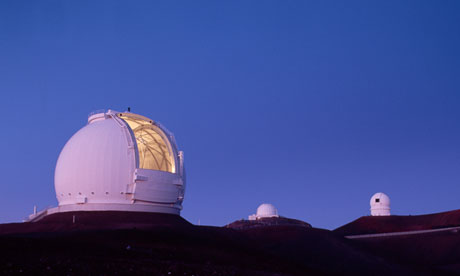
Hawaii observatory


The Hawaii Observatory on Mauna Kea. Photograph: Roger Ressmeyer/Corbis


A team of Japanese astronomers using telescopes on Hawaii say they have seen the oldest galaxy yet discovered.


  The team calculates that the galaxy is 12.91bn light years away, and their research will be published in the Astrophysical Journal. The scientists with the National Astronomical Observatory of Japan used the Subaru and Keck telescopes on the summit of Mauna Kea.


  A light year is the distance that light travels in a year, about 6 trillion miles (9.66 trillion kilometres). Seeing distant galaxies is in effect looking back in time.


  Richard Ellis of the California Institute of Technology, an influential expert in cosmology and galaxy formation, said the latest work was more convincing than some other claims of early galaxies.


  He said the Japanese claim was more "watertight," using methods that everyone can agree on. But he said it was not much of a change from a similar finding by the same team last year.


Here it is, such as it is.


"It's the most distant bullet-proof one that everybody believes," Ellis said.


  In 2010, a French team using Nasa's Hubble Space Telescope claimed to have discovered a galaxy 13.1bn light years away and last year a California team using Hubble said it had seen a galaxy 13.2bn light years away. Both Hubble teams published findings in the journal Nature.


Vija Celmins sketching “Reverse Galaxy.”  The truth in her work has always amazed me.


However, the two Hubble teams have yet to confirm their findings with other methods, said Ellis. A team of Arizona State University astronomers this month claimed to have found a galaxy 13bn light years away using a telescope in Chile.


  Current theory holds that the universe was born of an explosion, called the Big Bang, about 13.7bn years ago. Astronomers using the most powerful telescopes available are peering deeper and deeper into that dawn of the universe.


• This article was amended on 12 June 2012 to change references to "light years ago" to "light years away".


A “space painting” by the great Chilean Surrealist painter, Matta.  I have always believed space looks like this.