A couple in Japan's capital Tokyo are the first in the world to be married by a robot.
Tomohiro Shibata and Satoko Inoue like robots, so much so they didn't want a priest or a judge to marry them, they wanted a robot. So, at a rooftop restaurant in Tokyo the two were joined in matrimony by Kokoro Co.'s I-FAIRY robot.
Kokoro's I-FAIRY is capable of generating natural seeming movements like head nods and arm gestures based up on the speech it has been loaded with. The couple said that as robots had brought them together - they both work in the robotics industry - having one officiate over their wedding was a natural choice.
This is all a ploy, of course, so when the robot uprising comes, we're caught off guard. Just wait, you'll see.
Source: BBC
YESTERDAY afternoon, we walked over to Penn's Landing, where we had never been. It was a very beautiful day. A rock band was playing in the bandshell overlooking the Delaware River.
The lyric of theirs I remember goes like this:
"The robots have finished their tasks/Now they're in the back room, drinking from flasks".
Not so great, but intriguing, and on that sunny afternoon it made me think about this BBC news story, that terrific movie The Philadelphia Experiment starring Michael Pare and Nancy Allen (you can see Navy vessels on the river from Penn's Landing) and my friend's college rock band, The Band From Planet 5. They wrote lyrics like that.
Obviously, we should wish the couple a long and happy marriage.
We acquired our cat Claude (named because when pronounced the French way, it sounds like “cloud”, and he looks like a cloud) when Caroline saw him in the window of American Kennels on Lexington Avenue for what she thought was an excessively long period and she came to believe that no one was going to purchase him. Although he was quite expensive, his perceived plight turned this adoption into another cat rescue operation for us and, as I recall, Claude was “only” our fourth cat and, as the poet Christopher Smart said, quite correctly, in his Jubilate Agno, "For every house is incomplete without him and a blessing is lacking in the spirit."
Our Brazilian friends (they are numerous) referred to Claude throughout kittenhood and beyond as a “nene” (pronounced nay-nay), which is Brazilian Portuguese for “baby”. The name and description stuck for an overly long period due to his small size and, I suppose, because his luxuriant long creamy coat made him seem like a gorgeous female infant. When Jane was quite small, they could conveniently be seen as being quite small together and nursery teammates.
In terms of personality, however, nothing could be further from the truth. Claude has always been a small male lion, a cat of enormous personal power and dignity. His champion blood lines seem to confirm and be consistent with his “royal” demeanor, his natural good manners and inborn grace. Almost alone among our large family of cats he has a sweet tooth; cake, muffins and scones are irresistible to him. Claude’s sense of justice is also royal in the most elevated sense. He has always protected his older sister Rose, who along with Pansy, took him in hand as a kitten and taught him to mouse, is a good sibling, but as a naturalized American has also learned that good fences make good neighbors. He naturally commands and deserves respect.
A note to prospective Persian cat owners: Do groom them regularly. They enjoy it, it’s healthy for them, and if you don’t, you will be forced to submit them for “lion cut” grooming which, although “cool for summer” is essentially like turning your Persian into a Parris Island private. I’m not suggesting that Claude couldn’t make it in the Marines, but he’s a cat, not a soldier, and the only time I ever saw him look truly unhappy was when he was shorn of his fur.
Claude would love to sample an Eton Mess. First up is Lindsay Bareham’s version. Nigella Lawson’s recipe follows and then Heston Blumenthal’s. Blumenthal writes, inspiringly: “What is so wonderful about this dessert is that it cannot be improved upon.”
Method
Remove the strawberry stalks by running a small, sharp knife round the base of the leaf in a pointed plug shape while turning the strawberry. Quarter large fruit, halve medium ones and leaves small British strawberries whole. Place in a bowl and sprinkle the sugar over the top. Leave until the sugar melts and the strawberries glisten and turn juicy.
Break the meringue nests into small chunks. Whip the cream in a mixing bowl until it doubles in size and forms soft peaks — do not over-whip! Use a rubber spatula to loosely but evenly fold the meringue through the cream, then repeat with two thirds of the strawberries. Place a sieve over a small bowl and tip the remaining strawberries and sugary juices into the sieve. Use a spoon to press the strawberries through the sieve, scraping underneath so nothing is wasted.
Transfer the Mess to a serving bowl and swirl the strawberry sauce over the top in a pretty pattern.
Eton Mess 2 (Nigella Lawson)
Serves 4
INGREDIENTS
500g strawberries
2 teaspoons caster or vanilla sugar
2 teaspoons pomegranate juice
500ml whipping cream
4 x small meringue nests from a packet
METHOD
1. Hull and chop the strawberries and put into a bowl. Add the sugar and pomegranate juice and leave to macerate while you whip the cream.
2. Whip the cream in a large bowl until thick but still soft.
3. Roughly crumble in four meringue nests — you will need chunks for texture, as well as a little fine dust.
4. Take out a ladleful, or about 100g of the chopped strawberries and fold the meringued cream and the rest of the fruit mixture together.
5. Arrange on four serving plates or glasses, or in a
mound, and top each with some of the remaining strawberries.
Eton Mess 3 (Heston Blumenthal)
Serves 4
For the meringue
100g egg whites
100g caster sugar
100g icing sugar
For the mess
4 bananas
2 tbsp lime juice
200ml double cream
Seeds of 2 vanilla pods
1 tbsp kirsch
Grated zest of 4 limes
Preheat the oven to its lowest setting (110C/ 225F/Gas Mark ) and line a baking tray with parchment. Beat the egg whites until very stiff — this is important as they must stay stiff when the sugar is added. Beat in the caster sugar, then the icing sugar. Spoon the meringue mix onto a baking tray, in 12 even shapes. Cook for 4 hours, or overnight. They should be crisp all the way through, with no colour. Turn the oven off, open the door and leave the meringues inside so they cool down slowly.
Peel the bananas. Purée 2 of them with half the lime juice. Cut the other 2 bananas into 3mm-thick slices and mix with the remaining lime juice to prevent them browning. Whisk the cream until stiff — being careful not to overwhip it — and stir into the crushed or puréed banana. Then fold in the vanilla seeds and kirsch.
Break the cool meringue into large pieces, mix with the banana cream and the sliced bananas. Spoon into a bowl and grate over the lime zest before serving.
This morning I saw a famously insincere politician mouthing platitudes on television. In an attempt to agree with the person asking him rather predictable questions, he described congressional confirmation hearings for U.S. Supreme Court justices as "sad Kabuki theater". My first thought was: "how pretentious -- why drag Kabuki into this?"
Then, I learned that the word "kabuki" is believed to derive from the verb kabuku, meaning "to be out of the ordinary", which is hardly an apt description for most congressional hearings.
However, a propos of politics, one remark I discovered last year did come to mind. It's from the Scottish novelist Muriel Spark and it goes like this: "All politicians simply want to manipulate people; that, mixed with a marked tendency to kleptomania".
I found the Kabuki photo above on another blogger's website. She entitled it, interestingly, "Congressional Kabuki". I have no idea what she meant.
But I'm "re-cured". No more morning television.
Following is a superb recipe for Tempeh and Tofu Cooked Salad, which is taken from Sri Owen's Exotic Feasts:
425 g (14 oz) tempeh
375 g (12 oz) tofu
125 g (4 oz) beansprouts
2 green chilis, seeded and finely sliced
3 shallots, finely sliced
1 tsp very finely chopped ginger
1 clove garlic, crushed
2 tbsp. mild vinegar
1 tbsp light soy sauce
1/2 tsp mustard
1 tsp sugar
6 tbsp water
salt to taste
125 ml (4 fl oz) sunflower oil for frying the tempeh and tofu
Cut the tempeh and tofu into thin pieces, about 2.5 cm (1 inch) square. Wash the beansprouts and drain in a colander.
In a non-stick frying pan, fry the tempeh in several batches until it is just beginning to turn yellow. Do the same with the tofu. Set these aside on absorbent paper.
Discard the oil, except for 2 tablespoonsful. Fry the chilis, shallots, ginger and garlic, stirring continuously for one minute or so, then add the vinegar, soy sauce, mustard and ginger. Stir again and add the water. Let this mixture simmer for 2 minutes, then taste and add salt if needed.
Now put in the fried tempeh and tofu, stir them around and add the beansprouts. Stir again and leave to simmer for just 2 minutes. Serve warm or cold as preferred.
Please note that Sri Owen serves this dish as part of a vegan menu consisting of:
Sweetcorn and smoked tofu soup
Wild and white rice pilaf served with:
Spiced aubergine loaf with red pepper sauce and
Tempeh and Tofu cooked salad
Avocado and coconut ice cream
This is the only part of the menu we have prepared, but I've never gone wrong with Sri Owen's recipes or recommendations.
Yesterday, when Miss J. B. Cravan’s wristwatch beeped at 7 am on the desk where she left it the night before, it woke the somnambulist inhabiting the space, who was sitting, waiting and watching, delayed and arrested. He was dreaming about his “blog” and planning to compose a dismayed and disgruntled piece called Tired Of Waiting For You, using the title of the famous Kinks song. He anticipated problems in the writing because, to quote another song he liked (by Kevin Ayers), “there’s not a lot to say, when you’re feeling this way”. Unlike the Kinks song, which is terrific, but basically trivial in its subject matter, the Ayers song says it all in terms of terminal frustration, e.g., “when you’re up, they’ll love you to death/when you’re down, they’ll steal your last breath”. For the somnambulist, irresolution and problems still seemed to comprise the unchanging daily menu.
Quite suddenly, things improved. Can’t say why exactly, but they did.
Perhaps it was something she said. Or something he read. Or the memory of the ancient game carved into the winged figure’s foot by the Assyrian soldiers. Or the 121st anniversary of the opening of the Eiffel Tower.
Or just possibly, the thought of finally acquiring his own Inspiratron.
This morning I originally thought of writing about what grows on trees (leaves, fruit, bark) and what doesn’t (General Counsel positions, significant quantities of courtesy and consideration), but I decided that was too mundane and too limiting, so I turned my attention to ArtDaily.org, the entertaining and visually exciting online art world newspaper, where I learned about the following British Museum exhibition, which sounds really worthwhile:
The printed image in China from the 8th to the 21st centuries
Ithink my dyspeptic reaction to the Lou Reed “Romanticism” exhibition of photography, which I wrote about last night, had a great deal to do with the fact that I spent a few hours yesterday in rapt and concentrated enjoyment of photographs and paintings by the great American artist, Charles Sheeler. Viewed against the backdrop of Sheeler’s work, the Reed exhibition (and the expensive coffee table book that accompanies it; not the first in the artist's series of photography books and surely not the last), appears simply to be a gimmicky cheap shot celebrity-centric variation on the “blockbuster exhibition” gambit, so tired and in this case writ so small as to induce more than dismay, disgust even. What next for the artist who gave us “I’ll Be Your Mirror”, “Waiting For The Man”, “Heroin” and “White Light/White Heat”? Am I the only one who recalls that the projected sunglass line, “Lou’s Views”, a sort of optical equivalent of the pocket protector, never got off the ground? Seeing Lou Reed become Paris Hilton is depressing.
Because Reed once commented convincingly about his work that: “the idea behind it was to try and bring a novelist’s eye to it ……..I don’t believe in dressing up reality; I don’t believe in using make-up to make things look smoother” , learning that his “Romanticism” images were achieved through the use of a “special” new Schneider Optics lens, which captures some infrared light and achieves instant Caper David Friedrich effects, conferring the Friedrich mantle on the lens’s owner, was deeply disappointing.
I mean, when Christopher Isherwood wrote in Goodbye To Berlin: "I am a camera with its shutter open, quite passive, recording, not thinking", that was obviously not the case or Isherwood's method. Ferdinand de Saussure’s statement: “Far from it being the object that antedates the viewpoint, it would seem that it is the viewpoint that creates the object”, is more on point.
Therefore, to try to effect a sort of self-cure and move on, I am posting several pairs of photographs by some distinctive 19th and 20th century artists. In each pairing, I will include one non-figurative work and one portrait:
Charles Sheeler:
Nadar:
Man Ray:
Arthur Batut:
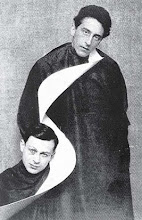
Ifirst saw the last Batut image, an early demonstration of deliberate double exposure for artistic effect, on the cover of the Penguin paperback edition of Robert Louis Stevenson's Strange Case of Dr. Jekyll and Mr. Hyde. It was extremely effective and I was amazed to learn that Batut is considered the father of aerial photography. The other Batut photo is an aerial shot (taken from a kite) of Labruguiere, the town where he lived.
All that being said, the view from my window last night over the back terrace, which was illuminated by a bulb I had just replaced following a long period of darkness, looked a lot like one of Lou Reed's "aura of strangeness, otherworldliness" photos. So I guess that I just don't know, I guess that I just don't know.
As someone who listened to Sister Ray this morning, and who has viewed as many of the photographs as I've been able to find online and tried to assess them and the things Lou says below generously, I have strong negative feelings about this. That being said (and said sadly), there's also a very strong "who cares?" element at work here, first on Lou's level (I believe) and then on mine.
Palma is lovely, though. And when you get out into the Mallorquin countryside, as you should, please enjoy yourself and have an Hierbas (or two) on me and my friend, Bobby the horse.
As Elvis's bodyguards asked so memorably (with Steve Dunleavy's able assistance), "What happened?"
PALMADE MALLORCA.-
TheEs Baluard Museum presents an exhibition of new photographs by Lou Reed. The exhibition, entitled Romanticism, features stunning black and white and color images of landscapes and architectural motifs, shot on the artist’s travels to Scotland, Denmark, Big Sur and elsewhere. The photographs are taken with a specially altered digital camera, which gives them an aura of strangeness, or otherworldliness. They have a timeless quality but are simultaneously very modern, like Reed himself. They are surprisingly small in scale, making these striking natural images personal, portable, and intimate.
This collection of photographs takes its name from the 18th and 19th century art movement that sought a return to the emotion, beauty, and unknowability of the natural as a counterpoint to industrial era’s emphasis on technological development and the pursuit of rational knowledge. Reed’s images recall this impulse: they focus on the aesthetic and the sublime; the splendor of a single tree against a cloudy Scottish sky, suffused with light. There is, however, also something uncanny and eerie about some of the photographs; the absence of human figures, a road leading over a bridge into a dense, shadowy forest. Reed has recently adapted the poet and writer Edgar Allen Poe’s The Raven, the supernatural is a theme that underwrites much of his recent work. Perhaps, like the Romantics, Reed is commenting on another Industrial Revolution — the rapid developments of globalization are once again placing the natural into both literal and metaphoric danger — the beauty of his landscapes takes on a more urgent meaning.
Reed says of his work, “I love photography. I love digital. I love digital. It’s what I’d always wished for. Being in the camera and experiencing the astonishing accomplishment of the creations of life sparked through the beauty of the detailed startling power of the glass lens. A new German lens brings a mist to me. The colors and light I come to see through the beauty of the camera. A love that lasts forever is the love of the lens of sharpness – of spirit warmth and depth and feeling. It makes my body pour emotion into the heartbeat of the world. A great trade and exchange. I think of the camera as my soul. Much like a guitar. My lovely Alpa has rosewood grips. What more could you need?”